
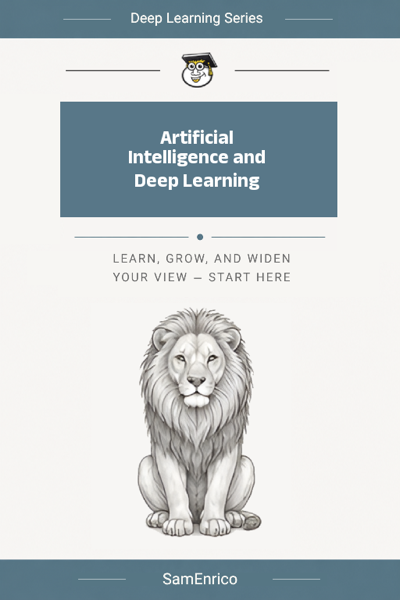
Artificial Intelligence and Deep Learning eBook
A Coursebook on Artificial Intelligence and Deep L
by Goff Nakesha
A Coursebook on Artificial Intelligence and Deep Learning
Formats
Free sample
Chapter 1: The Intelligence Paradox...--–- In the summer of 1956, a small group of mathematicians and cognitive scientists gathered at Dartmouth College with an audacious proposal. They believed—against all conventional wisdom—that every aspect of learning or any other feature of intelligence could in principle be so precisely described that a machine could be built to simulate it. They were laughed at, funded anyway, and unknowingly started a fire that would take seventy years to become an inferno. Today, that fire has consumed our assumptions about work, creativity, and what it means to be intelligent. Yet here is the paradox that haunts every AI researcher, every tech CEO, and every student opening this book: the machines we call "intelligent" cannot fold a fitted sheet, cannot understand why a joke is funny, and would stare blankly at a squirrel crossing the road while a self-driving car navigates around it perfectly.
How can a system defeat the world champion of Go—a game more complex than chess—yet fail at tasks a four-year-old masters? This chapter answers that question by building the conceptual foundation for everything that follows. You will learn what AI actually is (and emphatically is not), why the relationship between AI, machine learning, and deep learning matters more than any single algorithm, and why the coming years will belong not to those who fear the machine but to those who understand its true nature.The Four-Letter Word That Ruins AI Conversations Before writing a single line of code or training a single model, you must unlearn something. The word "intelligence" is poisoning your understanding. In everyday language, intelligence suggests consciousness, understanding, intentionality—the rich inner life that makes humans human.
But when AI researchers say "intelligence," they mean something far narrower and far stranger: the ability to achieve goals in a wide range of environments. That's it. No consciousness required. No self-awareness. No soul.
This definition, first formalized by computer scientist Stuart Russell, explains the paradox. A Go-playing AI achieves a goal (winning the game) in a specific environment (the 19x19 board). It does this brilliantly. Ask that same system to describe the feeling of victory, and it cannot, because it feels nothing. Ask it to play tic-tac-toe, and it would need to be retrained from scratch.
This narrowness is not a bug—it is the entire point.Consider the most impressive AI system you have heard about recently. Perhaps a model that generates photorealistic images from text descriptions. Perhaps a chatbot that passes the bar exam. Perhaps a protein-folding system that solves biology's fifty-year grand challenge. Each of these is a marvel of engineering.
Each is also, in the technical sense, brittle . Change the lighting in an image slightly, and a computer vision system falls apart. Rephrase a question from "What is the capital of France?" to "France's capital, could you name it for me?" and a language model might hallucinate an answer about Paris, Texas. The brittleness reveals the truth: these systems are matching patterns, not reasoning about the world.This chapter introduces a distinction that will protect you from hype and guide your technical decisions throughout this book. Artificial Narrow Intelligence (ANI) —sometimes called "weak AI"—performs specific tasks within defined boundaries.
Every AI system that exists today, from Chat GPT to self-driving cars to medical diagnosis tools, is ANI. Artificial General Intelligence (AGI) —"strong AI"—would perform any intellectual task a human can, with flexibility and transfer learning. AGI does not exist. Artificial Superintelligence (ASI) would surpass human capabilities across all domains. ASI is speculative fiction, though a useful lens for ethics discussions in Chapter 12.
Why does this distinction matter? Because the business world is littered with failed AI projects that started with the implicit assumption that ANI works like human intelligence. It does not. A model that achieves 99% accuracy in a research paper may fail catastrophically in the wild because the "wild" is a different environment than the training data.The History You Need to Know (In Under 800 Words)The story of AI is not a straight line of progress. It is a series of booms and busts, each fueled by overpromised and then punished by reality.
Understanding this cycle will protect you from the same mistakes.The Birth: 1950-1974. Alan Turing asked "Can machines think?" in his 1950 paper, proposing the Turing Test as a benchmark. At Dartmouth 1956, the field received its name and founding mythology. Early work focused on symbolic AI—programming explicit rules for reasoning, like a child learning algebra by memorizing procedures rather than understanding numbers. Herbert Simon declared in 1965 that "machines will be capable, within twenty years, of doing any work a man can do." This was optimistic by roughly half a century.The First Winter: 1974-1980.
The promised revolution did not arrive. Real-world problems proved messier than the toy domains where symbolic AI succeeded. A program that solved algebra problems could not understand a simple story about a birthday party because stories require common sense—the vast, unspoken web of knowledge about how the world works. Funding dried up. Researchers retrenched.The Expert Systems Era: 1980-1987.
AI returned with a narrower promise: not general intelligence but specialized expertise. Expert systems encoded the knowledge of human specialists—doctors, geologists, engineers—into if-then rules. These systems worked, modestly, and corporations paid millions. Japan's Fifth Generation Computer Project threatened to surpass the United States, triggering panic and funding.The Second Winter: 1987-1993. Expert systems turned out to be impossible to maintain.
Adding new rules broke old ones. No one could debug a system with ten thousand rules because no one understood the interactions. The hardware market collapsed. AI became a career-ending phrase.The Quiet Rise of Statistics: 1990s. While symbolic AI struggled, a different approach grew quietly: machine learning.
Instead of programming rules, researchers gave algorithms data and let them discover patterns. This was less sexy than reasoning about consciousness. It also worked. IBM's Deep Blue beat Garry Kasparov at chess in 1997 using brute-force search, not understanding.The Deep Learning Breakthrough: 2012. A team led by Geoffrey Hinton entered the Image Net competition, challenging computers to classify images into 1000 categories.
Their deep neural network—a model with many layers of artificial neurons—crushed the competition, halving the error rate of previous best systems. Every major tech company pivoted overnight. The current boom began here.The Generative Revolution: 2017-2024. The transformer architecture, introduced in a paper titled "Attention Is All You Need," enabled models that could generate human-quality text. Open AI's GPT series, Google's BERT, and hundreds of successors demonstrated capabilities that seemed, to casual observers, like the arrival of AGI.
They were not. But they were useful enough to reshape industries.This history teaches one lesson that will recur throughout this book: AI progresses not when it tries to replicate human intelligence, but when it solves constrained problems with statistical rigor. The moment researchers stopped asking "How can we make machines think?" and started asking "How can we make machines learn patterns from data?" progress exploded.The Three-Layer Cake: AI, Machine Learning, and Deep Learning One of the most common points of confusion among newcomers—and, embarrassingly, among journalists and executives—is the relationship between artificial intelligence, machine learning, and deep learning. These terms are not…
This is the end of the free sample. Get the eBook to keep going. Buy now
About this book
Details
- Author
- Goff Nakesha
- Publisher
- SamEnrico
- Language
- English
- Genre
- Non-Fiction, Informative, Educational
- Released
- 2026-05-06
- Pages (approx.)
- 126
- Available as
- eBook, Audiobook

Read better in the ZLOADR app
Your eBooks on your phone or tablet. Sign in with your SamEnrico account and start reading.
More by Goff Nakesha
 Rib Pain Meditation GuideGoff Nakesha$11.99
 Networking for Sales ProfessionalsGoff Nakesha$11.99
 Clutter and Spend ConnectionGoff Nakesha$11.99
 Cycling Time Trial Hypnosis GuideGoff Nakesha$11.99
 Press Release Quick ReferenceGoff Nakesha$11.99
 The Layoff Survival PlanGoff Nakesha$11.99
 Morning Meditation for AnticipatoryGoff Nakesha$11.99
 Making Mistakes LiberatingGoff Nakesha$11.99
 Indian Migrant Worker StoryGoff Nakesha$11.99
 Steel Titans of the Pacific: The Birth of Carrier Warfare (1942)Goff Nakesha$11.99
 The Tides of Timbuktu: How African Mathematicians Charted the CosmosGoff Nakesha$11.99
 How to Produce Bean SproutsGoff Nakesha$11.99