
Non-FictionTrue CrimeFire Science
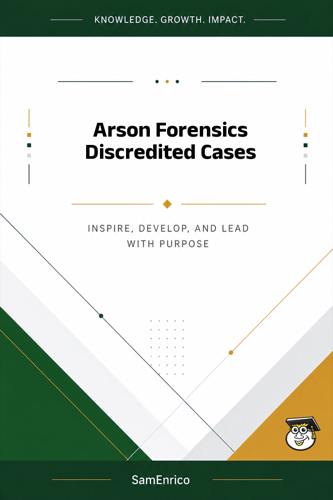
Arson Forensics Discredited Cases eBook
Uncover innocent firefighters convicted based on f
Uncover innocent firefighters convicted based on flawed arson investigation techniques later debunked.
Formats
Free sample
Chapter 1: The Call They Answered--The first explosion hit at 7:36 p.m. on November 29, 1988. It was not loud so much as it was absolute—a white fist that punched through the fabric of the Kansas City evening and left, in its wake, a silence more terrible than any sound. Firefighter Tom Newman was standing sixty feet from the building when the shockwave lifted him off his boots and threw him into a chain-link fence. His ears rang with a frequency that seemed to come from inside his own bones.
For three seconds—an eternity in the life of a firefighter—he could not remember his own name. Then the second explosion came, and the world became fire.Newman had been a firefighter for eleven years. He had crawled through burning hotels, pulled children from overturned cars, and once held a man's hand while they cut him out of a wrecked semi-truck. He had seen death in its many costumes—charred, drowned, crushed, and simply tired. But he had never seen anything like this.
The construction site at 75th and Holmes had been a two-story metal building undergoing renovation. Now it was a crater. The roof had lifted off and settled back down at an angle, like a hat worn by a drunkard. Steel beams that weighed hundreds of pounds had been twisted into cursive. And somewhere inside that twisted metal, beneath that crooked roof, were six of his brothers.The call had come in at 7:17 p.m.
as a routine structure fire at a construction site. Engine Company 41 arrived first, followed by Truck Company 41, then Engine 32, then a dozen other units that would be added to the response list over the next twelve minutes. The dispatcher's notes, later reviewed by investigators, indicated nothing unusual: "Possible trash fire. Construction debris. Occupants not reported." Firefighters did what firefighters always do.
They suited up. They went in. They did not know that the building was not burning the way buildings normally burn. They did not know that natural gas had been accumulating in the crawlspace for hours, seeking an ignition source like a patient predator. They did not know that the "routine structure fire" was actually a bomb waiting for its fuse.The first explosion killed six men instantly.
Captain Gerald Halloran, forty-four years old, a twenty-year veteran who had been scheduled to retire in six months. Firefighter Thomas Fry, thirty-one, who had just returned from paternity leave to see his newborn daughter's first smile. Firefighter James "Jimmy" Kilventon Jr., thirty-two, whose father had been a firefighter before him and whose son would become one after. Firefighter Luther "Louie" Jones, thirty-nine, a gentle giant who sang off-key country music during every truck ride. Firefighter Michael Montalvo, twenty-eight, the youngest of the six, who had written a letter to his mother the week before saying he had finally found his purpose.
And Firefighter Richard "Rich" Miller, forty-two, the unofficial department historian, who had kept a scrapbook of every fire he had ever fought. The scrapbook was found three days later, twenty yards from the building, its pages still smoking.The second explosion, which occurred approximately ninety seconds after the first, injured eleven more firefighters and sent dozens of civilians running for cover. By the time the flames were extinguished—nearly four hours later, after every available unit in Jackson County had been called to the scene—the construction site had become a funeral pyre. The Kansas City Fire Department had not lost six firefighters in a single incident since 1973. The city mourned.
The flags flew at half-mast. And somewhere in the chaos, while the investigators picked through the ashes with gloved hands and heavy hearts, a seed was planted that would grow into one of the most devastating miscarriages of justice in American history.The Thin Red Lie The firefighter occupies a strange place in the American imagination. He is simultaneously a hero and a suspect, a guardian and a potential threat. We put him on calendars and donate to his charitable foundations. We teach children to wave at fire trucks and grown men to buy the firefighter a beer.
And yet, when a fire goes wrong—when a building burns too quickly, too strangely, too inconveniently—the firefighter is often the first person we suspect. This is the paradox at the heart of every wrongful arson conviction involving a first responder: the very knowledge that makes a firefighter effective also makes him vulnerable. The expertise that saves lives becomes, in the eyes of investigators, evidence of guilt.The statistics bear this out. According to data compiled by the National Registry of Exonerations, firefighters and other first responders are wrongfully convicted of arson at a rate approximately three times higher than the general population, relative to their representation in arrest statistics. This is not because firefighters are more likely to commit arson—in fact, studies have consistently shown that the prevalence of firefighter-set fires is comparable to or lower than that of the general public.
The disparity exists because arson investigators, when faced with a fire they cannot explain, systematically turn their attention to the people who understand fire best. It is a form of professional paranoia: the belief that only an insider could have created a scene so confusing, so resistant to easy explanation, that the investigator's own expertise has been defeated.This phenomenon has a name in the forensic community: the "hero-to-arsonist trope." Coined by legal scholar Deborah Tuerkheimer in her landmark study of wrongful arson convictions, the trope describes the narrative structure that prosecutors use to convict firefighters. The story goes like this: a respected firefighter, motivated by hidden demons (insurance money, thrill-seeking, a pathological need for admiration), sets a fire that only he could set. He then "discovers" the fire and responds heroically, knowing that his status as a first responder will insulate him from suspicion. The trope works because it resolves a cognitive dissonance: it is easier for jurors to believe that a hero has secretly turned villain than to believe that the fire itself was not a crime at all.
The alternative—that the fire was accidental and the investigator simply made a mistake—requires the jury to accept institutional failure, which is far more unsettling than individual evil.The Marlborough Five case, which this chapter has begun to introduce and will examine in depth in Chapter 9, represents the purest expression of the hero-to-arsonist trope in American legal history. Five firefighters—Bryan Sheppard, Tom Newman, Steve Young, Tim Pigott, and Steve Miller—were accused of setting the fire that killed their six colleagues. The prosecution's theory was that the men had conspired to commit arson for insurance purposes, and that the resulting explosion had been an unintended consequence of their scheme. There was no direct evidence of this conspiracy. There were no eyewitnesses, no fingerprints on accelerant containers, no recorded confessions, no financial records showing unusual activity.
What the prosecution had instead was a set of burn patterns that an ATF agent claimed were "inconsistent with accidental fire," and the testimony of a jailhouse informant who said the men had confessed to him while incarcerated. The burn patterns, later discredited by fire science, were the centerpiece of the case.…
This is the end of the free sample. Get the eBook to keep going. Buy now
About this book
Details
- Author
- Winstead Brynn
- Publisher
- SamEnrico
- Language
- English
- Genre
- Non-Fiction, True Crime, Fire Science
- Released
- 2026-06-09
- Pages (approx.)
- 136
- Available as
- eBook, Audiobook

Read better in the ZLOADR app
Your eBooks on your phone or tablet. Sign in with your SamEnrico account and start reading.
More by Winstead Brynn
 Investor One Pager GuideWinstead Brynn$11.99
 Retirement Housing and SSI Eligibility BriefWinstead Brynn$11.99
 Men's Air Pollution Heart DefenseWinstead Brynn$11.99
 Outsourcing to VietnamWinstead Brynn$11.99
 The Phantom of Pebble Beach: The $38 Million Heist That Shocked the Supercar WorldWinstead Brynn$11.99
 Breaking Chains: The Unfinished Story of Catalonia's 2017 Independence BidWinstead Brynn$11.99
 Understanding Chromosome 13p DuplicationWinstead Brynn$17.99
 Technical Seo ExecutiveWinstead Brynn$11.99
 VPN Service Retention GuideWinstead Brynn$12.99
 Vendor Business Continuity PlanWinstead Brynn$12.99
 How to Become a Calender-let-off HelperWinstead Brynn$11.99
You may also like
 Hong Kong Handover 1997Dunn Johnnie$11.99
 Zumba For Postnatal Recovery CourseNeal Christian$11.99
 Zumba for BeginnersLadner Nikia$11.99
 YouTube Comment Mining GuideHumes Pandora$12.99
 Worry Box MeditationCarlin Rudy$11.99
 Workplace Stress MeditationNguyen Lynn$11.99
 Workplace Stress and Sleep RepairHawley Ivory$11.99
 Workplace Perfectionism CureDelaney Jeffry$11.99
 Workplace Injustice Anger GuideWallen Isabelle$11.99
 Work Addiction and Burnout LinkGreenwood Ester$11.99
 Women in Yoga and WellnessBeattie Galina$11.99
 Women in Stand Up ComedyChun Evangeline$11.99