
Non-FictionInformativeEducational
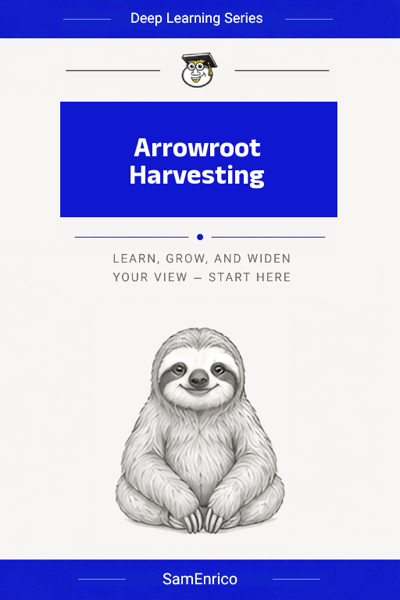
Arrowroot Harvesting eBook
A Coursebook on Arrowroot Harvesting
by Yu Jackelyn
A Coursebook on Arrowroot Harvesting
Formats
Free sample
Chapter 1: The White Gold Promise...--I was doubled over in a Miami airport bathroom, sweating through my shirt, when I first heard the words “arrowroot” spoken as something other than a dry botanical term. Through the stall divider, a woman was consoling her crying toddler. “Shh, baby,” she said, “I’ll find you some arrowroot biscuits when we land. You know they settle your tummy.” She had no idea that a stranger was listening, desperate, clutching her own cramping stomach after a gluten-filled airport sandwich. That moment—humiliating, painful, and completely accidental—sent me on a six-year journey that would upend my career, empty my savings, and eventually lead me to stand in a muddy field at dawn, holding a rhizome that looked like nothing more than a dirty ginger root.
But that dirty root, I would come to learn, was white gold. This book is the story of how I learned to grow it, harvest it, and turn it into a life-changing crop—and how you can do the same, whether you have half an acre or twenty.My name is not important, because this book is not about me. But the mistakes I made are important, because they will save you years of frustration. I am not a botanist, a third-generation farmer, or a Ph D in soil science. I am a former marketing executive who had never grown anything more demanding than basil on a windowsill.
When my digestive system collapsed under the weight of stress, poor diet, and a genetic predisposition to irritable bowel syndrome, I did what any desperate person would do: I searched the internet for answers. I found thousands of pages on the low-FODMAP diet, the autoimmune protocol, gluten-free living, and the miraculous properties of resistant starches. Buried in a footnote on a obscure nutrition forum was a single sentence that changed everything: “Arrowroot starch is the most easily digested of all starches, with granules so small they pass through the gut without fermenting.”I had never heard of arrowroot. I assumed it was some kind of tropical root, like cassava or taro. A quick search revealed that arrowroot—Maranta arundinacea—is a perennial herb native to the Caribbean and northern South America, grown for thousands of years by the Arawak and Taíno peoples.
They used it as a digestive aid, a wound dressing, and a baby food. The name “arrowroot” comes from the Arawak word aru-aru, meaning “meal of meals.” But somewhere along the way, arrowroot was forgotten, relegated to a dusty shelf in health food stores, outcompeted by cheaper cornstarch and more fashionable superfoods like quinoa and kale. That neglect, I realized, was an opportunity. If I could learn to grow arrowroot, I could have a crop with almost no competition, a growing market of gluten-sensitive consumers, and a product that genuinely helped people.There was just one problem: I had no land, no farming experience, and no idea if arrowroot would even grow in Florida, where I had just moved to escape the cold winters of the Northeast. I bought six rhizomes online from a nursery in Hawaii—expensive, about $40 with shipping—and planted them in five-gallon buckets on my apartment balcony.
For six months, I watered them, talked to them, and watched their broad, tropical leaves unfurl. Then I harvested. The rhizomes were small, twisted, and produced less than a cup of starch. But that cup of starch, when I whisked it into hot coconut milk and added a touch of vanilla, produced a pudding so silky and neutral that my angry gut didn’t so much as gurgle. I ate the whole bowl and waited for the familiar pain.
It never came.That was my Damascus moment. I quit my job three months later, sold my car, and leased two acres of overgrown former citrus land an hour north of Tampa. The farmer who owned the land thought I was insane. “Arrowroot?” he said, spitting tobacco juice into the dust. “Ain’t nobody grown that around here since my granddaddy’s time.
Good luck, city girl.” I needed more than luck. I needed knowledge. So I did what any obsessive would do: I read every academic paper, every agricultural extension bulletin, and every forgotten book on arrowroot I could find. I traveled to St. Vincent, where arrowroot is still a cash crop, and watched old farmers harvest with machetes and canvas bags.
I visited the University of the West Indies and begged a plant pathologist to teach me about nematodes. I failed. I failed a lot. My first in-ground crop was wiped out by root-knot nematodes because I didn’t rotate crops. My second crop rotted in the field because I overwatered during the drying-off period.
My third crop—I am not exaggerating—was eaten by wild pigs the night before I planned to harvest.But my fourth crop, in the fourth year, was perfect. The rhizomes were fat, creamy white, and dripping with starch. I processed them on a concrete slab using a secondhand meat grinder and a pillowcase. The flour that came out was the color of fresh snow, with a smell like clean rain. I sold it at a local farmers market for $15 a pound and sold out in two hours.
A woman with a colicky baby bought three bags and cried. A chef from a Tampa farm-to-table restaurant bought five pounds and asked if I could supply him weekly. A man with late-stage pancreatic cancer, unable to digest anything else, bought a single bag, and his wife emailed me a week later to say he had kept down his first full meal in months.That is the promise of arrowroot. It is not a miracle cure—I am not a doctor, and I will make no medical claims. But it is a miracle crop for the small-scale farmer: low inputs, minimal equipment, high value, and a story that sells itself.
Unlike corn or soy, which require massive acreage to turn a profit, arrowroot can be grown profitably on as little as a quarter-acre. Unlike potatoes, which must be rotated annually to avoid blight, arrowroot can be grown in the same field for two to three years if managed properly. Unlike cassava, which contains cyanide precursors and must be thoroughly cooked, arrowroot is safe to eat raw (though not in large quantities). And unlike every commodity crop, arrowroot has no futures market, no government subsidies, and no oversupply. It is a true niche crop—and niches are where small farmers make real money.I have written this book for three kinds of people.
First, the homesteader or small-scale farmer who wants to diversify their income with a high-value, low-labor crop. Second, the health-conscious grower who wants to produce their own gluten-free, digestible starch for personal use. Third, the entrepreneur who sees an opportunity in the $40 billion gluten-free market and wants to build a business around a product with virtually no competition. These three audiences have different goals, but they share a common need: a practical, step-by-step guide to growing, harvesting, and processing arrowroot without expensive equipment or a degree in agriculture.This book is that guide. It is organized as a 12-week coursebook, from…
This is the end of the free sample. Get the eBook to keep going. Buy now
About this book
Details
- Author
- Yu Jackelyn
- Publisher
- SamEnrico
- Language
- English
- Genre
- Non-Fiction, Informative, Educational
- Released
- 2026-05-07
- Pages (approx.)
- 119
- Available as
- eBook, Audiobook

Read better in the ZLOADR app
Your eBooks on your phone or tablet. Sign in with your SamEnrico account and start reading.
More by Yu Jackelyn
 Internal Comms Risk RegisterYu Jackelyn$11.99
 Anger for ChefsYu Jackelyn$11.99
 Mindfulness for WorkaholicsYu Jackelyn$11.99
 The AgTech Investment OutlookYu Jackelyn$11.99
 The Stoneworkers' Secret: How Medieval Masons Built Cathedrals for the BirdsYu Jackelyn$11.99
 Understanding Spondyloepiphyseal Dysplasia Nephrotic SyndromeYu Jackelyn$17.99
 Humming and Vibration BreaksYu Jackelyn$12.99
 Multi Stakeholder CooperativeYu Jackelyn$12.99
 How to Become a Contract AdministratorYu Jackelyn$11.99
You may also like
 Hong Kong Handover 1997Dunn Johnnie$11.99
 Zumba For Postnatal Recovery CourseNeal Christian$11.99
 Zumba for BeginnersLadner Nikia$11.99
 YouTube Comment Mining GuideHumes Pandora$12.99
 Worry Box MeditationCarlin Rudy$11.99
 Workplace Stress MeditationNguyen Lynn$11.99
 Workplace Stress and Sleep RepairHawley Ivory$11.99
 Workplace Perfectionism CureDelaney Jeffry$11.99
 Workplace Injustice Anger GuideWallen Isabelle$11.99
 Work Addiction and Burnout LinkGreenwood Ester$11.99
 Women in Yoga and WellnessBeattie Galina$11.99
 Women in Stand Up ComedyChun Evangeline$11.99