
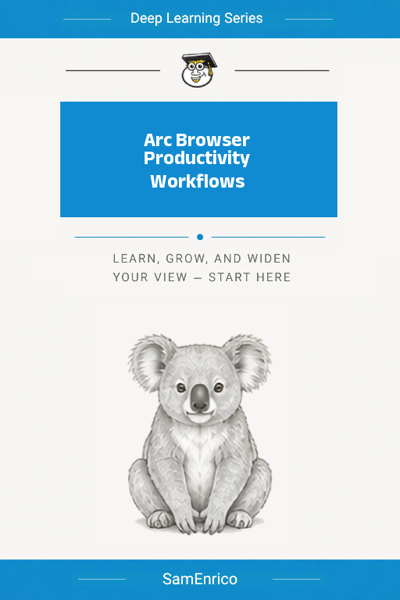
Non-FictionInformativeEducational
Arc Browser Productivity Workflows eBook
A Coursebook on Arc Browser Productivity Workflows
by Grimm Estell
A Coursebook on Arc Browser Productivity Workflows
Formats
Free sample
Chapter 1: The Hundred-Tab Hangover--–- You have 47 tabs open right now. I know this because I used to have 247. They spread across three browser windows like a digital oil spill—one window for “work” (Slack, Gmail, Jira, five Google Docs), one for “research” (Stack Overflow, a half-read Wikipedia article about the Punic Wars, a recipe for sourdough I swore I’d bake last March), and one for “I’ll get to this later” (which contained exactly the same kind of tabs as the other two, plus a You Tube video about restoring a 1978 Fender Stratocaster that you have absolutely no intention of ever watching).Your browser tabs are not just open. They are metastasizing. And you can feel it every time you click from one to another—that tiny pause, that micro-friction, that quiet voice in your head that whispers, “I should really close some of these.” But you don’t.
Because what if you need that tab later? What if the thing you’re vaguely saving turns out to be the thing that unlocks your entire project? What if closing a tab is the digital equivalent of throwing away a winning lottery ticket?This is the Hundred-Tab Hangover. It is not a hardware problem. It is not an internet speed problem.
It is a cognitive disease, and every traditional browser you have ever used is the vector.The Cost of Keeping Tabs Open Let me be precise about what those 47 tabs are doing to you. Not metaphorically—literally.Every time your brain switches between tasks, there is a cognitive penalty called the “switching cost.” Researchers at the University of California, Irvine found that it takes an average of 23 minutes and 15 seconds to fully return to a task after an interruption. Now, you are not being interrupted by a phone call or a coworker tapping your shoulder. You are interrupting yourself every time you click from your email tab to your documentation tab to your Slack tab and back again.Each of those clicks costs you a fraction of a second. But over the course of a day, those fractions add up to minutes.
Over a week, hours. Over a year, you have lost weeks of focused attention to the simple act of finding the right tab.I have watched hundreds of knowledge workers navigate their browsers. The pattern is always the same:They need to find a specific tab.They glance at the top of the browser window, scanning a row of identical favicons and truncated titles that all say “Goo…” or “Mic…” or “Not…”They cannot find the tab visually, so they start clicking through tabs one by one, like flipping through a deck of cards looking for the ace of spades.They finally find the tab—and immediately forget why they needed it in the first place.They switch back to the previous tab, spend thirty seconds reorienting, and start the process over again.This is not a skill issue. This is a design issue. Traditional browsers were built in the 1990s, when the average user had five tabs open and a 56k modem.
The browser was a container for documents—a digital folder, nothing more. That model has not changed in twenty-five years, even as our relationship with the web has transformed completely.We do not “browse” anymore. We live in the browser. For many of you reading this book, the browser is your operating system. It is where you write, communicate, research, design, code, manage projects, attend meetings, and occasionally watch that Fender Stratocaster restoration video.
And yet the tool you use to do all of this is fundamentally unchanged from the era of Geo Cities and Netscape Navigator.The Invention You Didn’t Know You Were Waiting For Arc is not a browser. Let me say that again because it sounds like marketing nonsense, but I mean it literally: Arc is not a browser. It is a spatial operating system for the internet.Here is what I mean by that. When you open Safari or Chrome or Edge, you are presented with a blank slate—a search bar, some bookmarks if you’ve bothered to set them up, and a list of recently visited sites. The browser does not know who you are, what you are working on, or how to help you.
It is a passive container. You fill it with tabs, and those tabs quickly become indistinguishable from one another.Arc, by contrast, asks you a question the moment you open it: “What are you working on?” It expects you to have multiple contexts—work, personal, side projects, research—and it gives you distinct, customizable spaces for each of them. It assumes that some things you need every day (your email, your calendar, your project management tool) and other things you need only once (that recipe, that Wikipedia article, that You Tube tutorial). It treats tabs not as precious artifacts to be hoarded but as temporary visitors that should leave when their work is done.This shift in philosophy—from hoarding to flow, from reactive to proactive—is the entire point of this book. You are not going to learn a few clever shortcuts and call it a day.
You are going to retrain the way your brain relates to the browser. You are going to move from a state of constant low-grade anxiety (“I have too many tabs open but I’m afraid to close them”) to a state of calm control (“My browser is organized around my priorities, and everything else has already left”).A Brief Confession Before I go any further, I need to confess something. I was not always an organized person. My desktop looked like a digital landfill. My downloads folder contained eight different files all named “final_FINAL_v3.pdf.” And my browser—my poor, abused browser—was a war crime.I remember one Monday morning, sitting down to start a major project, and realizing that I had forty-seven tabs open from the previous week.
Forty-seven. I could not remember why most of them were there. I scanned the titles: “How to center a div (the correct way)”—I had solved that problem on Tuesday. “Five signs you’re burned out”—I had opened that in a moment of late-night self-diagnosis. “Cheap flights to Austin”—I had no trip planned.And yet I could not close them.
What if I needed that CSS article later? What if the burnout signs were actually important? What if those flights went on sale and I missed the deal?I sat there for twenty minutes, paralyzed by my own tabs. Then I did the only thing that made sense: I opened a new browser window and started fresh, leaving the old one minimized like a digital haunted house I was too afraid to enter.That was the day I realized the problem was not me. The problem was the tool.What This Chapter Is Not Before we go further, let me be clear about what this chapter is not.
This is not a setup guide. You will not find installation instructions here. You will not be told to create an account, import your bookmarks, or toggle any settings. Those things…
This is the end of the free sample. Get the eBook to keep going. Buy now
About this book
Details
- Author
- Grimm Estell
- Publisher
- SamEnrico
- Language
- English
- Genre
- Non-Fiction, Informative, Educational
- Released
- 2026-06-02
- Pages (approx.)
- 145
- Available as
- eBook, Audiobook

Read better in the ZLOADR app
Your eBooks on your phone or tablet. Sign in with your SamEnrico account and start reading.
More by Grimm Estell
 Music Therapy for Road RageGrimm Estell$11.99
 The Software UX Creativity GuideGrimm Estell$11.99
 Cost Segregation Study BenefitsGrimm Estell$11.99
 Tongue Scraping GuideGrimm Estell$11.99
 Caregiver Medical AdvocacyGrimm Estell$11.99
 The Stress Cold Sore LinkGrimm Estell$11.99
 Metta for a StepchildGrimm Estell$11.99
 Green Beret HALOGrimm Estell$11.99
 Color Coded Calendar SystemGrimm Estell$11.99
 The Silent Sands: Bedouin Secrets of the Great Southern OceanGrimm Estell$11.99
 The Royal Navigators of the Indian Ocean: The Swahili Sultanates' Maritime EmpireGrimm Estell$11.99
 Operation Midnight Climax: The CIA’s Secret LSD Love HotelGrimm Estell$11.99
You may also like
 Hong Kong Handover 1997Dunn Johnnie$11.99
 Zumba For Postnatal Recovery CourseNeal Christian$11.99
 Zumba for BeginnersLadner Nikia$11.99
 YouTube Comment Mining GuideHumes Pandora$12.99
 Worry Box MeditationCarlin Rudy$11.99
 Workplace Stress MeditationNguyen Lynn$11.99
 Workplace Stress and Sleep RepairHawley Ivory$11.99
 Workplace Perfectionism CureDelaney Jeffry$11.99
 Workplace Injustice Anger GuideWallen Isabelle$11.99
 Work Addiction and Burnout LinkGreenwood Ester$11.99
 Women in Yoga and WellnessBeattie Galina$11.99
 Women in Stand Up ComedyChun Evangeline$11.99