
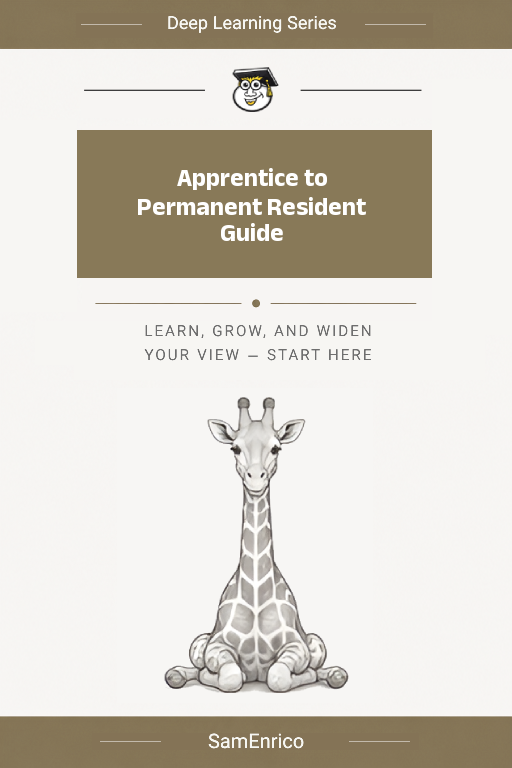
Non-FictionNon-Obvious CareerApprenticeship Migration
Apprentice to Permanent Resident Guide eBook
Start as a sponsored apprentice in Australia or Ca
Start as a sponsored apprentice in Australia or Canada and convert to permanent residency including employer sponsorship, trade certification upgrades, and provincial pathways.
Formats
Free sample
Chapter 1: The 477 Advantage--If you are reading this book, you have likely already discovered that the path from a sponsored apprenticeship to permanent residency is not a straight line. It is a maze of visa subclasses, points tests, labour market assessments, and provincial nominee programs that seem designed to confuse rather than clarify. Here is the truth that the best-selling migration guides rarely state plainly: in 2026, a skilled tradesperson with the right strategy has a clearer, faster, and more certain pathway to permanent residency than a university graduate with a master's degree. The numbers prove it. Canada's April 2026 trades draw invited carpenters, welders, and electricians with a Comprehensive Ranking System score of just 477.
During that same month, a general draw for university-educated professionals required 524 points. The difference of 47 points represents years of additional Canadian experience, a master's degree, and near-perfect English. The tradesperson got invited anyway.This chapter establishes the foundational framework for everything that follows. You will learn why the traditional advice about immigration no longer applies to tradespeople, how to read the policy signals from both countries, and the single most important metric for tracking your own chances of success. By the end of this chapter, you will understand not just the rules but the strategy behind them.The Great Rebalancing of 2024-2026Between 2020 and 2023, both Australia and Canada focused almost exclusively on attracting highly educated professionals.
The logic seemed sound: a software engineer or financial analyst would earn a high salary, pay substantial taxes, and rarely require social services. Tradespeople, by contrast, were viewed as important but secondary—a necessary workforce to build houses and fix cars, but not the target of aggressive recruitment campaigns.That logic has collapsed under the weight of reality. Australia is in the midst of a housing crisis that requires 240,000 new dwellings annually just to keep pace with population growth. The actual construction rate in 2025 was 165,000 dwellings. The shortfall of 75,000 homes per year means rents are climbing, homelessness is increasing, and the federal government is desperate for carpenters, bricklayers, electricians, and plumbers.
Canada faces a similar crisis. The federal government's 2025-2027 Immigration Levels Plan explicitly prioritizes tradespeople in category-based draws, setting aside 25 to 30 percent of all Express Entry invitations for construction and skilled trades occupations.The result is what immigration lawyers call the Great Rebalancing. University graduates now compete for a shrinking share of invitations while tradespeople benefit from dedicated draws, lower point thresholds, and expedited processing. In 2026, an electrician with two years of Canadian experience and moderate English has a higher statistical chance of receiving an invitation to apply for permanent residency than a computer scientist with a Ph D and perfect English. This is not hyperbole.
The data from IRCC's 2025 annual report shows that 47 percent of Express Entry invitations went to category-based draws, with trades representing the third-largest category after healthcare and STEM. The trades category had the lowest average CRS score of any category by a significant margin.Australia has not implemented formal category-based draws, but the effect is similar. State nomination lists heavily favour trades over professionals. Western Australia's 2025-2026 state nomination list includes 47 trade occupations and only 22 professional occupations. South Australia has suspended nominations for most professional occupations entirely while actively recruiting welders, heavy-duty mechanics, and refrigeration technicians.
The message from the states is unambiguous: we need people who can build, fix, and maintain things.The 477 Advantage: Why That Number Changes Everything Let us spend a moment on the number 477. That was the CRS cutoff for the April 10, 2026, trades category draw in Canada. To understand why this number matters, you need to understand the CRS scoring system.A single applicant under 30 years old with a valid job offer (backed by a positive LMIA) and two years of Canadian work experience scores approximately 485 to 520 points, depending on English scores and education level. That same applicant with one year of Canadian work experience scores 440 to 470 points. The April 2026 cutoff of 477 means that a tradesperson with two years of Canadian experience, a job offer, and English at CLB 7 (IELTS 6.0) would receive an invitation.
The same tradesperson with 18 months of Canadian experience would not.This creates a predictable, mathematical pathway. You need a job offer (LMIA-backed) and two years of Canadian work experience. That is it. You do not need a university degree. You do not need perfect English.
You do not need a relative in Canada. You need to work for two years, keep your record clean, and apply. The system has been redesigned to clear the backlog of trade applications by lowering the threshold to precisely the level that matches the profile of a sponsored apprentice who has completed their hours.Australia does not publish an equivalent single number because its invitation system depends on points, occupation caps, and state nomination. However, the effective threshold for most trade occupations in 2026 is 85 to 95 points. A 30-year-old electrician with Superior English (IELTS 8.0), eight years of overseas experience, and a state nomination (190 visa) scores approximately 90 points.
That same electrician with Proficient English (IELTS 7.0) and no state nomination scores 65 points—below the effective threshold for most invitation rounds. The implication is that Australia places a premium on English ability and state nomination, while Canada places a premium on Canadian work experience and job offers.The Three Pillars of a Successful Application Every successful application from a sponsored apprentice to permanent resident rests on three pillars. No application can succeed without all three. Most failed applications fail because one pillar is weak or missing.Pillar One is valid work authorization. You cannot apply for permanent residency from inside Australia or Canada unless you hold a valid visa that permits work.
For most readers, this will be a 407 Training Visa (Australia) or a 482 Temporary Skill Shortage visa (Australia) or a closed work permit backed by an LMIA (Canada). The moment your work authorization lapses, your pathway to permanent residency resets or collapses entirely. This is why Chapter 4 (Australia) and Chapter 12 (Canada) focus so heavily on bridging visas and maintaining status. A single gap in your work authorization can undo years of progress.Pillar Two is a positive skills assessment. Both countries require an independent assessment of your trade qualifications before you can apply for permanent residency.
In Australia, Trades Recognition Australia (TRA) administers the Job Ready Program, a four-step process that takes 12 to 18 months and requires an approved employer to supervise you. In Canada, the Red Seal program or a provincial certificate of qualification serves the same function. Without a positive skills assessment, you cannot proceed to the final application stage regardless of how long you have worked or how much you have earned.Pillar Three is sufficient points or a qualifying job offer. For Australia's independent visa pathways (Subclass 189 and 190), you need 85 to 95 points. For the employer-sponsored pathway (Subclass 186), you need a job offer from an approved sponsor and two years of work on a 482 visa.
For Canada, you need either enough CRS points to be invited in a general or category draw (currently 477 for trades) or a provincial nomination (which adds 600 points and guarantees an invitation). Most sponsored apprentices will pursue the employer-sponsored pathway in Australia and the Canadian Experience Class (CEC) in Canada, as these routes directly reward the time you…
This is the end of the free sample. Get the eBook to keep going. Buy now
About this book
Details
- Author
- Baca Nicholle
- Publisher
- SamEnrico
- Language
- English
- Genre
- Non-Fiction, Non-Obvious Career, Apprenticeship Migration
- Released
- 2026-06-01
- Pages (approx.)
- 151
- Available as
- eBook, Audiobook

Read better in the ZLOADR app
Your eBooks on your phone or tablet. Sign in with your SamEnrico account and start reading.
More by Baca Nicholle
 Naomi Osaka Silent PowerBaca Nicholle$11.99
 The Floating on Clouds GuideBaca Nicholle$11.99
 Online Proctoring Anxiety WorkbookBaca Nicholle$11.99
 Workplace Esteem VisualizationBaca Nicholle$11.99
 Equifax CISO Position VacancyBaca Nicholle$11.99
 The Forge of the Tuatha Dé Danann: Crafting the Weapons of GodsBaca Nicholle$11.99
 The Last Duel of the Iron Lady: Margaret Thatcher’s Final BattleBaca Nicholle$11.99
 Understanding Geleophysic DwarfismBaca Nicholle$17.99
 DispatcherBaca Nicholle$11.99
 Last Minute Booking PatternsBaca Nicholle$12.99
 Ultimate Handbook Guide to Vijayawada : (India) Travel GuideBaca Nicholle$11.99
You may also like
 Hong Kong Handover 1997Dunn Johnnie$11.99
 Zumba For Postnatal Recovery CourseNeal Christian$11.99
 Zumba for BeginnersLadner Nikia$11.99
 YouTube Comment Mining GuideHumes Pandora$12.99
 Worry Box MeditationCarlin Rudy$11.99
 Workplace Stress MeditationNguyen Lynn$11.99
 Workplace Stress and Sleep RepairHawley Ivory$11.99
 Workplace Perfectionism CureDelaney Jeffry$11.99
 Workplace Injustice Anger GuideWallen Isabelle$11.99
 Work Addiction and Burnout LinkGreenwood Ester$11.99
 Women in Yoga and WellnessBeattie Galina$11.99
 Women in Stand Up ComedyChun Evangeline$11.99