
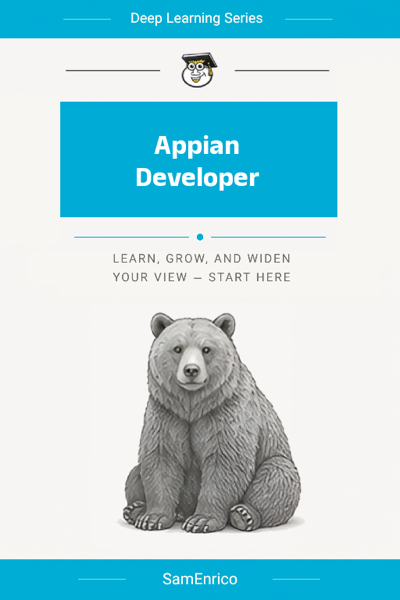
Non-FictionInformativeEducational
Appian Developer eBook
A Coursebook on Appian Developer
by Longo Theo
A Coursebook on Appian Developer
Formats
Free sample
Chapter 1: The 5 PM Fire Drill--–- The first lie you have to unlearn is that writing more code makes you a better developer. The second lie is that low-code platforms are just toys for business analysts. You’re holding this book because someone—a manager, a mentor, or your own burning curiosity—told you that Appian is worth your time. But until you’ve stood in front of a smoking production process at 4:55 PM on a Friday, watching vendors fail to onboard and the CFO’s dashboard go blank, you won’t fully understand why this chapter exists. This is not a gentle introduction. This is a rescue mission for your career.The chapter opens with a story. Fin Corp, a mid-sized financial services company that will serve as our laboratory for the next twelve chapters, had a problem. Their vendor onboarding process—the lifeblood of their procurement operation—was drowning in paper. A new vendor would submit a W-9. A procurement associate would scan it. A legal analyst would check sanctions lists. A finance manager would approve budget lines. Each step happened in a separate spreadsheet, shared via email attachments with subject lines like “URGENT – Vendor – FINAL v3 – REAL final – USE THIS ONE.” The average onboarding took twenty-three days. The error rate on tax ID numbers was 12 percent. And the cost of rework—chasing down missing signatures, correcting typos, resubmitting rejected forms—ate 30 percent of the procurement team’s capacity.Your traditional coding brain looks at this and thinks: database schema, API layer, React front end, authentication middleware, testing suite, deployment pipeline. Six months of engineering time, a team of four developers, and probably a few anxious all-nighters before launch.Your future Appian developer brain looks at this and sees a different path. Not easier in the sense of being less rigorous. More powerful in the sense of being more direct. You model the data once. You design the workflow visually. You build the interface declaratively. And you deploy in weeks, not months.But before you can think like an Appian developer, you have to stop thinking like a traditional coder. That’s what this chapter is for.The 80 Percent Statistic That Changes Everything Industry analysts have been tracking low-code adoption for nearly a decade, and one number keeps surfacing: organizations that adopt low-code platforms for process automation report productivity gains of 70 to 80 percent compared to traditional development. That number sounds like marketing hype until you understand where the savings actually come from.Traditional development spends about 40 percent of project time on boilerplate: setting up authentication, wiring database connections, configuring deployment pipelines, writing CRUD operations that differ only by table name. Another 30 percent goes to coordination: making sure the front-end developer talks to the back-end developer who talks to the database administrator who talks to the security team. Low-code platforms like Appian eliminate boilerplate through pre-built components and eliminate coordination through unified tooling.You don’t write SQL for CRUD because Appian generates it. You don’t wire REST endpoints because Appian exposes them. You don’t manage state synchronization because Appian’s reactive model handles it. The 80 percent productivity gain isn’t about typing faster. It’s about not typing things that shouldn’t need typing in the first place.But here’s the catch: you have to learn a new mental model. Traditional development is procedural—you write instructions for the computer to execute in sequence. Appian development is declarative—you describe the desired state, and the platform figures out how to achieve it. This shift is harder than learning a new syntax. It requires unlearning assumptions you’ve built over years of coding.The Three Pillars (Not Four)Many introductory materials list four pillars of Appian architecture: Records, Processes, Interfaces, and Rules. That’s technically accurate but pedagogically backwards because it implies all four are equally fundamental at every stage of learning. They are not.For the first half of this book, we will work with three pillars: Processes, Interfaces, and Rules. Records—which are powerful but complex—will receive a targeted overview in this chapter and then a full deep-dive in Chapter 7. Why delay? Because Records sit on top of data structures you need to build first. Teaching Records before CDTs and Data Stores is like teaching advanced queries before basic SELECT statements. It can be done, but the student ends up confused about what the platform is doing versus what they configured.So here are the three pillars you need now:Processes are the choreography of work. A process model is a visual map of who does what, in what order, and what happens when things go wrong. In Appian, you build processes using a drag-and-drop interface that implements the BPMN (Business Process Model and Notation) standard. A process node might represent a human task (“Manager approves vendor”), automated logic (“Validate tax ID”), or a decision point (“Is contract value over $50,000?”). Processes are the spine of any automation application.Interfaces are what users see and interact with. Appian uses a proprietary UI framework called SAIL (Self-Assembling Interface Layer). SAIL is declarative: you write expressions that describe the interface based on current data, and Appian handles rendering and updates. If that sounds like React hooks or Vue’s reactivity system, you’re on the right track—but SAIL predates both and is more tightly integrated with the rest of the platform.Rules are reusable logic. Any calculation, validation, or transformation you write can become a rule. Rules take inputs and return outputs with no side effects (pure functions, in programming language terms). You can call rules from interfaces, other rules, or process models. Rules are where your custom logic lives.That’s it. Three pillars for the first half of your learning journey. Processes orchestrate, interfaces present, rules calculate. Everything else—Records, integrations, security, performance tuning—builds on this foundation.But let’s be concrete. Let’s look at Fin Corp’s vendor onboarding problem through the lens of these three pillars.Fin Corp’s Vendor Onboarding: The Case Study That Runs Through This Book Fin Corp is a fictional company, but its problems are real. They have 450 active vendors supplying everything from office furniture to cloud hosting. Onboarding a new vendor requires:Submission – The procurement specialist collects vendor details: legal name, tax ID, address, banking information, and the products or services offered.Legal review – The legal team checks the vendor against sanctions lists, reviews the proposed contract for compliance with financial regulations, and flags any conflicts of interest.Procurement approval – The procurement manager evaluates pricing, terms, and whether the vendor meets quality standards.Finance setup – The finance team creates the vendor record in the ERP system, sets up payment terms, and configures tax withholding.Activation – The vendor receives credentials for Fin Corp’s supplier portal and can begin submitting invoices.In the current paper-based process, each step happens in isolation. The procurement specialist emails the vendor details to legal. Legal prints the email, reviews it, scans it back, and emails it to procurement. Procurement approves, emails finance, and so on. The process has no visibility, no accountability, and no way to measure where delays happen.Now imagine you’re an Appian developer tasked with automating this. Your first design meeting with Fin Corp’s stakeholders will surface a few non-negotiable requirements:The form for submitting a new vendor must be dynamic: individual vendors (sole proprietors) provide a Social Security Number; corporate vendors provide a Tax ID Number…
This is the end of the free sample. Get the eBook to keep going. Buy now
About this book
Details
- Author
- Longo Theo
- Publisher
- SamEnrico
- Language
- English
- Genre
- Non-Fiction, Informative, Educational
- Released
- 2026-05-06
- Pages (approx.)
- 155
- Available as
- eBook, Audiobook

Read better in the ZLOADR app
Your eBooks on your phone or tablet. Sign in with your SamEnrico account and start reading.
More by Longo Theo
 Brokerage Fees Decoded HandbookLongo Theo$11.99
 Mortician Embalming StressLongo Theo$11.99
 NVC For Church LeadershipLongo Theo$11.99
 Race Car Pit Crew StressLongo Theo$11.99
 The Siege of Zaragoza: Nuns, Nurses, and the Flames of FaithLongo Theo$11.99
 How to Produce a Bird ScarerLongo Theo$11.99
 Freemium Social Proof OfflineLongo Theo$12.99
 A Beginners Guide to Hijara (Volume 1)Longo Theo$11.99
You may also like
 Hong Kong Handover 1997Dunn Johnnie$11.99
 Zumba For Postnatal Recovery CourseNeal Christian$11.99
 Zumba for BeginnersLadner Nikia$11.99
 YouTube Comment Mining GuideHumes Pandora$12.99
 Worry Box MeditationCarlin Rudy$11.99
 Workplace Stress MeditationNguyen Lynn$11.99
 Workplace Stress and Sleep RepairHawley Ivory$11.99
 Workplace Perfectionism CureDelaney Jeffry$11.99
 Workplace Injustice Anger GuideWallen Isabelle$11.99
 Work Addiction and Burnout LinkGreenwood Ester$11.99
 Women in Yoga and WellnessBeattie Galina$11.99
 Women in Stand Up ComedyChun Evangeline$11.99