
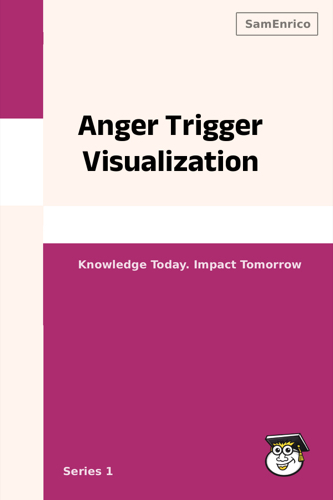
Anger Trigger Visualization eBook
Use mental rehearsal to identify triggers in a saf
Use mental rehearsal to identify triggers in a safe environment.
Formats
Free sample
Chapter 1: The Counting Lie--The problem isn't your anger. The problem is that you're trying to solve a split-second biological event with a slow, conscious strategy that was never designed to work in the first place.Let me prove this to you in under ten seconds.Think about the last time you lost your temper. Really lost it. The kind of explosion that left you embarrassed, exhausted, or repairing damage for days afterward. Now ask yourself a simple question: at what point during that escalation did you first realize you were angry?If you're like most people, the answer is somewhere between "too late" and "way too late." You didn't decide to get angry.
You didn't see it coming, weigh your options, and consciously choose an outburst. Instead, you were fine one moment and then suddenly—almost magically—you weren't. Something happened. A switch flipped. And by the time your conscious brain caught up, your mouth was already moving, your fists were already clenching, and the damage was already done.This is the fundamental problem that every anger management strategy must solve, and almost none of them address directly.
Your anger lives in a part of your brain that operates faster than your conscious thought. Much faster. And when you try to manage anger in the moment—by counting to ten, taking deep breaths, or repeating calming affirmations—you are asking your slow, deliberate prefrontal cortex to outrun a neurological process that has already crossed the finish line.It's not going to work. Not consistently. Not for the kind of anger that actually ruins lives.This chapter will explain exactly why traditional anger management fails at the precise moment you need it most.
More importantly, it will introduce the only strategy that matches the speed of anger: mental rehearsal. You cannot learn to control anger while you're angry, just as you cannot learn to swim while you're drowning. You must practice before the wave hits. And that practice happens entirely in your imagination.The Speed of Anger To understand why counting to ten is a lie, you need to understand something about how your brain processes threats.The human brain has two distinct pathways for detecting and responding to danger. The first pathway is fast, automatic, and ancient.
It runs through the amygdala, a small almond-shaped cluster of neurons deep in your temporal lobe that acts as your brain's smoke detector. The amygdala doesn't think. It doesn't analyze. It doesn't weigh evidence or consider context. It simply scans incoming sensory information for anything that resembles a past threat, and when it finds a match, it triggers a cascade of physiological responses within milliseconds.This is the low road.
It's efficient, energy-saving, and life-saving when you're facing an actual predator. But it's also incredibly crude. The amygdala cannot distinguish between a hungry tiger and a sarcastic comment from your spouse. It cannot tell the difference between a physical threat to your body and a perceived threat to your social status. All it knows is pattern matching: this situation looks like that past situation, and that past situation led to pain, so we are going to respond as if your life depends on it.The second pathway is slow, deliberate, and conscious.
It runs through your prefrontal cortex—the part of your brain just behind your forehead that handles executive functions like planning, reasoning, and impulse control. This is the high road. It takes longer because it processes more information, considers context, evaluates alternatives, and makes nuanced judgments. When the high road is in charge, you can pause, reflect, and choose a response rather than react on autopilot.Here's the problem: the low road is roughly six times faster than the high road.By the time your prefrontal cortex has registered that a comment was made, the amygdala has already sounded the alarm, your adrenal glands have already released cortisol and adrenaline, your heart rate has already increased by thirty beats per minute, your blood has already rushed to your extremities, your pupils have already dilated, and your body is already primed for aggression. All of this happens in less than half a second.Counting to ten takes ten seconds.Do you see the mismatch?
By the time you start counting, the physiological explosion has already occurred. You are not preventing anything. You are simply waiting for the wave to pass while trying not to make it worse. And sometimes that works—not because counting has any special power, but because the biological wave of anger naturally peaks and subsides within about ninety seconds if you don't feed it with more triggering thoughts.But here's what no one tells you: even when counting to ten "works," it hasn't actually solved the underlying problem. You haven't rewired the trigger.
You haven't changed the automaticity. You've simply waited out one instance of a recurring pattern. The next trigger will hit just as fast, and you'll be counting again, and again, and again, always reacting, never retraining.That's not management. That's survival. And survival is exhausting.The Myth of In-the-Moment Control I want to be very clear about something.
I am not saying that deep breathing, counting, or other in-the-moment techniques have no value. They do. When you are already activated, a slow exhale can stimulate your vagus nerve and trigger a parasympathetic "rest and digest" response. Counting can distract your amygdala long enough for your prefrontal cortex to partially re-engage. These are real physiological effects.But they are crisis interventions, not training programs.Think about it this way.
If you wanted to become a professional boxer, would you spend all your training time in the ring during actual matches? Of course not. You would spend hours in the gym hitting a heavy bag, shadowboxing in front of a mirror, watching film of past fights, and sparring with partners who are not trying to knock you out. You would rehearse combinations until they became automatic. You would drill footwork until you no longer had to think about where your feet were going.
You would visualize yourself slipping punches and landing counters.Then, and only then, would you step into the ring for a real fight.Anger management has been trying to teach people to box by putting them in the ring and shouting advice between rounds. "Remember to breathe!" "Count to ten!" "Use your words!" These are fine suggestions, but they are useless if the fighter has never practiced them outside the chaos of combat. The ring is not a classroom. The argument is not a rehearsal space. The moment of explosion is the worst possible time to learn a new skill.This is why so many people experience the same humiliating cycle.
They read an anger management book or attend a few therapy sessions. They learn some useful techniques. They feel hopeful. And then, in the next conflict, they forget everything. The anger hits like a wave, the techniques vanish from their mind, and they react exactly as they always have.
Then they feel shame. Then they try harder next time. Then it happens again.The problem is not your effort or your willpower. The problem is that you are trying to learn a new response…
This is the end of the free sample. Get the eBook to keep going. Buy now
About this book
Details
- Author
- Longo Latesha
- Publisher
- SamEnrico
- Language
- English
- Genre
- Non-Fiction, Self-Help, Guided Imagery
- Released
- 2026-06-09
- Pages (approx.)
- 144
- Available as
- eBook, Audiobook

Read better in the ZLOADR app
Your eBooks on your phone or tablet. Sign in with your SamEnrico account and start reading.
More by Longo Latesha
 Infidelity Recovery After AddictionLongo Latesha$11.99
 Grounding Meditation for DissociationLongo Latesha$11.99
 Mobile Game Addiction HelpLongo Latesha$11.99
 Child Soldier, Now FreeLongo Latesha$11.99
 Iceland Traverse InteriorLongo Latesha$11.99
 Progress Billing ImplementationLongo Latesha$11.99
 Digital Distraction ManagementLongo Latesha$11.99
 When Yahoo Lost the InternetLongo Latesha$11.99
 The Jade Phoenix's Last Lesson: Wisdom from the Celestial SageLongo Latesha$11.99
 The Divine Fire: Mozart, Haydn, and the Birth of Classical BrillianceLongo Latesha$11.99
 The Mineral Guide to ArtiniteLongo Latesha$11.99
 Growing CynodonLongo Latesha$11.99
You may also like
 The Safe Place VisualizationLaflamme Candra$11.99
 Guided Imagery Sleep StoriesHoliday Cecil$11.99
 Beach Visualization Relaxation GuideLantz Hanna$11.99
 Anger Visualization MeditationPatino Lashaunda$11.99
 Self Hypnosis Visualization Scripts HandbookDillard Ladonna$11.99
 Visualization For Inner Child Healing CourseBerman Nella$11.99
 Visual Imagery Trance Induction GuideChristie Minh$11.99
 Pain Visualization Healing ImageryFredericks Sunni$11.99
 Guided Sleep VisualizationOlmstead Twila$11.99
 Guided Imagery for Deep SleepKing Nathaniel$11.99
 Beach Relaxation Visualization GuideBurton Dean$11.99
 Walking Meditation ScriptsLund Anastasia$11.99