
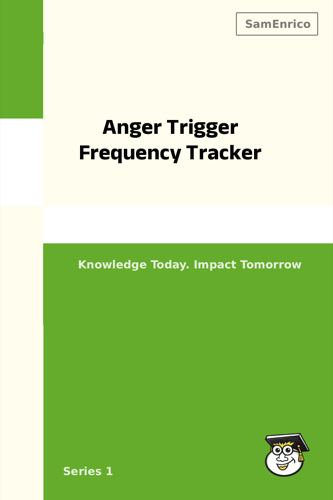
Non-FictionSelf-HelpFrequency Analysis
Anger Trigger Frequency Tracker eBook
Count how often each trigger occurs to prioritize
Count how often each trigger occurs to prioritize which to address first.
Formats
Free sample
Chapter 1: The Hidden Variable...--You have likely opened this book because you are exhausted. Not the pleasant tiredness that follows a good day’s work, but the bone-deep fatigue of someone who spends more time being angry than they want to admit. You have tried the breathing exercises. You have counted to ten. You have walked away.
You have apologized, repeatedly, for words that left your mouth before your brain could stop them. And still, the anger comes back. It arrives in the morning when your child cannot find their shoes. It arrives mid-afternoon when a colleague interrupts you for the third time. It arrives at dinner when your partner asks a perfectly reasonable question that somehow feels like an attack.Here is what no one has told you: you are not failing at anger management because you lack willpower.
You are failing because the entire anger management industry has been asking the wrong question. They ask, “How intense was your anger?” They ask, “How did you express it?” They ask, “What coping skill did you use?” These are all questions about the explosion. They ignore the spark. And a single spark, repeated ten thousand times, will burn down a forest just as thoroughly as one great fire.This book asks a different question. A question that will change everything about how you understand your own anger.
That question is not “How angry did you feel?” It is “How often did it happen?” Welcome to the Frequency First revolution.The Explosion That Wasn’t Let me tell you about a client I will call Maya. When Maya first came to see me, she described herself as “a monster.” Her reason: three months earlier, she had screamed at her seven-year-old daughter for spilling milk at breakfast. The screaming lasted five minutes. Her daughter cried. Maya cried.
Her husband stood frozen in the doorway. The memory still made Maya’s hands shake when she described it.I asked Maya how many times she had yelled at her daughter in the past year. She thought for a long time and said, “That was the only time. The only time I lost control like that.”Then I asked Maya a different question. “How many times in the past week did you feel a flash of anger—even a small one—that you did not act on?”Her face changed.
“Every day,” she said. “Multiple times a day. The alarm clock. The coffee maker breaking. My husband leaving his socks on the floor.
The dog barking. My boss emailing at 6 AM. The traffic. The grocery store being out of the brand I like. The news.
The neighbor’s car alarm. My own reflection in the mirror because I was running late and looked tired.”“How many?” I asked again.She pulled out her phone and started counting. By the time she finished, she had listed forty-seven triggers from the past seven days. Forty-seven flashes of anger. Forty-seven moments when her nervous system shifted into a state of low-grade threat response.
Forty-seven small cortisol spikes. Forty-seven small rehearsals of the neural pathway that would eventually, three months later, produce a five-minute scream at a child holding a spilled cup of milk.Maya was not a monster. Maya was a person who experienced anger forty-seven times per week but only expressed it once per year. The explosion was not the problem. The explosion was the inevitable result of the problem.The Catharsis Lie You have been told, probably by well-meaning people and possibly by therapists, that you need to “let your anger out.” Punch a pillow.
Scream into a void. Write an angry letter you never send. This advice comes from a theory called catharsis, which dates back to Aristotle and was popularized in modern psychology by Sigmund Freud and Josef Breuer. The idea is simple: suppressed emotion builds up like steam in a pressure cooker, and releasing it prevents an explosion.There is only one problem with this theory. It is completely, demonstrably wrong.In 2002, social psychologist Brad Bushman published a landmark meta-analysis of catharsis research.
He reviewed dozens of studies and found that people who vented their anger—by punching bags, screaming, or rehearsing their grievances—did not become less angry. They became more angry. The act of venting reinforced the neural pathways associated with aggression. Each punch told the brain, “This is an acceptable response.” Each scream told the nervous system, “This situation requires high arousal.” Venting did not drain the pressure cooker. It added fuel to the fire.More recent research using f MRI brain imaging has shown why.
When you experience anger, your amygdala (the brain’s threat detection center) activates. When you then act aggressively—even in a “safe” way like punching a pillow—your prefrontal cortex (the brain’s impulse control center) learns to step aside. The pathway from trigger to aggression becomes faster and more automatic. You are not releasing anger. You are practicing it.This is why traditional anger management often fails.
It focuses on what to do during or after the explosion. But by the time you are in an explosion, the neural pathway has already fired. You are fighting against momentum. The only way to truly change your relationship with anger is to change the frequency of the sparks that lead to the fire. And you cannot change what you do not measure.The Frequency First Principle Here is the central insight of this book, the one that will rewire how you think about your anger for the rest of your life.When it comes to changing behavior, how often a trigger occurs is more actionable than how intense the anger feels.Let me explain why.
Intensity is dramatic. Intensity gets our attention. When you scream at someone, when you slam a door, when you feel your blood pressure spike to dangerous levels—you remember that moment. Your brain flags it as important. So you naturally assume that high-intensity triggers are the ones you need to fix.But intensity is rare by definition.
True explosions do not happen every hour. They happen once a week, once a month, once a year. Between explosions, there is a long, quiet stretch of low-intensity anger. The irritation at a slow website. The frustration at a miscommunication.
The annoyance at a background noise. These moments barely register. You forget them by the time you finish reading this sentence. And that is exactly why they are dangerous.A low-intensity trigger that happens fifty times a week does more damage to your relationships, your health, and your daily peace than a high-intensity blow-up that happens once a year. Here is the math.
Suppose a high-intensity blow-up costs you three hours of recovery time, two apologies, and one day of elevated blood pressure. That is real damage. But it happens once a year. Now suppose a low-intensity annoyance costs you only ten seconds of irritation, one minor snide comment, and a tiny cortisol spike. That seems like nothing.
But if it happens fifty times per week, fifty-two weeks per year, the cumulative cost is enormous. You have spent over seven hours per year actively irritated. You have made over two thousand minor snide…
This is the end of the free sample. Get the eBook to keep going. Buy now
About this book
Details
- Author
- Walling Nanette
- Publisher
- SamEnrico
- Language
- English
- Genre
- Non-Fiction, Self-Help, Frequency Analysis
- Released
- 2026-06-08
- Pages (approx.)
- 131
- Available as
- eBook, Audiobook

Read better in the ZLOADR app
Your eBooks on your phone or tablet. Sign in with your SamEnrico account and start reading.
More by Walling Nanette
 NA Step Working HandbookWalling Nanette$11.99
 Project Time Blocking MethodWalling Nanette$11.99
 PNE App Patient GuideWalling Nanette$11.99
 The Hollow Hill: A Druid's Last Stand Against the Iron AgeWalling Nanette$11.99
 The Poisoner's Apprentice: The Untold Story of Graham YoungWalling Nanette$11.99
 Understanding HyperornithinemiaWalling Nanette$17.99
 Robo Advisor Technology StackWalling Nanette$12.99
 Corporate Career Stability PrimerWalling Nanette$12.99
 A Beginners Guide to Baseball (Volume 1)Walling Nanette$11.99
 Surgical First AssistantWalling Nanette$11.99
You may also like
 Hong Kong Handover 1997Dunn Johnnie$11.99
 Zumba For Postnatal Recovery CourseNeal Christian$11.99
 Zumba for BeginnersLadner Nikia$11.99
 YouTube Comment Mining GuideHumes Pandora$12.99
 Worry Box MeditationCarlin Rudy$11.99
 Workplace Stress MeditationNguyen Lynn$11.99
 Workplace Stress and Sleep RepairHawley Ivory$11.99
 Workplace Perfectionism CureDelaney Jeffry$11.99
 Workplace Injustice Anger GuideWallen Isabelle$11.99
 Work Addiction and Burnout LinkGreenwood Ester$11.99
 Women in Yoga and WellnessBeattie Galina$11.99
 Women in Stand Up ComedyChun Evangeline$11.99