
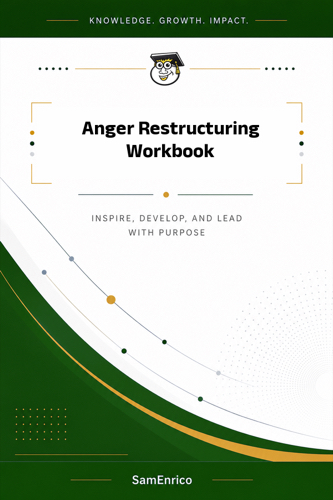
Anger Restructuring Workbook eBook
Practice worksheets for identifying and changing a
Practice worksheets for identifying and changing angry thoughts.
Formats
Free sample
Chapter 1: The Six Seconds--–- You’re driving home after a long day. The freeway is clogged, everyone seems to be driving slowly on purpose, and you’ve been stopped at the same red light for what feels like an eternity. Then it happens. A driver cuts you off without a signal, sliding into the tiny gap you’ve been guarding for half a mile. Your hands tighten on the steering wheel.
Heat rises up the back of your neck. Your jaw clenches so hard your teeth ache. And before you can think, your hand is on the horn, your mouth is forming words you wouldn’t say to a stranger’s face, and your middle finger is already up against the glass.Ten seconds later, you feel like an idiot. Or worse, you don’t. You feel justified.
But either way, you lost control. And somewhere in the wreckage of that moment, you ask yourself the question that has haunted humans for thousands of years: What just happened?The answer, it turns out, is both simpler and more useful than you might imagine. In the space between the driver cutting you off and your hand hitting the horn, approximately six seconds passed. Six seconds. That’s all the time your brain needed to take you from a neutral state to a full-blown anger reaction.
And in those six seconds, a specific, predictable sequence of events unfolded inside you—a sequence that, once you understand it, becomes the single most powerful lever for change you will ever encounter.This chapter is about those six seconds. It is about the anatomy of an angry thought: where it comes from, how it moves through your body, and most importantly, where you can intercept it before it becomes something you regret. By the end of this chapter, you will have a map of your own anger pattern, a vocabulary for what happens inside you, and two worksheets that will begin the process of restructuring your angry thoughts from the inside out.The Great Misunderstanding About Anger Before we dive into the six-second sequence, we need to clear up a widespread misunderstanding. Most people believe that anger is a primary emotion—that it arises directly from events in the world, like a reflex. Someone does something unfair, and you get angry.
End of story.This is wrong. And not just a little wrong—profoundly, life-changingly wrong.Decades of research in cognitive neuroscience, affective science, and clinical psychology have converged on a single conclusion: anger is almost always a secondary emotion. That means it arrives on the heels of another, more vulnerable emotion that you may not even be aware of. The most common primary emotions hiding beneath anger are:Hurt – You feel wounded, dismissed, or devalued.Fear – You feel threatened, unsafe, or anxious about what might happen next.Shame – You feel exposed, humiliated, or fundamentally flawed.Frustration – You feel blocked, powerless, or unable to achieve a goal.Here’s why this matters: If you only treat the anger—by venting, suppressing, or managing the explosion—you are treating the symptom, not the cause. It’s like taking a painkiller for a broken leg.
The pain might fade for an hour, but the leg is still broken, and you’re going to feel it again as soon as you try to walk.The good news is the reverse is also true. When you learn to identify the primary emotion hiding underneath your anger, you gain access to a completely different set of solutions. You stop asking “How do I stop being so angry?” and start asking “What is this anger protecting me from feeling?” That shift in questions changes everything.The Six-Second Sequence: Your Anger Map Now let’s walk through what actually happens in those six seconds between trigger and action. I’m going to give you a five-step model. Learn it.
Practice it. It will become the backbone of every other skill in this workbook.Step 1: Trigger Something happens in your environment or inside your body. A person says something. A car cuts you off. You remember a past injustice.
You feel tired, hungry, or overwhelmed. This is the spark—neutral by itself, but loaded with potential.Step 2: Automatic Thought Your brain instantly interprets the trigger. This happens so fast you usually don’t notice it. The thought might be verbal (“He did that on purpose”) or imagistic (a flash of a past betrayal). It might be loud or barely audible.
But it’s always there. This is the most important step in the entire sequence because it’s the one you can actually change.Step 3: Physical Sensation Your body responds to the automatic thought. Your sympathetic nervous system activates. Adrenaline and cortisol flood your system. Your heart rate increases.
Your breathing becomes shallow. Your muscles tense. Your face flushes. These sensations are not the anger itself—they are your body preparing for action based on what your brain just told it.Step 4: Urge You feel a powerful impulse to do something. Yell.
Punch. Withdraw. Slam a door. Send a cutting text. Cry.
This urge is not an action—it’s a proposal from your brain. You can accept it, modify it, or reject it entirely.Step 5: Action You do something. Sometimes it matches the urge. Sometimes it doesn’t. But once you act, the sequence is complete, and you live with the consequences.Here’s the crucial insight that most anger management resources get wrong: You cannot skip steps.
You cannot go directly from trigger to action. The sequence is hardwired. But you can learn to notice the steps as they happen, and at each step, you have a choice. The earlier you intercept the sequence, the easier it is to change the outcome.Why Most Anger Management Fails Let me be blunt about something. If you’ve tried to manage your anger before—through deep breathing, counting to ten, or “just letting it go”—and it didn’t stick, it’s not because you’re weak or broken.
It’s because those techniques target the wrong part of the sequence.Deep breathing, for example, mostly affects Step 3 (physical sensation). That’s useful, but if your automatic thought is still screaming “He disrespected me!” the physical sensation will return within seconds of you finishing your breath. Counting to ten is an attempt to delay Step 5 (action), but it doesn’t change Steps 2, 3, or 4. You’re just white-knuckling your way through the urge, which is exhausting and unsustainable.The approach in this workbook is different. We are going to go directly to Step 2: the automatic thought.
Because if you change the thought, the sensation changes on its own. The urge changes on its own. The action changes on its own. No white-knuckling required.This is what cognitive restructuring means: systematically identifying and changing the automatic thoughts that fuel your anger. It is not suppression (bottling it up) and not catharsis (letting it out).
It is rewriting the script your brain is using to interpret the world.A Note on Terms: Automatic Thoughts, Distortions, and Hot Thoughts Before we go further, let me clarify three terms that will appear throughout this book. They are related…
This is the end of the free sample. Get the eBook to keep going. Buy now
About this book
Details
- Author
- Castellano Jeffie
- Publisher
- SamEnrico
- Language
- English
- Genre
- Non-Fiction, Self-Help, Workbook, CBT
- Released
- 2026-06-09
- Pages (approx.)
- 132
- Available as
- eBook, Audiobook

Read better in the ZLOADR app
Your eBooks on your phone or tablet. Sign in with your SamEnrico account and start reading.
More by Castellano Jeffie
 Cloudflare CDN Outage GuideCastellano Jeffie$11.99
 Scott Peterson Jury SelectionCastellano Jeffie$11.99
 The Sole Proprietorship GuideCastellano Jeffie$11.99
 Gadget Addiction Recovery GuideCastellano Jeffie$11.99
 The Healing Hands of Timbuktu: The Secret Love Story Behind the City of ScholarsCastellano Jeffie$11.99
 Understanding Vitamn B12 Responsive MethylmalonicaciduriaCastellano Jeffie$17.99
 Startup Visa Processing TimesCastellano Jeffie$12.99
 Membership Site Terms GuideCastellano Jeffie$12.99
 Private NannyCastellano Jeffie$11.99
 How to Start a Nightlight Business (Beginners Guide)Castellano Jeffie$11.99