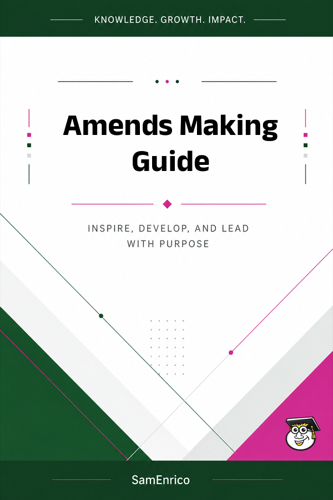
Amends Making Guide eBook
Prepares for and makes direct amends wherever poss
Prepares for and makes direct amends wherever possible without causing harm.
Formats
Free sample
Chapter 1: The Mirror Test--The phone buzzed for the third time in an hour. You glance at the screen and feel your stomach drop. It’s your partner. Or your parent. Or that friend you’ve been avoiding.
You don’t answer. Instead, you scroll mindlessly through social media, hoping the feeling will pass. But it doesn’t. It never does. Because somewhere beneath the notifications, the to-do lists, and the noise of daily life, there is a quiet, relentless voice whispering: You have not been good to the people you love.
And you know it.That voice is not your enemy. It is the beginning of every genuine repair ever attempted by any human being. But most of us spend our lives trying to silence it. We drown it in work, in entertainment, in defensiveness, in new relationships that we will also eventually harm because we never learned how to clean up the wreckage of the old ones. This chapter is not about making you feel worse.
You already feel bad enough. This chapter is about taking that vague, suffocating guilt and turning it into something sharp, specific, and actionable. Before you can make a single amend, you have to see clearly what you have done. And that requires the hardest thing any of us will ever do: looking in the mirror without flinching.The Difference Between Feeling Bad and Knowing What You Did There is a profound difference between feeling guilty and knowing your harms. Feeling guilty is a state of emotional discomfort.
It is vague, global, and often paralyzing. You wake up at three in the morning with a general sense of dread. You avoid certain people. You change the subject when someone brings up the past. You say “I’m a terrible person” as if that statement itself is a form of penance.
But it is not. In fact, it is the opposite. Self-flagellation is often a secret way of avoiding change. If you declare yourself irredeemably bad, you never have to do the slow, boring, humiliating work of specific repair.Knowing your harms is entirely different. Knowing your harms is a list.
It is a document. It is a set of sentences that begin with “I did X to Y on Z date, and the impact was W.” There is no emotion in that sentence except the emotion you bring to it. The sentence itself is a fact. And facts can be addressed. Feelings cannot.In my years of studying apology literature, therapeutic models, and the lived experience of people who have successfully repaired broken relationships, one finding stands out above all others: people who successfully make amends do not begin with emotion.
They begin with inventory. They begin by writing down, in plain language, exactly what they did, to whom, and what it cost that person. Only after they have that list do they begin to feel their way through the repair. The feeling comes second. The facts come first.This chapter will teach you how to conduct what I call a Relational Audit.
It is a structured, written inventory of past harms. It is not a journal entry. It is not a confession meant to make you feel catharsis. It is a working document. You will return to it again and again as you work through this book.
And by the end, you will either have addressed every item on that list, or you will have made a conscious, ethical decision to leave certain items untouched because speaking would cause more harm than silence.Perceived Slights Versus Actual Tangible Harm Before you write a single name, you must understand a distinction that will save you years of unnecessary shame. Not every unpleasant interaction between two people constitutes a harm that requires amends. Human beings are allowed to be awkward, clumsy, or mildly inconsiderate without carrying a lifelong debt. The question you must ask yourself for each potential item on your inventory is this: Did the other person actually lose something because of me?Let me be specific. A perceived slight is when someone felt hurt or offended, but no tangible loss occurred.
You forgot to text them back for two days. You made a joke that landed poorly. You showed up ten minutes late. These things can be irritating. They can even damage relationships if repeated endlessly.
But they are not, in themselves, the kind of harm that requires the full amends process outlined in this book. Apologize briefly, change your behavior, and move on. Chapter Twelve will teach you how to handle these small daily repairs in sixty seconds or less.Actual tangible harm is different. It involves a measurable loss. That loss can be financial: you borrowed money and did not repay it.
You damaged property. You cost someone a job opportunity through lies or negligence. That loss can be emotional or relational, but only if the emotional harm has observable, lasting consequences: you betrayed a confidence that destroyed a friendship. You engaged in infidelity that shattered a partner’s sense of safety. You abused a position of power over a child, an employee, or a vulnerable person.
That loss can also be physical: you caused injury, you destroyed something irreplaceable, you created an environment of fear.The distinction matters because many people spend years drowning in guilt over minor social friction while avoiding the actual, serious harms they have caused. The Relational Audit forces you to prioritize. The big things go at the top. The small things go in a separate list for daily maintenance. The perceived slights go nowhere—you simply try to be a kinder person going forward.The Refrain You Will Learn to Hate (And Then Love)Throughout this book, and especially in this chapter, you will encounter a refrain that may initially make you defensive.
Here it is: What you meant to do does not undo what you actually did.Write that down. Put it on your bathroom mirror. Because every time you sit down to write your inventory, your brain will offer you explanations. I didn’t mean to hurt them. I was under a lot of stress.
I was reacting to something they did first. I was drunk. I was young. I was scared. The inventory is not the place for these explanations.
The inventory is for actions and impacts only. Your intentions will be noted, examined, and sometimes even shared with the harmed party if they ask. But they do not belong in the initial list. Because intentions are the single most common tool of avoidance. As long as you are focused on what you meant, you are not looking at what you did.A man once came to me with a long story about how he had been fired from his job for embezzlement.
He spent twenty minutes explaining that his wife was sick, his medical bills were overwhelming, and he had only intended to borrow the money temporarily. He genuinely believed he was a good person who had made a mistake. And perhaps that was true. But when I asked him to write his inventory without any explanation, he wrote: “I stole $47,000 from my employer over eighteen months.” That sentence changed…
This is the end of the free sample. Get the eBook to keep going. Buy now
About this book
Details
- Author
- Ellington Mariano
- Publisher
- SamEnrico
- Language
- English
- Genre
- Non-Fiction, Self-Help, Amends
- Released
- 2026-06-11
- Pages (approx.)
- 151
- Available as
- eBook, Audiobook

Read better in the ZLOADR app
Your eBooks on your phone or tablet. Sign in with your SamEnrico account and start reading.
More by Ellington Mariano
 The Resilience Against ImposterEllington Mariano$11.99
 Procrastination AngerEllington Mariano$11.99
 Hangover Recovery NapEllington Mariano$11.99
 Fibromyalgia and Weather SensitivityEllington Mariano$11.99
 A Zen Monk's Daily LifeEllington Mariano$11.99
 The Community Meeting SpeakerEllington Mariano$11.99
 George Kennan ContainmentEllington Mariano$11.99
 Psychological Safety TeamsEllington Mariano$11.99
 Gilded Exile: The Untold Story of the Romanovs in ParisEllington Mariano$11.99
 The Ghost of the Golden Mile: The Unseen Hand Behind Indira Gandhi's AssassinationEllington Mariano$11.99
 Scalping Techniques and Execution SpeedEllington Mariano$11.99
 Justinian's Vision: The Codification of Law and the Rise of ByzantiumEllington Mariano$11.99