
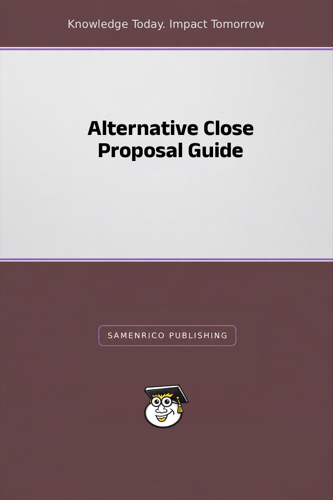
Non-FictionBusiness BriefClosing Techniques
Alternative Close Proposal Guide eBook
Offer tiered options instead of yes-no choices to
Offer tiered options instead of yes-no choices to guide prospects toward premium selections.
Formats
Free sample
Chapter 1: The $1.2 Million Mistake--The email arrived at 9:47 AM on a Tuesday. Sarah, a senior account executive at a fast-growing Saa S company, had spent six weeks on this deal. Six weeks of discovery calls, product demos, executive briefings, security questionnaires, and three rounds of pricing negotiations. She had built a custom proposal, sixty-seven pages of meticulous detail, with exactly one price at the bottom: $1.2 million for a three-year enterprise agreement.She clicked send. Then she waited.Day one: nothing.
Day two: "Thanks, reviewing internally." Day seven: she sent a follow-up. Day ten: another follow-up. Day fourteen: she called the procurement lead, who said, "We're still evaluating." Day twenty-one: she called the economic buyer, who said, "We've decided to go in a different direction."Six weeks of work. Zero dollars in revenue. And no idea why.Sarah's story is not unusual.
It is, in fact, the most common sales tragedy in modern business. Every day, thousands of talented salespeople, consultants, and entrepreneurs pour their energy into crafting what they believe is the perfect proposal. They customize every line. They align every deliverable. They price fairly.
And then they send a single document with a single number and ask the prospect to make a single decision: yes or no.That is the mistake. And it is a $1.2 million mistake.The Binary Trap: Why One Option Is a Gamble Every sales proposal presents a choice. The question is whether you control the structure of that choice or leave it to chance. When you present a single proposal with a single price, you are not simplifying the decision for your prospect. You are forcing them into a binary frame: accept the offer exactly as written, or reject it entirely.This is what I call the Binary Trap.The Binary Trap has three predictable outcomes, none of them good.
The first outcome is outright rejection. The prospect looks at your price, compares it to their internal budget or their perception of value, and says no. The deal dies immediately. You never get a chance to adjust, explain, or negotiate because the proposal itself became the final word.The second outcome is price haggling. The prospect wants to say yes, but the single number feels too high.
So they come back with a counteroffer. Now you are in a zero-sum negotiation where every concession feels like a loss. You cut your price. They feel like they won. But you have just trained them that your first number was never real.
Next time, they will wait even longer to counter.The third outcome is silence. This is the most common and the most painful. The prospect receives the proposal, feels overwhelmed by the binary decision, and defers. They tell themselves they will get back to it tomorrow. Tomorrow becomes next week.
Next week becomes never. They never say no. They just disappear. And you are left wondering what happened.Sarah experienced the silence outcome. But unlike most salespeople, she eventually learned why.
Months later, she ran into the procurement lead at a conference. Over coffee, she asked what had gone wrong.The answer was devastatingly simple."We liked you," the procurement lead said. "We liked the product. But your proposal gave us no way to say yes at a price our CFO would approve. The only option was $1.2 million.
We couldn't justify that. So we did nothing."They did not need $1.2 million solution. They needed a $600,000 solution with room to grow. But Sarah had never asked. She had assumed that if they wanted less, they would ask for less.
They did not. They just walked away.The Neurology of No: Why Binary Choices Trigger Fear To understand why the Binary Trap is so destructive, we have to go beneath behavior and into the brain. The human mind is not designed to evaluate binary choices under uncertainty. It is designed to detect threats.When you present a single proposal with a single price, you are activating a neurological pathway that Chris Voss, the former FBI hostage negotiator and author of Never Split the Difference, calls the "amygdala hijack." The amygdala is the brain's fear center. Its job is to scan for danger.
And a high-stakes binary decision registers as danger.Here is what happens inside your prospect's brain when they open your single-option proposal. The amygdala activates. Blood flow shifts away from the prefrontal cortex, the region responsible for logic, reasoning, and long-term planning. The prospect becomes defensive. They start looking for reasons to say no rather than reasons to say yes.
Every number looks too high. Every term looks risky. The question shifts from "What value will I gain?" to "What will I lose if I make the wrong choice?"This is loss aversion in action. Behavioral economists Daniel Kahneman and Amos Tversky demonstrated that humans feel losses approximately twice as intensely as equivalent gains. A $10,000 price feels like a potential $10,000 loss.
The brain wants to avoid that loss at all costs. So it says no.Now contrast this with how the brain responds to a menu of options. When you present three distinct ways to solve a problem, the amygdala calms down. The prefrontal cortex engages. The prospect shifts from risk assessment mode to preference evaluation mode.
They are no longer asking "Should I buy?" They are asking "Which of these best fits my needs?" That single linguistic shift changes everything.Let me say that again because it is the single most important idea in this entire book.When you ask "Should I buy?" you invite fear. When you ask "Which should I buy?" you invite curiosity.Fear closes doors. Curiosity opens them.Decision Versus Selection: The Language Shift That Changes Everything Most salespeople use the word "decision" constantly. "We need you to make a decision." "What will it take to get a decision?" "I'm following up on your decision."Stop.The word "decision" carries weight. It implies finality, risk, and consequence.
No one wants to make a bad decision. So they delay making any decision at all.Replace that word with "selection." A selection is lighter. A selection implies preference, not judgment. A selection says, "Among these good options, which do you prefer?" not "Is this one good enough to risk your career on?"This is not semantics. This is cognitive framing.
And it works because it aligns with how the brain naturally operates under conditions of choice.Consider a simple experiment conducted by Sheena Iyengar at Columbia University. Shoppers at a gourmet grocery store were offered free samples of jam. In one condition, they could sample from a display of six jams. In another condition, they could sample from a display of twenty-four jams. The larger display attracted more attention.
But here is the critical finding: shoppers who saw the six-jam display were ten times more likely to actually purchase jam than those who saw the twenty-four-jam display.Too many options create paralysis. But too few options create binary conflict. The sweet spot, as Iyengar discovered, is between three and six options. And for sales proposals specifically, three options consistently outperform both two and four.Why three? Because three creates what I call the Goldilocks effect.
One option is a gamble. Two options create conflict. Three options create comparison.When a prospect compares three options, they are…
This is the end of the free sample. Get the eBook to keep going. Buy now
About this book
Details
- Author
- Harrell Tamela
- Publisher
- SamEnrico
- Language
- English
- Genre
- Non-Fiction, Business Brief, Closing Techniques
- Released
- 2026-06-08
- Pages (approx.)
- 134
- Available as
- eBook, Audiobook

Read better in the ZLOADR app
Your eBooks on your phone or tablet. Sign in with your SamEnrico account and start reading.
More by Harrell Tamela
 Vitamin B12 Deficiency HandbookHarrell Tamela$11.99
 NVC for Academic SettingsHarrell Tamela$11.99
 Availability ExpectationsHarrell Tamela$11.99
 Toddler Trigger ControlHarrell Tamela$11.99
 Liver Cancer SurvivorHarrell Tamela$11.99
 Food Addiction in TeensHarrell Tamela$11.99
 Posture Power for ConfidenceHarrell Tamela$11.99
 Britney Spears ToxicHarrell Tamela$11.99
 The Last Pharaoh: Cleopatra’s Secret LegacyHarrell Tamela$11.99
 The Great Bitcoin Heist: How a Genius Coder Stole $4.5 Billion and VanishedHarrell Tamela$11.99
 The Last Whisper of the Saturn V: Apollo 11's Forgotten Test FlightHarrell Tamela$11.99
 The Mineral Guide to NatrophiliteHarrell Tamela$11.99
You may also like
 Hong Kong Handover 1997Dunn Johnnie$11.99
 Zumba For Postnatal Recovery CourseNeal Christian$11.99
 Zumba for BeginnersLadner Nikia$11.99
 YouTube Comment Mining GuideHumes Pandora$12.99
 Worry Box MeditationCarlin Rudy$11.99
 Workplace Stress MeditationNguyen Lynn$11.99
 Workplace Stress and Sleep RepairHawley Ivory$11.99
 Workplace Perfectionism CureDelaney Jeffry$11.99
 Workplace Injustice Anger GuideWallen Isabelle$11.99
 Work Addiction and Burnout LinkGreenwood Ester$11.99
 Women in Yoga and WellnessBeattie Galina$11.99
 Women in Stand Up ComedyChun Evangeline$11.99