
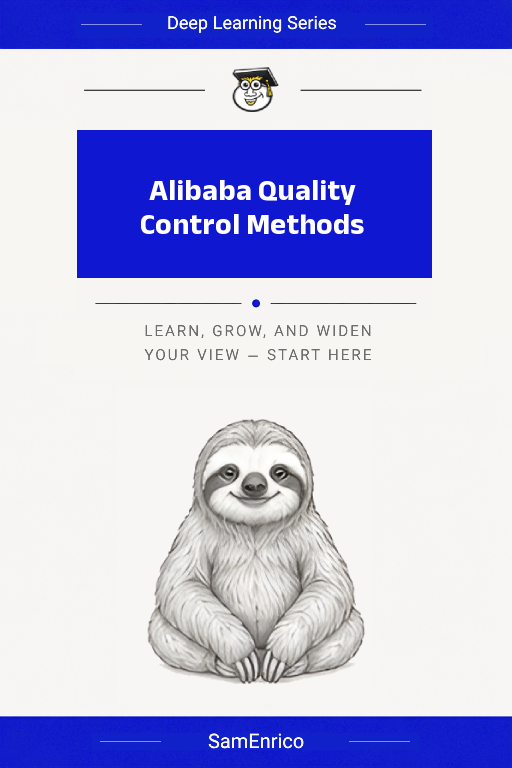
Alibaba Quality Control Methods eBook
Hire third-party inspectors in China before shipme
Hire third-party inspectors in China before shipment, comparing pre-shipment risk reduction to Amazon's transparency program and Jumia's verification.
Formats
Free sample
Chapter 1: The Million-Dollar Blindspot–- In the summer of 2019, a mid-sized home goods retailer from Texas placed what seemed like a routine order with a supplier in Zhejiang province. The product was simple: 50,000 bamboo cutting boards, laser-engraved with the retailer's private label. The samples had been perfect—beautiful grain, smooth edges, crisp engraving. The supplier had excellent communication, sending weekly photo updates of the production line. The buyer, confident in the relationship, waived the third-party inspection.
After all, why spend $600 to verify what the photos already showed?Six weeks later, the container arrived at the Port of Long Beach. Customs pulled two cartons for a random agricultural inspection—bamboo products are subject to heightened scrutiny for pests and treatment compliance. What they found stopped the entire shipment. The cutting boards were not bamboo at all. They were a cheaper composite of bamboo dust and melamine binder, pressed into boards that looked like bamboo but would delaminate within three months of washing.
The supplier had substituted materials the moment the buyer stopped watching.The retailer lost 187,000ontheshipment.Theylostanother187,000 on the shipment. They lost another 187,000ontheshipment.Theylostanother240,000 in Amazon chargebacks when the first 1,000 units they had already shipped to fulfillment centers began delaminating and generating negative reviews. They lost their Amazon selling privileges for ninety days. They lost customers who had trusted their brand. All because a supplier changed the recipe when no one was looking.This is not a story about a dishonest supplier, though the supplier was certainly dishonest.
This is a story about a blind spot in global trade that costs importers billions of dollars every year. The blind spot is this: in the gap between the sample you approve and the container you receive, anything can happen. And without a system of independent verification, you will never know what crossed that gap until it is too late.The Anatomy of a Blind Spot Every import transaction has a blind spot. It exists in the space between your payment and your delivery, between the supplier's promises and the factory's actions, between the sample you touched and the goods you never saw being made. The blind spot is not a conspiracy.
It is a structural feature of long-distance manufacturing, created by three forces that no amount of trust can overcome.The first force is time. A typical order from sample approval to container loading takes sixty to ninety days. In that window, a factory can change materials, substitute components, reduce quality checks, or rush production without informing you. The factory is not necessarily malicious; it may be responding to its own pressures—a raw material shortage, a broken machine, a rush order from a larger customer. But whether the change is intentional or circumstantial, the result is the same: what you get is not what you approved.The second force is distance.
When you are eight thousand miles away, you cannot see the production line. You cannot smell the glue. You cannot feel the fabric. You are dependent on what the factory chooses to show you—and what the factory chooses to show you is always the best version of the truth. Photos can be staged.
Videos can be edited. Samples can be specially prepared. The factory has every incentive to present the most favorable image, and no incentive to reveal problems that might delay payment.The third force is the principal-agent problem, a concept from economics that describes what happens when one person (the principal) hires another person (the agent) to act on their behalf, but the agent's interests do not perfectly align with the principal's. Your supplier is your agent in China. You pay them to produce goods according to your specifications.
But their interests—maximizing their profit, minimizing their hassle, keeping their production line running—are not identical to yours. When your interest in quality conflicts with their interest in speed or cost, which one wins? The answer is written in every container graveyard.The Five Ways Quality Dies The blind spot is dangerous because it conceals not one but five distinct ways that quality can fail between sample approval and container delivery. Understanding these five failure modes is the first step toward closing the blind spot.The first failure mode is material substitution. This is what happened to the Texas retailer with the bamboo cutting boards.
The supplier shows you a sample made from high-grade materials, then switches to cheaper alternatives once production begins. The substitution may be obvious—plastic instead of metal, pine instead of oak—or subtle enough to escape visual inspection, like the bamboo dust composite. In either case, the result is a product that fails long before it should.The second failure mode is tolerance drift. Every manufacturing process has tolerances—the allowable variation from specifications. A good factory keeps tolerances tight during the initial production run, when quality checks are frequent.
But as the order progresses, especially under time pressure, tolerances can drift. Seams become slightly wider. Colors shift slightly off-spec. Thread counts drop slightly. Each drift is too small to notice in isolation.
Together, they transform a quality product into a reject.The third failure mode is workmanship degradation. The first few hundred units of an order are usually made by the factory's best workers, under the close supervision of the quality manager. By unit five thousand, the best workers have moved on to other orders, replaced by newer or less skilled workers. The quality manager is now splitting attention across three production lines. The care that went into the first units does not survive to the last units unless there is independent monitoring.The fourth failure mode is quantity gaming.
This is the practice of shipping fewer units than invoiced, or mixing defective units into the container in the hope that the buyer will not count every carton. A common tactic is to pack perfect units on the top and sides of each carton, where an inspector might see them, while hiding defective units in the middle. Another tactic is to load the container in two shifts: perfect goods during the day when the inspector is present, then defective goods at night after the inspector leaves.The fifth failure mode is outright fraud. This is the rarest but most devastating failure mode. A dishonest supplier takes your deposit, produces nothing, and disappears.
Or they produce something approximating your product, ship it to a freight forwarder, and present falsified documents claiming inspection and loading. By the time you discover the fraud—usually when the container arrives empty or full of rubble—the supplier has dissolved their Alibaba account and reopened under a new name.The Sample Illusion At the heart of every quality failure is a misunderstanding about what a sample represents. Most buyers believe a sample is a promise: "the production units will match this sample." In reality, a sample is a photograph. It captures a single moment, a single unit, a single performance. It tells you nothing about consistency, nothing about the factory's systems, nothing about what will happen when you are not watching.The most sophisticated suppliers know this.
They maintain what industry insiders call a "sample factory"—a small, high-quality production line dedicated to making perfect samples for prospective…
This is the end of the free sample. Get the eBook to keep going. Buy now
About this book
Details
- Author
- Carroll Kenny
- Publisher
- SamEnrico
- Language
- English
- Genre
- Non-Fiction, Business Brief
- Released
- 2026-05-29
- Pages (approx.)
- 130
- Available as
- eBook, Audiobook

Read better in the ZLOADR app
Your eBooks on your phone or tablet. Sign in with your SamEnrico account and start reading.
More by Carroll Kenny
 Alzheimers Anticipatory GriefCarroll Kenny$11.99
 Luxury Brand Addiction CureCarroll Kenny$11.99
 The Postpartum Yoga GuideCarroll Kenny$11.99
 REM Nap Benefits GuideCarroll Kenny$11.99
 Self Hypnosis for Phobia ReliefCarroll Kenny$11.99
 Nonverbal Cues for CoachesCarroll Kenny$11.99
 Mass Disaster Dental IDCarroll Kenny$11.99
 Self Hypnosis for Nail BitingCarroll Kenny$11.99
 The Burning of Washington: Dolley Madison's Defiance in the War of 1812Carroll Kenny$11.99
 The Great Zoo Escape: The Cold War's Most Bizarre Spy CaperCarroll Kenny$11.99
 A Collector's Handbook to the Vauxhall Victor 1600Carroll Kenny$11.99
 Ultimate Handbook Guide to Yongcheng : (China) Travel GuideCarroll Kenny$11.99
You may also like
 Hong Kong Handover 1997Dunn Johnnie$11.99
 Zumba For Postnatal Recovery CourseNeal Christian$11.99
 Zumba for BeginnersLadner Nikia$11.99
 YouTube Comment Mining GuideHumes Pandora$12.99
 Worry Box MeditationCarlin Rudy$11.99
 Workplace Stress MeditationNguyen Lynn$11.99
 Workplace Stress and Sleep RepairHawley Ivory$11.99
 Workplace Perfectionism CureDelaney Jeffry$11.99
 Workplace Injustice Anger GuideWallen Isabelle$11.99
 Work Addiction and Burnout LinkGreenwood Ester$11.99
 Women in Yoga and WellnessBeattie Galina$11.99
 Women in Stand Up ComedyChun Evangeline$11.99