
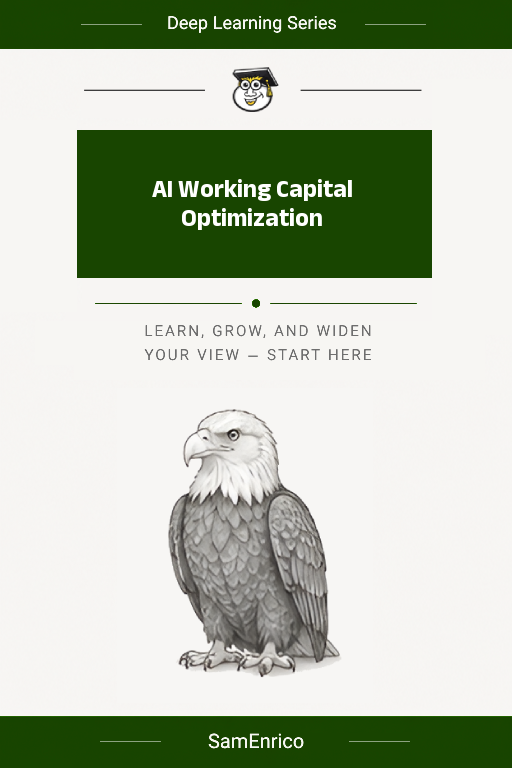
Non-FictionAI OperatorWorking Capital
AI Working Capital Optimization Audiobook
Use AI to analyze DSO, DPO, and inventory days to
by Burton Barry
Use AI to analyze DSO, DPO, and inventory days to recommend working capital improvements.
Formats
Free sample
Chapter 1: The Liquidity Paradox--–- On a Tuesday morning in March, the CEO of a fifty-year-old manufacturing company watched his bank balance fall below payroll. His company was profitable. His products were in demand. His order book was full for the next four months. Yet here he was, staring at a screen that showed 47,000incashandapayrollobligationof47,000 in cash and a payroll obligation of 47,000incashandapayrollobligationof890,000 due in forty-eight hours.
He had done everything right by traditional measures. He had grown revenue every year for a decade. He had kept costs under control. He had never missed a debt payment. But none of that mattered on that Tuesday morning, because cash—the oxygen of any business—had stopped flowing.This scene plays out somewhere in the global economy every single day.
Profitable companies fail. Growing companies collapse. Well-managed businesses with loyal customers and healthy margins suddenly find themselves unable to pay suppliers, meet payroll, or fund operations. The culprit is rarely a lack of profitability. It is almost always a failure of working capital management.
And the tragedy is that most of these failures are entirely preventable.The financial metrics that dominate boardroom discussions—revenue growth, EBITDA, net income, gross margin—are all backward-looking measures of profitability. They tell you what happened. They do not tell you what is about to happen to your cash. A company can report record profits while its bank account is bleeding dry. This is not an accounting trick.
It is the fundamental reality of the gap between when you pay for something and when you get paid for it. That gap is called the Cash Conversion Cycle, and it is the single most misunderstood and mismanaged metric in corporate finance.The Paradox Defined The liquidity paradox can be stated simply: profitability and liquidity are not the same thing, and optimizing for one often damages the other. A business can be highly profitable on paper while being functionally insolvent in practice. Consider a distributor that sells high-margin goods to large retailers. The distributor pays its suppliers in thirty days.
Its retail customers pay in ninety days. On paper, each sale generates a healthy profit. In reality, every sale creates a sixty-day cash gap that must be funded from somewhere. If the distributor grows too fast, that cash gap widens dangerously. More sales mean more cash tied up in the gap.
The company can literally sell its way into bankruptcy.This is not a theoretical curiosity. It is a structural reality of…
This is the end of the free sample. Get the Audiobook to keep going. Buy now
About this book
Details
- Author
- Burton Barry
- Publisher
- SamEnrico
- Language
- English
- Genre
- Non-Fiction, AI Operator, Working Capital
- Released
- 2026-06-01
- Pages (approx.)
- 145
- Available as
- eBook, Audiobook

Listen in the VoxFlicks app
Audiobooks and audio dramas wherever you go. Sign in with your SamEnrico account and press play.
More by Burton Barry
 Price Testing A/B GuideBurton Barry$11.99
 Name Backup RecordingBurton Barry$11.99
 Nap Alarm StrategiesBurton Barry$11.99
 Contempt In Relationships GuideBurton Barry$11.99
 Spotify Wrapped ObsessionBurton Barry$11.99
 Shopping Relapse PreventionBurton Barry$11.99
 OKRs for EntrepreneursBurton Barry$11.99
 The Vision Screening VolunteerBurton Barry$11.99
 The Star Maps of the Dogon: Decoding the Cosmos in Ancient MaliBurton Barry$11.99
 The Cursed Gaze of Medusa's SistersBurton Barry$11.99
 Service Providers Guide to Leather & Vinyl RepairBurton Barry$11.99
 How to Produce UndergroundBurton Barry$11.99
You may also like
 Hong Kong Handover 1997Dunn Johnnie$11.99
 Zumba For Postnatal Recovery CourseNeal Christian$11.99
 Zumba for BeginnersLadner Nikia$11.99
 YouTube Comment Mining GuideHumes Pandora$12.99
 Worry Box MeditationCarlin Rudy$11.99
 Workplace Stress MeditationNguyen Lynn$11.99
 Workplace Stress and Sleep RepairHawley Ivory$11.99
 Workplace Perfectionism CureDelaney Jeffry$11.99
 Workplace Injustice Anger GuideWallen Isabelle$11.99
 Work Addiction and Burnout LinkGreenwood Ester$11.99
 Women in Yoga and WellnessBeattie Galina$11.99
 Women in Stand Up ComedyChun Evangeline$11.99