
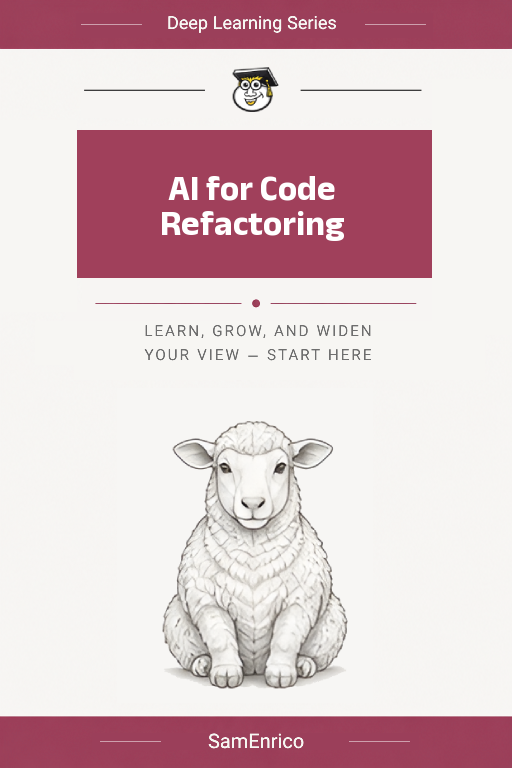
AI for Code Refactoring eBook
Identify code smells and automatically refactor co
Identify code smells and automatically refactor complex functions using AI. Improve maintainability.
Formats
Free sample
Chapter 1: The Legacy Tax--–- It was a Tuesday afternoon when Sarah, a senior engineer with fifteen years of experience, realized she had spent her entire week changing seven lines of code. Seven lines. Forty-seven hours. The task was simple: add a new payment method to the checkout flow. In a greenfield project, this would take twenty minutes.
But Sarah worked in a codebase that had been accumulating technical debt since before some of her teammates were born. Every change required touching files nobody understood, updating functions that seemed to exist only to call other functions, and praying that the ancient logging system wouldn't collapse under the weight of her modifications. On Friday, when she finally deployed her change, she celebrated by deleting the branch and walking away from her desk. She did not feel like an engineer. She felt like a archaeologist who had just defused a bomb made of other people's bad decisions.This chapter is for Sarah.
It is for every developer who has ever opened a file and whispered "what the hell is this." It is for the senior architect who inherited a system held together by documentation that says "this works, don't ask why." And it is for the engineering manager who knows that their team's velocity is bleeding out slowly, invisibly, like a wound nobody wants to examine.We are going to name the enemy. We are going to measure the cost. And then we are going to introduce the only tool that can actually fix it: the AI Refactoring Agent.The Uncomfortable Truth About Your Codebase Let us begin with an exercise. Open your project right now. Pick a file that was written more than two years ago by someone who no longer works at your company.
Look at the last commit date. Now look at how many times that file has been changed in the past six months. If you are like most teams, you will see a pattern: the oldest files are changed the most often. Not because they are important, but because they are entangled. Changing one thing breaks five others.
Fixing those five reveals seven more. The code has become a crystal lattice of dependencies, each shard connected to every other shard, and nobody knows where to strike the hammer.This is not your fault. Code decays. It is a law of software thermodynamics. Every change, no matter how careful, adds a little more entropy.
A conditional added here. A flag passed there. A copy-paste of a function because changing the original was too scary. Over years, these small wounds accumulate into something surgeons call a "failure to thrive." The code still runs. It still passes tests.
But it resists change like a body rejecting a transplant.Traditional refactoring tools cannot help you here. Your IDE can rename a variable across a hundred files in half a second. Your linter can tell you that your line length is eighty-seven characters when it should be eighty. Your static analyzer can flag a potential null pointer exception. But none of these tools understand what the code is supposed to do.
They operate on syntax, not semantics. They see tokens, not intent.This is the gap that artificial intelligence fills. For the first time in the history of software engineering, we have tools that can read a function and understand what it is trying to accomplish, not just how it is written. We have models that can look at a module and see that ten different functions all validate credit cards in slightly different ways, and then suggest consolidating them into one. We have agents that can propose a refactoring, execute it, verify that nothing broke, and present the result for your approval.But before we can use these tools effectively, we need to understand what we are fighting against.
We need to name the beast.Defining the Legacy Tax The Legacy Tax is the measurable drag on engineering velocity caused by accumulated technical debt. It is not a metaphor. It is a number you can calculate.Here is the formula:Legacy Tax = (Time spent understanding the code + Time spent fixing unintended consequences + Time spent working around old decisions) / Total development time Run this calculation for your last three sprints. Be honest. When you add a feature, how much of that time is actually spent on the feature itself versus navigating the existing codebase?
In healthy systems, the Legacy Tax is around twenty percent. In typical enterprise systems, it is closer to sixty percent. In the worst systems I have consulted on, I have seen ninety percent. Ninety percent of engineering time spent not building new things, but managing the consequences of old decisions.Let me give you a concrete example. I worked with a financial services company whose core transaction processor had been written in 2008 and never meaningfully refactored.
The team estimated that adding a new field to a transaction record required an average of forty-seven code changes across twelve files. Forty-seven changes for one field. The reason was not complexity. The reason was that the original developers had hardcoded assumptions about transaction structure in five different places, each place assuming the other places would handle validation, none of them actually doing so.When we calculated their Legacy Tax, the number was eighty-three percent. For every hour of feature work, they spent four hours dealing with the consequences of the past.
The company was paying five engineers to do one engineer's worth of new work. The other four were fighting fires that should never have existed.The Legacy Tax has three components, each worse than the last.The Understanding Tax. You cannot change what you do not understand. Every time you open a file and spend ten minutes tracing through function calls, every time you add logging to figure out why a variable is set to a value that seems impossible, every time you ask the person who wrote the code three years ago what they were thinking, you are paying the Understanding Tax. This tax is invisible because it feels like "work." But it is waste.
Pure waste.The Coupling Tax. You change one thing, and unrelated things break. This is the classic "I fixed a bug and created two more" phenomenon. Coupling tax is the reason developers learn to fear deployments. It is the reason Friday afternoon commits are forbidden.
It is the reason your team has a "rollback plan" for every change. The coupling tax is the most expensive component because it is exponential. Every new dependency multiplies the potential for breakage.The Paralysis Tax. This is the worst one. The Paralysis Tax is the time you do not spend because you are afraid.
It is the feature you do not build because touching that module is too risky. It is the refactoring you do not do because you know it will cascade. The Paralysis Tax is invisible because it never appears in your commits. It lives in your backlog, in the "someday" column, in the conversations where someone says "we should really fix that" and everyone nods and then nobody does anything.Together, these three taxes determine your team's real velocity. And here is the terrifying truth: most…
This is the end of the free sample. Get the eBook to keep going. Buy now
About this book
Details
- Author
- Rooney Emeline
- Publisher
- SamEnrico
- Language
- English
- Genre
- Non-Fiction, AI Operator, Software Craft
- Released
- 2026-06-01
- Pages (approx.)
- 133
- Available as
- eBook, Audiobook

Read better in the ZLOADR app
Your eBooks on your phone or tablet. Sign in with your SamEnrico account and start reading.
More by Rooney Emeline
 Rent Don't Buy RuleRooney Emeline$11.99
 Long Term MAT MaintenanceRooney Emeline$11.99
 The George Washington Leadership GuideRooney Emeline$11.99
 Active Listening For Depressed Loved OnesRooney Emeline$11.99
 The Great Gold Robbery: Britain's First Million-Dollar HeistRooney Emeline$11.99
 How to Start a Fish Fillet Production Business (Beginners Guide)Rooney Emeline$11.99
 Developer Support EngineerRooney Emeline$11.99
 Learn to Play the RoberoRooney Emeline$11.99
You may also like
 AI for Code Migration and UpgradesCrisp Cleora$12.99
 Prompt Engineering for Code GenerationMartins Verona$12.99
 Prompt Chains for Complex LogicCoons Elicia$12.99
 AI Pair Programming for DevelopersWatters Merna$12.99
 AI for Database Query GenerationBlalock Claudie$12.99
 Debugging with AI AssistantsRipley Melina$12.99
 AI for Unit Test GenerationDwyer Isabella$12.99
 AI for Documentation GenerationFitzgerald Jennifer$12.99
 AI Code Review AssistantMerrill Deann$12.99