
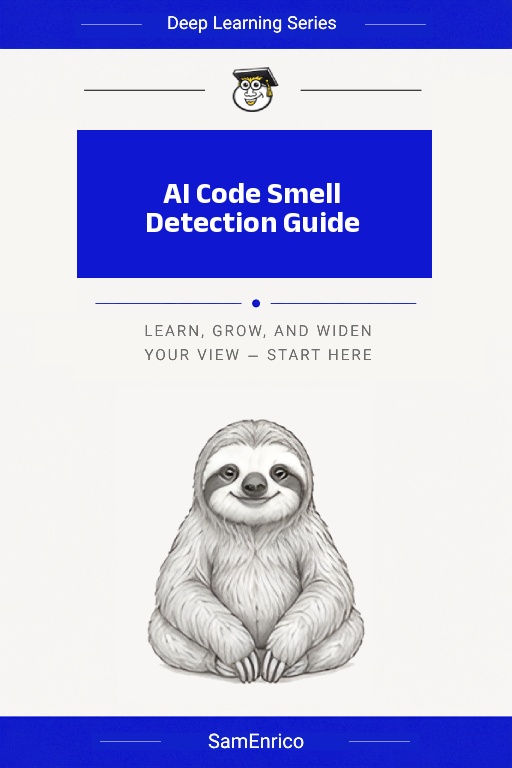
AI Code Smell Detection Guide
Detect code smells, anti-patterns, and maintainabi
Detect code smells, anti-patterns, and maintainability issues using AI analysis.
Formats
About this book
Free sample
Chapter 1: The Phantom Intern--The first time you ship AI-generated code to production, it feels like magic. You type a comment, press Tab, and a complete function materializes. Tests pass. The PR gets approved in minutes. Your team ships a feature in an afternoon that would have taken three days last year.
You feel productive. You feel like the future has arrived.Then, six weeks later, a bug report arrives. The edge case the AI didn't consider. You open the file and stare at a function you barely recognize—forty-seven lines of conditional logic, a hallucinated API parameter that does nothing, and a variable that gets reassigned three times before being used. You fix the bug in ten minutes, but the file now feels fragile.
Two weeks later, another bug. Another patch. The code congeals.You have just met the Phantom Intern.This chapter opens with a sobering reality: as of 2025, over forty percent of new production code is AI-generated. Tools like Copilot, Cursor, and Cody have transformed software development from a craft of deliberate construction into a high-speed exercise in curation and correction. But while developers are shipping features faster than ever, they are also accumulating a new category of technical debt that traditional tools cannot measure and traditional refactoring cannot easily address.
We call it artificial complexity.Unlike accidental complexity—the honest mistakes humans make when they misunderstand requirements or cut reasonable corners—artificial complexity arises from the statistical nature of large language models themselves. LLMs do not understand your system. They do not know your users. They produce what is statistically likely based on their training data, not what is maintainable for your specific context. The result is code that works today and becomes a liability tomorrow.This chapter introduces three novel anti-patterns specific to AI-generated code.
We will examine the Congealing Slop Pattern, where initially functional code resists modification as patches accumulate. We will meet the Probability Pixie, an LLM's tendency to choose statistically common but architecturally poor solutions. And we will name the Phantom Intern, the false productivity trap that seduces teams into trading short-term velocity…
This is the end of the free sample. Get the eBook to keep going. Buy now
Contents
- Chapter 1
- Chapter 2
- Chapter 3
- Chapter 4
- Chapter 5
- Chapter 6
- Chapter 7
- Chapter 8
- Chapter 9
- Chapter 10
- Chapter 11
- Chapter 12
Details
- Author
- Irwin Shenita
- Publisher
- SamEnrico
- Language
- English
- Genre
- Non-Fiction, AI Operator, Quality Assurance
- Released
- 2026-06-01
- Pages (approx.)
- 143
- Available as
- eBook, Audiobook

Read better in the ZLOADR app
Your eBooks on your phone or tablet. Sign in with your SamEnrico account and start reading.
More by Irwin Shenita
 Translating Criticism With NVCIrwin Shenita$11.99
 Gacy Last Words TranscriptIrwin Shenita$11.99
 D Day Paratrooper NightIrwin Shenita$11.99
 The Opposite Action DBT SkillIrwin Shenita$11.99
 The Vanishing of the Blue Lake: Australia's First National Park MysteryIrwin Shenita$11.99
 Learn to Play the VuvuzelaIrwin Shenita$11.99
 Ged InstructorIrwin Shenita$11.99
 10 Ways to Use Fennel Seeds (Recipe Book)Irwin Shenita$11.99
You may also like
 Contract Abstraction Quality ControlMcelroy Hui$11.99
 Quality Control Automation GuideCrider Weldon$12.99
 Prompt Validation for Business RulesThibodeaux Elane$12.99
 AI for Test Failure DebuggingCrider Garret$12.99
 AI for Security Vulnerability DetectionIrby Maya$12.99
 AI for Performance Issue DetectionMaurer Tawanda$12.99
 AI for Code Review AutomationLundy Vada$12.99
 AI Debugging Assistant GuideIrizarry Laronda$12.99
 AI Code Review Checklist GenerationCaron Glinda$12.99
 Content Quality Review AI GuideOrosco Nery$12.99
 AI for Log Analysis & DebuggingBoudreaux Shelby$12.99
 AI for Automated Code Fix SuggestionsIbarra Laurena$12.99