
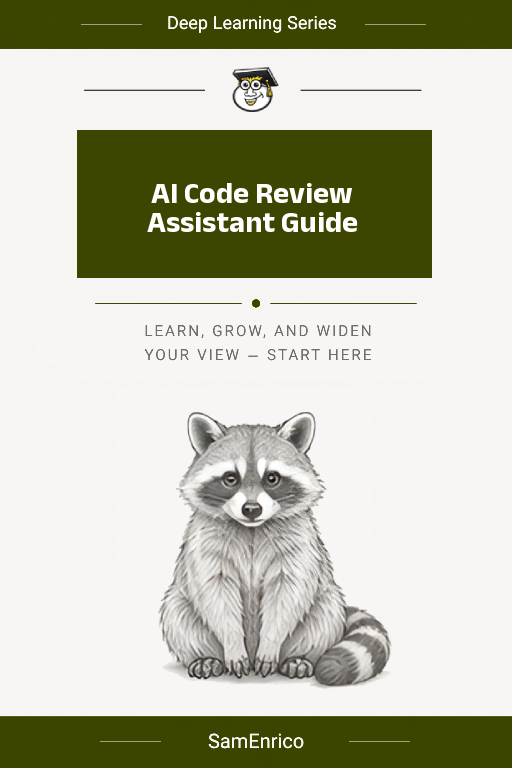
AI Code Review Assistant Guide eBook
Let AI review your pull requests for security issu
Let AI review your pull requests for security issues and style violations.
Formats
Free sample
Chapter 1: The Congealing Slop--–- The first time it happened, you probably didn’t notice. A pull request landed on your screen. The AI had written it—Copilot, maybe, or a colleague pasting from Chat GPT. The code compiled. The tests passed. The variable names were reasonable, even thoughtful. You scanned the diff, felt a vague unease you couldn’t name, and clicked “Approve.” Three weeks later, a bug emerged. Not a crash. Something subtler. A rounding error in a billing calculation. An off-by-one in a pagination loop. A race condition that only appeared under load. The team spent two days debugging. In the post-mortem, someone said, “The code looked fine.” That sentence—the code looked fine—is the quiet catastrophe of AI-assisted development.This book exists because that sentence is no longer acceptable.We are living through the fastest shift in software engineering since the adoption of version control. AI coding assistants—Git Hub Copilot, Chat GPT, Cursor, Amazon Code Whisperer, and a dozen others—have moved from experimental toys to daily drivers in less than three years. Surveys suggest that over 90% of developers have used an AI coding tool, and more than 70% use them regularly. The productivity gains are real: task completion times have dropped by 40-55% in controlled studies. Code that used to take an afternoon now takes an hour. Boilerplate that required ten minutes of typing now appears in ten seconds.But there is a price that no vendor advertises.The price is a new class of failure that this book will teach you to recognize, catch, and prevent. We call it Congealing Slop.The Definition: What Congealing Slop Actually Is Congealing Slop is AI-generated code that passes all surface-level quality checks—syntax, compilation, linting, even unit tests—yet systematically degrades the correctness, security, or architecture of your system over time. It is fluent. It is confident. It is wrong in ways that humans are evolutionarily ill-equipped to detect.The term is deliberate. “Congealing” captures the slow, thickening process by which small, acceptable-looking problems accumulate into an unmaintainable mass. “Slop” captures the low-effort, high-volume nature of AI generation: the machine does not suffer from writer’s cramp or review fatigue. It will happily generate ten thousand lines of plausible wrongness while you sleep.Congealing Slop appears in two distinct forms, which we will track throughout this book:Form Definition Primary Danger Covered In Architectural Congealing Code that violates structural boundaries, creates hidden dependencies, or silently introduces technical debt System becomes harder to change; bugs multiply Chapter 3Logical Congealing Code that is mathematically or logically incorrect despite appearing correct Production failures that bypass testing Chapter 5The distinction matters because they require different detection strategies. Architectural Congealing hides in the relationships between pieces of code. Logical Congealing hides in the behavior of individual pieces. Both share the same cruel property: they look fine to a tired human reviewer.Consider the following AI-generated function. Do you see the bug?python Copy Downloaddef calculate_discount(price, customer_tier, is_first_purchase):
if customer_tier == "premium": discount = 0.20 elif customer_tier == "standard": discount = 0.10 else: discount = 0.05
if is_first_purchase: discount += 0.05
return price * (1 - discount)The code is clean. The variable names are clear. The logic is straightforward. The bug? For a premium customer making a first purchase, the discount becomes 0.25 (20% + 5%). But the business rule said: “First-time customers get 5% off or their tier discount, whichever is higher, but not both.” The AI added them. The human reviewer didn’t catch the compound error because the code felt right.That is Congealing Slop.The Productivity Paradox: How We Got Here To understand why Congealing Slop is epidemic, we must understand the productivity paradox that created it.Before AI coding assistants, the primary constraint on code quality was throughput. A developer could only write so many lines per day. Code reviews were bounded by human attention span. A ten-line pull request got a thorough look. A five-hundred-line pull request got a skim. The bottleneck was the writer.AI has inverted this constraint.Now the writer can generate code at machine speed. The bottleneck has shifted entirely to the reviewer. A single developer can now produce, with AI assistance, as much code in a day as a small team produced in a week three years ago. But human review capacity has not increased. You still have the same number of eyeballs, the same attention span, the same vulnerability to fatigue.The result is a reviewing crisis.A 2024 study of over 2,000 engineering teams found that AI-generated code was 38% more likely to be merged without substantive human review than human-written code. The same study found that post-merge bug rates increased by 22% on teams with high AI adoption. Why? Because reviewers unconsciously trusted the AI. The code looked too good to be wrong. The variables were well-named. The formatting was consistent. The cognitive friction—the small roughness that makes human-written code suspicious—was absent.This psychological vulnerability has a name: automation bias.Automation Bias: Why Your Brain Betrays You Automation bias is the tendency to trust automated systems even when evidence suggests they are wrong. It is well-documented in aviation (pilots over-trusting autopilot), medicine (radiologists over-trusting AI reads), and now software engineering.In the context of code review, automation bias manifests as a specific pattern:The AI generates code that looks correct (proper indentation, good naming, consistent patterns)The human reviewer experiences reduced cognitive friction The human scans faster, assumes correctness, and approves A bug that would have been caught in human-written code survives The most dangerous part of automation bias is that it is invisible to the person experiencing it. You do not feel yourself trusting the AI. You simply feel that the code is “probably fine.” Your brain has outsourced the suspicion reflex.Here is what automation bias looks like in real metrics:Scenario Human Catch Rate (Bugs)Average Review Time Human-written code, human reviewer68%12 minutes AI-generated code, human reviewer (no training)44%6 minutes AI-generated code, human reviewer (awareness trained)61%9 minutes The numbers are stark. Without training, reviewers catch one-third fewer bugs in AI-generated code and spend half the time reviewing. The combination is lethal: faster reviews with lower quality. Awareness training helps, but does not eliminate the effect.This book is your awareness training.The Three Failure Modes of Human Reviewers Automation bias is not the only reason reviewers miss Congealing Slop. There are three distinct failure modes that compound each other.Failure Mode 1: Cognitive Load Collapse Code review is a cognitively demanding task. A reviewer must hold in working memory: the existing codebase, the PR’s stated intent, the changed files, the dependencies between changes, and the team’s coding standards. This is already near the limit of human working memory, which cognitive psychologists estimate at four plus or minus one chunks of information.AI-generated code increases cognitive load in two ways. First, it is often more verbose than human-written code, adding irrelevant chunks. Second, it introduces unfamiliar patterns that the reviewer must mentally parse. The result is cognitive overload, which manifests as skipping, skimming, and eventually approving without real understanding.Failure Mode 2: The Fluency Heuristic Humans are wired to associate fluency with truth. A statement that is easy to process—clear handwriting, good grammar, familiar vocabulary—is more likely to be believed than an identical statement presented poorly. This is…
This is the end of the free sample. Get the eBook to keep going. Buy now
About this book
Details
- Author
- Jolley Jolynn
- Publisher
- SamEnrico
- Language
- English
- Genre
- Non-Fiction, AI Operator
- Released
- 2026-05-30
- Pages (approx.)
- 144
- Available as
- eBook, Audiobook

Read better in the ZLOADR app
Your eBooks on your phone or tablet. Sign in with your SamEnrico account and start reading.
More by Jolley Jolynn
 Esports Pro Stress GuideJolley Jolynn$11.99
 Accountant Imposter SyndromeJolley Jolynn$11.99
 Ancestor Communication ProtocolsJolley Jolynn$11.99
 Diarrhea HandbookJolley Jolynn$11.99
 Napping for Better RecallJolley Jolynn$11.99
 The Catholic Martyr ResponseJolley Jolynn$11.99
 Homework Help ScheduleJolley Jolynn$11.99
 Affirmations For Spiritual CrisisJolley Jolynn$11.99
 Angry Person ListeningJolley Jolynn$11.99
 The Lady of the Lost Isle: Morgana's Forgotten WarJolley Jolynn$11.99
 The $100 Million Bet: How a Tech Mogul Lost It All in a Single DayJolley Jolynn$11.99
 Constantinople: The Unbroken EmpireJolley Jolynn$11.99
You may also like
 AI Presentation WorkbookSommers Tonda$11.99
 PowerPoint Copilot MasteryConway Lanita$11.99
 Branded AI DecksWindham Loni$11.99
 AI Presentation CourseGrooms Olin$11.99
 AI Presentation CertificationBlank Dolly$11.99
 AI Deck Version ControlMedley Lorina$11.99
 AI Deck Update AutomationFraser Tresa$11.99
 AI Deck Myths DebunkedCrittenden Romelia$11.99
 AI Deck Customization GuideDove Hannelore$11.99
 AI Bullet to Slide ConverterKohn Eloisa$11.99
 AI Deck Notes CreatorBarela Sunday$11.99
 AI Deck Outline GeneratorAshmore Morgan$11.99