
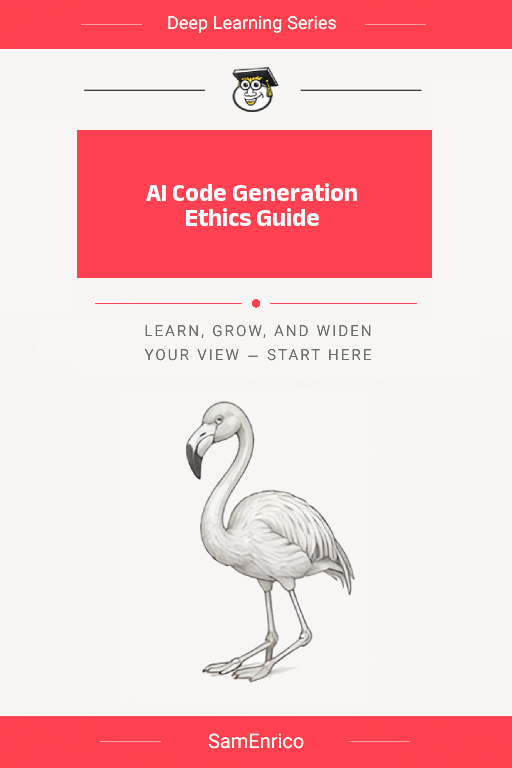
AI Code Generation Ethics Guide eBook
Understand copyright and licensing when using AI-g
Understand copyright and licensing when using AI-generated code.
Formats
Free sample
Chapter 1: The Ghost in the Compiler--Every time a software developer presses the "tab" key to accept a suggestion from Git Hub Copilot, they are making a quiet, unexamined bet. The bet is that the twelve lines of code that just appeared on their screen—elegant, efficient, perhaps even surprising—belong to no one and to everyone simultaneously. The bet is that the AI that generated those lines did not copy them from a copyrighted work, that the original author of that code (if there was one) does not mind, and that no lawyer will ever care. This is a dangerous bet, and most developers are losing it several dozen times per day without even knowing the stakes.The fundamental paradox of AI code generation is this: the outputs look and function exactly like traditional software, but they are created through an entirely novel process—statistical pattern matching, not human reasoning. A human programmer writes code by understanding a problem, designing a solution, and translating that design into syntax.
An AI writes code by analyzing billions of examples of other people's code and predicting the most likely next token given the current context. The human writes from intent; the AI writes from probability. Yet the result—a function that sorts an array, validates an email, or connects to a database—is indistinguishable in form and function.This indistinguishability is the source of the entire legal and ethical crisis explored in this book. Because AI-generated code looks like human-written code, we naturally apply the same legal frameworks: copyright, license compliance, authorship, and attribution. But those frameworks were designed for a world where every line of code had a known origin—a specific programmer typing at a specific keyboard, possibly employed by a specific company, possibly releasing that code under a specific license.
AI shatters that certainty. The code that appears on your screen may be a verbatim copy of a GPL-licensed library from 2015, a statistically unique recombination that has never existed before, or something in between. You cannot tell the difference by looking at it. Neither can the AI.The phrase "ghost in the compiler" is a deliberate double entendre. In computing, a "ghost" is often an unexpected or unexplained phenomenon—a phantom process, a mysterious memory leak, a bug that disappears when you try to debug it.
The AI inside your code generation tool is a ghost in exactly this sense: you cannot see how it works, you cannot audit its internal state, and you cannot predict its outputs with certainty. But "ghost" also carries the meaning of specter or spirit—something that haunts. And for developers who commit AI-generated code without understanding its origins, legal ghosts will indeed come back to haunt them: copyright claimants, license enforcers, and compliance auditors who demand to know where that code really came from.This chapter introduces the technical reality of how AI code generators work, why that reality creates novel legal risks, and why the developer who presses "tab" remains fully responsible for every line of code that results. By the end of this chapter, you will understand why AI is a tool—not an author, not a co-creator, and certainly not a shield against liability—and why the seemingly magical convenience of code generation demands a new level of professional diligence.The Black Box Problem To understand the legal risks of AI-generated code, you must first understand what large language models actually do—and, just as importantly, what they do not do. The most common misconception among developers is that AI coding tools "understand" code in any meaningful sense.
They do not. They are statistical engines trained to predict the next token (roughly, a word or symbol) in a sequence given all previous tokens. When you prompt an AI with "def quicksort(arr):", it does not recall a lesson on divide-and-conquer algorithms. It calculates the probability distribution of all possible next tokens across the billions of code examples it has seen, and it selects the most probable one—typically a newline, then an indentation, then "if len(arr)
This is the end of the free sample. Get the eBook to keep going. Buy now
About this book
Details
- Author
- Simpson Marian
- Publisher
- SamEnrico
- Language
- English
- Genre
- Non-Fiction, AI Operator
- Released
- 2026-05-29
- Pages (approx.)
- 118
- Available as
- eBook, Audiobook

Read better in the ZLOADR app
Your eBooks on your phone or tablet. Sign in with your SamEnrico account and start reading.
More by Simpson Marian
 Tax Qualified LTC Policies GuideSimpson Marian$11.99
 Imposter Negotiation SkillsSimpson Marian$11.99
 Task Sharing Therapy In Poor Nations GuideSimpson Marian$11.99
 Sacred Breathwork Leadership CourseSimpson Marian$11.99
 Morning Breath Awareness RitualSimpson Marian$11.99
 TM Science Research ReviewSimpson Marian$11.99
 Third Party FCPA ViolationsSimpson Marian$11.99
 Parent Time MistakesSimpson Marian$11.99
 Garvey Black StarSimpson Marian$11.99
 Neon Ghosts of the Silk Road: The AI That Rewrote HistorySimpson Marian$11.99
 Frozen Resolve: The 1982 Arctic Air Disaster That Redefined SurvivalSimpson Marian$11.99
 The Roadmakers: Rome’s Triumph of Concrete and EmpireSimpson Marian$11.99
You may also like
 AI Presentation WorkbookSommers Tonda$11.99
 PowerPoint Copilot MasteryConway Lanita$11.99
 Branded AI DecksWindham Loni$11.99
 AI Presentation CourseGrooms Olin$11.99
 AI Presentation CertificationBlank Dolly$11.99
 AI Deck Version ControlMedley Lorina$11.99
 AI Deck Update AutomationFraser Tresa$11.99
 AI Deck Myths DebunkedCrittenden Romelia$11.99
 AI Deck Customization GuideDove Hannelore$11.99
 AI Bullet to Slide ConverterKohn Eloisa$11.99
 AI Deck Notes CreatorBarela Sunday$11.99
 AI Deck Outline GeneratorAshmore Morgan$11.99