
Non-FictionInformativeEducational
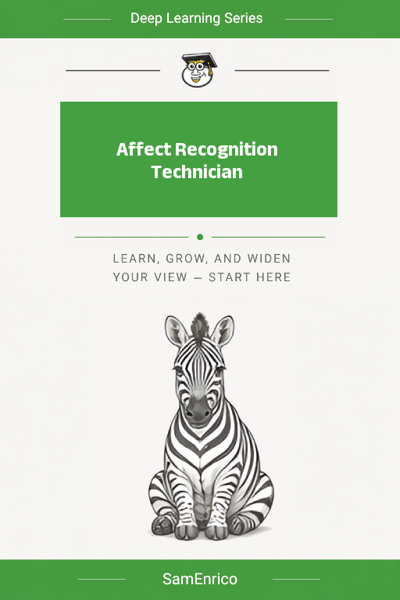
Affect Recognition Technician eBook
A Coursebook on Affect Recognition Technician
by Cloud Arlean
A Coursebook on Affect Recognition Technician
Formats
Free sample
Chapter 1: The Empathy Machine--The first time Priya watched a machine correctly identify a lie by the way a man’s nostrils flared for one-seventh of a second, she realized the world had just become a very different place. She was not an engineer. She was not a psychologist. She was a quality assurance tester for a failing automotive company, and the machine in question was a third-party affect recognition module that her manager wanted to install into the steering wheel of their new electric sedan. The module claimed to detect driver drowsiness, distraction, and emotional distress.
Priya’s job was to break it. Instead, she watched it catch a micro-expression that three human observers had missed, and she felt the floor shift beneath her feet. That was seven years ago. Today, she trains affect recognition technicians at a global certification institute, and she tells every incoming student the same thing: you are not learning to read minds. You are learning to read signals, and signals can be faked, filtered, and misunderstood.
But when they are real, they change everything.This book is not about the philosophy of emotion, though we will touch on philosophy. It is not about the ethics of affective computing, though we will dedicate an entire chapter to ethics because the field is dangerously undertrained in that regard. This book is a coursebook. It is designed to turn a curious reader into a competent affect recognition technician: someone who can select sensors, acquire clean data, process noisy signals, recognize facial action units, analyze vocal prosody, interpret physiological responses, fuse multimodal inputs, validate machine learning models, annotate ground truth, audit for bias, and deploy affective systems that actually help people without harming them. That is a tall order.
Twelve chapters, each with hands-on components, will get you there if you do the work.The Hidden History of Affective Computing Before we talk about how to recognize affect, we need to talk about why anyone ever wanted to build a machine that could do such a thing. The story begins in the late 1980s, when a young MIT researcher named Rosalind Picard became frustrated with computers that seemed willfully blind to the emotional states of their users. You could be furious at a software crash, and the machine would offer you the same cheerful dialog box it offered a relaxed user. You could be terrified while navigating a confusing interface, and the computer would cheerfully repeat the same unhelpful error message. Picard asked a simple question: what if the machine could tell?
What if it could see your frustration and change its behavior? This question launched the field of affective computing, a term she coined in her 1995 paper and solidified in her 1997 book of the same name.But the roots go deeper. Charles Darwin, in 1872, published The Expression of the Emotions in Man and Animals, arguing that facial expressions are not cultural inventions but evolved signals shared across species. A dog bares its teeth in aggression; a human does the same. A chimpanzee raises its brows in surprise; an infant does the same.
Darwin’s insight was radical: emotions are not just feelings. They are communication systems. They evolved because they helped our ancestors survive. A quick expression of fear warns the group. A flash of anger deters a threat.
These expressions happen too fast for conscious control—less than a fifth of a second—which means they leak truth even when the person wants to hide it.Then came Paul Ekman. In the 1960s and 1970s, Ekman traveled to Papua New Guinea to study the Fore people, a tribe isolated from Western culture. He showed them photographs of faces displaying six emotions—anger, disgust, fear, happiness, sadness, surprise—and asked them to match each face to a story. The Fore people performed as accurately as any American or Japanese subject. Ekman had found evidence for universal facial expressions.
Later, he added a seventh emotion: contempt, recognizable by a unilateral lip pull. He also discovered micro-expressions: those lightning-fast facial movements that flash across the face in 1/25 to 1/15 of a second, revealing concealed emotion. These became the basis for lie detection training for the FBI and CIA, and eventually, for machine learning models that could detect micro-expressions at superhuman speed.But universal expressions are only half the story. A smile in Tokyo is not always a smile in Texas. Display rules—cultural norms about when and how to show emotion—modify the universal signal.
Japanese participants in a classic study suppressed negative expressions when an authority figure was present. Americans amplified them. The face said different things, but the body often told the truth: heart rate and skin conductance revealed arousal regardless of what the face showed. This is why affect recognition cannot rely on any single channel. The face lies.
The voice lies. The body lies less, but even physiology can be fooled by exercise, caffeine, or a poorly fitting sensor.The Affect Recognition Technician Defined What exactly is an affect recognition technician? The role did not exist ten years ago. Today, it is a growing profession at the intersection of user experience design, data science, experimental psychology, and hardware engineering. A technician is not a researcher.
You do not need to publish papers on novel algorithms. You are not expected to derive new mathematical models of emotion. Your job is practical: you set up sensors, you collect data, you clean that data, you label it, you run models, you evaluate performance, you find biases, and you deploy systems that work in the real world. You are the bridge between the lab and the product.Let us break down the core responsibilities.Sensor setup and configuration. You need to know which camera to use for facial expression analysis (RGB works in good light, NIR works in darkness, thermal detects stress through facial temperature changes).
You need to know how to place microphones to capture prosody without ambient noise. You need to know how to attach ECG electrodes or PPG sensors to measure heart rate and heart rate variability. You need to know when to use an EDA ring on the finger versus a dry electrode on the wrist. You need to know how to synchronize all these data streams so that a facial expression at second 12.4 aligns with a heart rate change at second 12.7 and a vocal tremor at second 12.9.Data quality assurance. Raw data is garbage.
Sensors drift. Subjects move. Cables create motion artifacts. Lighting changes. A subject scratching their nose produces an EDA spike that looks exactly like an emotional arousal spike.
A subject nodding their head creates electrical noise in facial EMG that mimics a frown. A microphone picking up an air conditioner creates low-frequency rumble that obscures vocal pitch. The technician must see these artifacts, understand their sources, and either filter them out or mark them for exclusion. This is not glamorous work. It is essential work.Annotation and ground truthing.
If you want to train a machine learning model to recognize anger, you need thousands of video clips labeled by humans who agree on what anger looks like. But humans rarely agree. One annotator sees frustration, another sees concentration, a third sees mild anger.…
This is the end of the free sample. Get the eBook to keep going. Buy now
About this book
Details
- Author
- Cloud Arlean
- Publisher
- SamEnrico
- Language
- English
- Genre
- Non-Fiction, Informative, Educational
- Released
- 2026-05-07
- Pages (approx.)
- 148
- Available as
- eBook, Audiobook

Read better in the ZLOADR app
Your eBooks on your phone or tablet. Sign in with your SamEnrico account and start reading.
More by Cloud Arlean
 The Assertiveness for Writers GuideCloud Arlean$11.99
 Difficult Person PracticeCloud Arlean$11.99
 Road Rage And Alcohol UseCloud Arlean$11.99
 Harassment Anger GuideCloud Arlean$11.99
 The Augsburg Confession GuideCloud Arlean$11.99
 Bloodlines of Vukovar: The DNA of a Forgotten SiegeCloud Arlean$11.99
 Understanding Phosphomannoisomerase DeficiencyCloud Arlean$17.99
 Observability Vendor MapCloud Arlean$12.99
 Fiverr Pro VA Sourcing GuideCloud Arlean$12.99
 How to Start a Cabinet Case Made of Wood Business (Beginners Guide)Cloud Arlean$11.99
You may also like
 Hong Kong Handover 1997Dunn Johnnie$11.99
 Zumba For Postnatal Recovery CourseNeal Christian$11.99
 Zumba for BeginnersLadner Nikia$11.99
 YouTube Comment Mining GuideHumes Pandora$12.99
 Worry Box MeditationCarlin Rudy$11.99
 Workplace Stress MeditationNguyen Lynn$11.99
 Workplace Stress and Sleep RepairHawley Ivory$11.99
 Workplace Perfectionism CureDelaney Jeffry$11.99
 Workplace Injustice Anger GuideWallen Isabelle$11.99
 Work Addiction and Burnout LinkGreenwood Ester$11.99
 Women in Yoga and WellnessBeattie Galina$11.99
 Women in Stand Up ComedyChun Evangeline$11.99