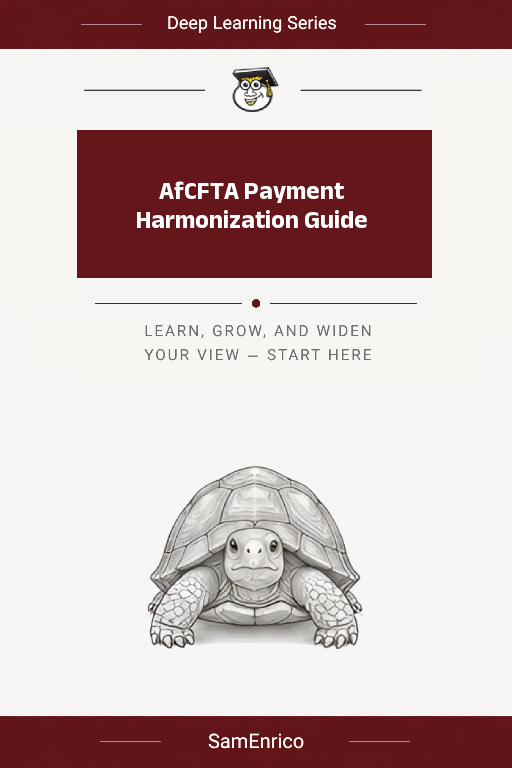
AfCFTA Payment Harmonization Guide
Prepare for African Continental Free Trade Area pa
by Himes Carl
Prepare for African Continental Free Trade Area payment systems. Use Pan African Payment and Settlement System to reduce costs for intra Africa exports.
Formats
About this book
Free sample
Chapter 1: The $5 Billion Leak--Every morning, Amina Okafor reviews her spreadsheets with a ritualistic precision that borders on desperation. As the founder of Lagos-based Okafor Textiles, she has built a business that employs forty-seven people and exports high-quality Ankara fabric to customers across West Africa. Her largest client is a wholesale distributor in Accra, Ghana, who places orders worth approximately $50,000 every month. By any measure, Amina should be thriving. The African Continental Free Trade Area promised to make her journey easier, cheaper, and faster.
Instead, she watches nearly thirty percent of her profit evaporate before the fabric ever crosses the border – not to tariffs, not to shipping costs, not to quality control issues, but to the simple, maddening act of moving money from one African country to another.This is not a story about bad luck or poor management. It is a story about a hidden architecture of extraction that has quietly drained an estimated $5 billion annually from African economies. And it is the story of why the old way of doing business must die.The Hard Currency Bottleneck: A Three-Thousand-Dollar Detour Let us follow Amina’s typical transaction from start to finish. A customer in Accra wants to purchase $10,000 worth of fabric. The customer holds Ghanaian Cedis in a local bank account.
Amina needs to receive Nigerian Naira in her Lagos account. In a rational world, this would be a simple exchange: Cedis to Naira, done. But the world of cross-border payments in Africa is not rational. It is a maze of correspondent banking relationships, hard currency dependencies, and hidden tolls that benefit everyone except the people actually trading.Because the Cedi and the Naira are not directly traded on global currency markets, the transaction must take a detour through a hard currency – almost always the US dollar, sometimes the Euro. The customer’s bank in Accra first converts Cedis to dollars at a spread that typically adds 2-4% to the cost.
Those dollars are then wired through a correspondent bank – usually in New York or London – which charges a fee of 25to25 to 25to50 for the privilege…
This is the end of the free sample. Get the eBook to keep going. Buy now
Contents
- Chapter 1
- Chapter 2
- Chapter 3
- Chapter 4
- Chapter 5
- Chapter 6
- Chapter 7
- Chapter 8
- Chapter 9
- Chapter 10
- Chapter 11
- Chapter 12
Details
- Author
- Himes Carl
- Publisher
- SamEnrico
- Language
- English
- Genre
- Non-Fiction, Business Brief, AfCFTA
- Released
- 2026-06-01
- Pages (approx.)
- 152
- Available as
- eBook, Audiobook

Read better in the ZLOADR app
Your eBooks on your phone or tablet. Sign in with your SamEnrico account and start reading.
More by Himes Carl
 Self Regulation ToolboxHimes Carl$11.99
 Postpartum Babywearing GuideHimes Carl$11.99
 Streaming Media CapitalHimes Carl$11.99
 Sheppard Case Evidence LogHimes Carl$11.99
 The Equestrian Loss GuideHimes Carl$11.99
 IBS Meal Prep CookbookHimes Carl$11.99
 Alcohol Recovery and ConcertsHimes Carl$11.99
 Time Audit And ResetHimes Carl$11.99
 Anger After InfidelityHimes Carl$11.99
 When the Sun Stole the Moon: The Hopi Emergence MythHimes Carl$11.99
 Paws of Justice: The K9 Heroes of 9/11Himes Carl$11.99
 Gilded Shadows: The Secret Life of Marie Antoinette’s PerfumerHimes Carl$11.99