
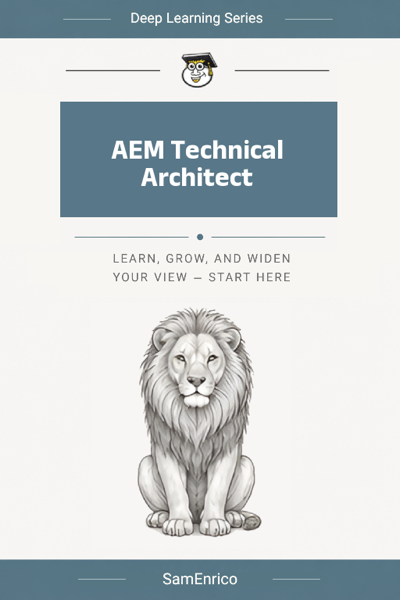
Non-FictionInformativeEducational
AEM Technical Architect eBook
A Coursebook on AEM Technical Architect
by Dick Lizette
A Coursebook on AEM Technical Architect
Formats
Free sample
Chapter 1: The Broken Promise...--The email arrived at 11:47 PM on a Tuesday. "The website is down. Again. Please explain by 9 AM." Fourteen words that would change how one senior developer thought about their entire career. For the past eighteen months, Priya had been the best AEM developer on her team.
She could debug any OSGi bundle, optimize any query, and build components faster than anyone else. But six months ago, she was promoted to Technical Architect. Now the project was two million dollars over budget, the Dispatcher crashed every Tuesday at 2 PM without fail, and the client had just asked for "something like Netflix personalization" due next sprint. The email wasn't just a complaint. It was an indictment.
And it was asking a question Priya suddenly realized she didn't know how to answer: What does an architect actually do when things go wrong?The Great Misunderstanding Most organizations promote their best individual contributors into architectural roles because they don't know what else to do with them. The logic seems sound: this person writes great code, understands the system deeply, and other developers respect them. Surely they will make a great architect. This logic is catastrophically wrong.The skills that make someone an exceptional senior developer — deep technical knowledge, fast implementation speed, ability to debug complex issues — are almost entirely different from the skills required to be an effective architect. A senior developer optimizes for completion.
An architect optimizes for outcome. A senior developer asks "how do I build this feature?" An architect asks "should we build this feature at all, and what will it cost us in two years?" A senior developer's primary output is working code. An architect's primary output is decisions and clarity.Priya learned this distinction the hard way. When she was a developer, she could see her impact daily: features shipped, bugs fixed, users happy. As an architect, her impact became invisible.
She spent hours in meetings, drew diagrams that no one read, and made decisions whose consequences wouldn't appear for months. Worse, she kept falling back into developer mode — jumping into code when things got stressful, solving problems herself instead of leading others to solve them. Every time she did this, she robbed her team of the opportunity to grow and robbed herself of the time needed to do architectural work.The Tuesday 2 PM crashes were a perfect example. Priya spent three weeks diving into the Dispatcher configuration, rewriting cache rules, and tweaking Apache settings. She fixed the crash.
But she never documented her diagnosis process, never trained anyone else on the Dispatcher, and never stepped back to ask why the architecture allowed a single misconfigured cache rule to bring down the entire site. She solved the symptom. She ignored the system. A developer solves problems. An architect redesigns the system so the problems cannot emerge.The Architect's Compass: The Five -Ilities When experienced architects evaluate technical options, they don't ask "which one is more powerful?" or "which one is more modern?" They ask a different set of questions, organized around five quality attributes that serve as a decision-making compass.
These attributes — scalability, maintainability, availability, security, and testability — appear throughout this book. They are the language architects use to translate business needs into technical reality.Scalability asks: as demand increases, can this system grow gracefully? A scalable architecture can handle ten times the traffic without ten times the cost or ten times the complexity. For the Global Bank case study that runs through this book, scalability meant designing an architecture where a flash sale — 50,000 concurrent users — wouldn't crash the site. It also meant ensuring that adding more publish instances actually improved performance, rather than creating new bottlenecks.Maintainability asks: six months from now, when the original developers have moved on, can someone else understand and safely change this system?
Maintainable architecture is boring architecture. It follows conventions, uses standard patterns, and avoids clever tricks that look impressive but confuse everyone else. The most maintainable AEM projects look almost identical to Adobe's reference implementations. The least maintainable projects are filled with custom frameworks that "solve problems" that Core Components already handled.Availability asks: when something breaks — not if, when — what happens to the user? A highly available system fails gracefully.
When the publish instance crashes, users see a cached page rather than an error. When the integration with Salesforce times out, the product page still loads, perhaps with slightly stale data. Availability is about managing expectations. No system is ever 100 percent available. The question is whether users notice when it isn't.Security asks: who can do what to which data under what circumstances?
Security is not a feature to add at the end. It is a constraint woven into every architectural decision. Every time you design a component, you make security choices: does this servlet need to be accessible from the internet? What data does this Sling Model expose? Can an author accidentally publish sensitive information?
Security architecture means answering these questions before writing code, not discovering the answers during a penetration test.Testability asks: can we know, with confidence, that this system works before it reaches production? A testable architecture is one where you can run automated tests quickly and reliably. When testing is hard, teams test less. When teams test less, production breaks. The architecture of an AEM project directly determines whether testing is easy or impossible.
Modular code with clear boundaries is testable. Spaghetti code with hidden dependencies is not.These five attributes form the architect's compass throughout this book. Every technical decision in later chapters — content hierarchy design, component strategy, integration patterns, caching rules — will be evaluated against these criteria. The compass does not give easy answers. It gives the right questions.
Should you extend a Core Component or build a custom one? Extending improves maintainability but might limit scalability. Building custom improves scalability but damages maintainability. The compass makes the trade-off explicit.The Four Roles You Are Not (Anymore)One of the most painful transitions for new architects is letting go of identities that no longer serve them. To become an effective architect, you must stop being four other people.
Not completely — you will still use those skills — but you must stop defining yourself by them.You are no longer the Senior Developer. The senior developer writes the most complex code, fixes the hardest bugs, and knows the system inside and out. Their value is in their individual output. An architect's value is in enabling others' output. When you find yourself thinking "it would be faster if I just wrote this myself," you are acting like a senior developer.
When you instead think "how can I design this so any competent developer can implement it correctly," you are acting like an architect.You are no longer the Tech Lead. The tech lead focuses on sprint-level implementation. They break down stories, assign tasks, and ensure the team meets its commitments. Their horizon is two weeks. An architect's horizon is two years.
When you worry about whether a story will fit in this sprint, you are acting like a tech lead. When you worry about whether the component design will need to be rewritten after the next Adobe release, you are acting like…
This is the end of the free sample. Get the eBook to keep going. Buy now
About this book
Details
- Author
- Dick Lizette
- Publisher
- SamEnrico
- Language
- English
- Genre
- Non-Fiction, Informative, Educational
- Released
- 2026-05-09
- Pages (approx.)
- 133
- Available as
- eBook, Audiobook

Read better in the ZLOADR app
Your eBooks on your phone or tablet. Sign in with your SamEnrico account and start reading.
More by Dick Lizette
 TM During Menopause HandbookDick Lizette$11.99
 School Uniform StruggleDick Lizette$11.99
 The Joy of SolitudeDick Lizette$11.99
 Emotional Intelligence in SportsDick Lizette$11.99
 The Self Esteem and Partner's Mental IllnessDick Lizette$11.99
 The Silent Exodus: A Witness Protection OdysseyDick Lizette$11.99
 How to Start a Music Box Mechanisms Business (Beginners Guide)Dick Lizette$11.99
 Understanding Myhre SyndromeDick Lizette$17.99
 Accounting Formula Memory TriggersDick Lizette$12.99
 Applied Materials SWOTDick Lizette$12.99
You may also like
 Hong Kong Handover 1997Dunn Johnnie$11.99
 Zumba For Postnatal Recovery CourseNeal Christian$11.99
 Zumba for BeginnersLadner Nikia$11.99
 YouTube Comment Mining GuideHumes Pandora$12.99
 Worry Box MeditationCarlin Rudy$11.99
 Workplace Stress MeditationNguyen Lynn$11.99
 Workplace Stress and Sleep RepairHawley Ivory$11.99
 Workplace Perfectionism CureDelaney Jeffry$11.99
 Workplace Injustice Anger GuideWallen Isabelle$11.99
 Work Addiction and Burnout LinkGreenwood Ester$11.99
 Women in Yoga and WellnessBeattie Galina$11.99
 Women in Stand Up ComedyChun Evangeline$11.99