
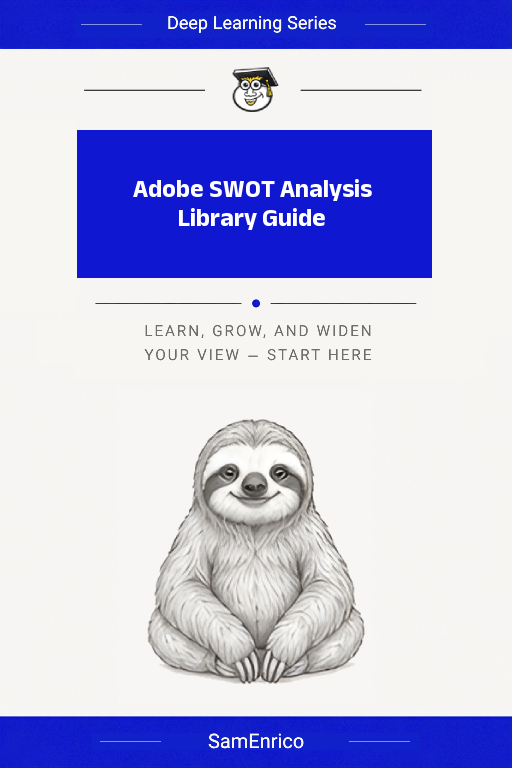
Non-FictionStrategic AtlasDesign Software
Adobe SWOT Analysis Library Guide eBook
Evaluate Creative Cloud subscription model, AI int
Evaluate Creative Cloud subscription model, AI integration (Firefly), Figma deal fallout, and competition.
Formats
Free sample
Chapter 1: The Fish That Swallowed Adobe...--On a cold December morning in 2013, Adobe’s then-CEO Shantanu Narayen stood before a room of skeptical Wall Street analysts and delivered a message that many considered career suicide. He told them that Adobe would no longer sell its flagship Creative Suite software for a one-time fee of up to 2,600.Instead,customerswouldpayamonthlysubscriptionof2,600. Instead, customers would pay a monthly subscription of 2,600.Instead,customerswouldpayamonthlysubscriptionof49.99 for access to the same tools. The room did not applaud. One analyst reportedly asked, “Are you trying to destroy your company?” Another wrote in a note to clients that Adobe had just “torched $3.4 billion in annual revenue with no guarantee anyone would follow.” The stock dropped 15 percent in two weeks.
Employees internally called the plan “Project Quicksilver,” but outsiders had a different name: the suicide pill.This chapter tells the story of that suicide pill—and why it turned out to be the smartest bet Adobe ever made. But the story is not a simple triumph. The decision to kill a profitable legacy business and endure what became known as the “Fish” model of short-term pain for long-term gain reveals something deeper about Adobe’s corporate psychology: a willingness to cannibalize itself before competitors could do the job. That willingness would save the company once. Whether it can save Adobe again, in an era of generative AI and browser-based challengers, is the question that haunts every page of this book.
Because the same courage that made Adobe a subscription empire also made it slow, expensive, and vulnerable to a new generation of disruptors. The fish that swallowed Adobe’s old business model is now being hunted by faster, leaner predators.The Perpetual License Prison To understand why Adobe took such a dramatic risk, you must first understand the prison of perpetual licensing. Before 2013, Adobe sold Creative Suite as a boxed product—first on floppy disks, then CDs, then DVDs, and finally as a digital download. A customer paid once, typically between 1,299and1,299 and 1,299and2,599 depending on the version, and owned that version forever. They could use Photoshop CS5 for ten years without giving Adobe another dollar.
This created a brutal business dynamic that software executives called the “upgrade cycle roller coaster.”Every eighteen to twenty-four months, Adobe would release a new version of Creative Suite with enough new features to convince professionals to upgrade. For six months after launch, revenue soared as designers, agencies, and enterprises opened their wallets. Then, for the next twelve to eighteen months, revenue would crater. Customers who had just upgraded had no reason to buy again. Adobe’s sales force would scramble, offering discounts and bundling deals to squeeze the last drops from a drying well.
Then the cycle would repeat. This was not a business model. It was a gambling addiction dressed in spreadsheets.Worse, Adobe was leaving money on the table. A professional photographer who used only Photoshop and Lightroom had no legal way to buy just those two apps. They had to buy the entire Creative Suite or resort to piracy—and many did.
Adobe estimated that for every legitimate copy of Photoshop in use, there were three pirated copies. In countries like China and Russia, the ratio was closer to ten to one. These pirates were not criminals in the traditional sense; they were students, hobbyists, and freelancers who would pay something—just not $2,600 for software they used twice a month. Adobe’s pricing model had created an entire shadow economy of unpaid users who had no path to becoming paying customers.The third problem was innovation velocity. When you sell perpetual licenses, you cannot push updates frequently.
Customers who paid $2,600 for a box expect that box to work the same way for years. If Adobe pushed a major update six months after release, customers would feel cheated—“I just bought this, and now you want me to pay again?” So Adobe stockpiled features for two years, releasing them in a single, overwhelming bundle that customers either loved or hated. Small, incremental improvements—the kind that make software delightful—were impossible. Every feature had to justify its place in the next billion-dollar upgrade cycle.By 2011, Adobe’s leadership recognized they were trapped. The perpetual license model had built the company, but it was also strangling it.
Revenue volatility made financial planning a nightmare. Piracy had locked them out of emerging markets. And competitors like Sketch (for UI design) and Affinity (for photo editing) were beginning to nibble at Adobe’s edges with cheaper, simpler products. Something had to change.The Boardroom Gamble In late 2011, a small team inside Adobe began working on what would become Project Quicksilver. Their mandate was simple: design a subscription-only future for Creative Suite and figure out how to sell it to a skeptical board.
The team studied Netflix’s transition from DVD rentals to streaming, Salesforce’s born-in-the-cloud subscription model, and even gym memberships—anything that turned a transactional purchase into an ongoing relationship.What they discovered was both encouraging and terrifying. The math worked beautifully if enough customers converted. A perpetual license customer paid 2,600once.Asubscriptioncustomerpaid2,600 once. A subscription customer paid 2,600once.Asubscriptioncustomerpaid600 per year (49.99monthly)forever.Afterfiveyears,thesubscriberwouldhavepaid49.99 monthly) forever. After five years, the subscriber would have paid 49.99monthly)forever.Afterfiveyears,thesubscriberwouldhavepaid3,000—more than the perpetual license.
After ten years, $6,000. The lifetime value of a subscriber was dramatically higher. But the conversion risk was enormous. If only half of Adobe’s existing customers moved to subscription, the company would lose hundreds of millions in the first year alone. If less than a third converted, the company would face bankruptcy.The team modeled every scenario.
They considered a hybrid model—selling both subscriptions and perpetual licenses—but rejected it because customers would simply choose whichever was cheaper in the short term. They considered forcing only new customers into subscriptions while grandfathering existing perpetual users, but that would create two parallel businesses with conflicting incentives. The only clean solution was the most painful: kill perpetual licenses entirely. No exceptions. No hybrid.
No going back.In June 2012, Narayen presented the plan to Adobe’s board. The room was divided. Several directors had built their careers on the perpetual license model; they understood upgrade cycles, channel sales, and boxed software. Subscriptions were foreign territory. One director reportedly asked, “What happens if our customers just leave?” Narayen’s answer became legendary in Silicon Valley: “Then we will have learned faster than our competitors that we built something they didn’t want.” The board approved the plan by a narrow margin, with a condition: Adobe would announce the transition at its next annual MAX conference and give customers a six-month warning before pulling the perpetual license option entirely.The Fish Model Explained The financial community needed a way to visualize what Adobe was attempting.
The company’s CFO, Mark Garrett, introduced a simple but powerful diagram that became known as the “Fish.” Imagine drawing the profile of a fish facing left. The head of the fish represents the first two years after the transition. During this period, revenue drops sharply—the head of the fish slopes downward. Why? Because existing perpetual license customers stop buying upgrades while they decide whether to subscribe.…
This is the end of the free sample. Get the eBook to keep going. Buy now
About this book
Details
- Author
- Urbina Marlena
- Publisher
- SamEnrico
- Language
- English
- Genre
- Non-Fiction, Strategic Atlas, Design Software
- Released
- 2026-05-29
- Pages (approx.)
- 148
- Available as
- eBook, Audiobook

Read better in the ZLOADR app
Your eBooks on your phone or tablet. Sign in with your SamEnrico account and start reading.
More by Urbina Marlena
 Gratitude in RecoveryUrbina Marlena$11.99
 College Application FeeUrbina Marlena$11.99
 Assertive Parenting GuideUrbina Marlena$11.99
 Imposter Syndrome Recovery WorkbookUrbina Marlena$11.99
 Sound Meditation for Beginners GuideUrbina Marlena$11.99
 The Clown’s Last Laugh: How DNA Cracked the Case of the Smiling KillerUrbina Marlena$11.99
 Exam-Ready Accounting FormulasUrbina Marlena$12.99
 Understanding Myoclonus Hereditary Progressive Distal Muscular AtrophyUrbina Marlena$17.99
 Briard BreedingUrbina Marlena$11.99
 How to Become a NickerUrbina Marlena$11.99
You may also like
 Hong Kong Handover 1997Dunn Johnnie$11.99
 Zumba For Postnatal Recovery CourseNeal Christian$11.99
 Zumba for BeginnersLadner Nikia$11.99
 YouTube Comment Mining GuideHumes Pandora$12.99
 Worry Box MeditationCarlin Rudy$11.99
 Workplace Stress MeditationNguyen Lynn$11.99
 Workplace Stress and Sleep RepairHawley Ivory$11.99
 Workplace Perfectionism CureDelaney Jeffry$11.99
 Workplace Injustice Anger GuideWallen Isabelle$11.99
 Work Addiction and Burnout LinkGreenwood Ester$11.99
 Women in Yoga and WellnessBeattie Galina$11.99
 Women in Stand Up ComedyChun Evangeline$11.99