
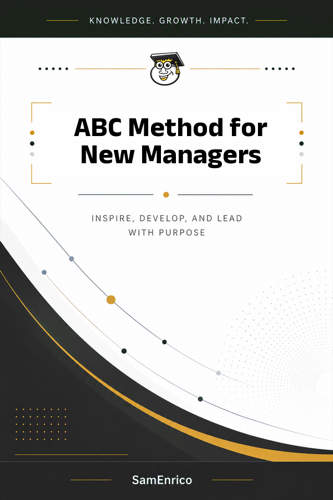
ABC Method for New Managers eBook
Distinguish between your tasks and delegate-able t
Distinguish between your tasks and delegate-able tasks to build team skills.
Formats
Free sample
Chapter 1: The Promotion Paradox--–- The email arrived at 11:17 PM. Sarah, newly promoted to engineering manager at a mid-sized tech firm, had just finished re-formatting a report her team member had submitted earlier that day. She told herself she was being helpful. She told herself it was faster to fix it than to explain the formatting guidelines again. She told herself that’s what good managers do.Her husband had stopped asking when she’d come to bed six months ago.Her team had stopped submitting reports without errors three months ago.
They’d learned that Sarah would fix everything anyway. Why waste an hour on formatting when Sarah would spend ten minutes at 11 PM making it perfect?Her own manager had stopped giving her new opportunities two months ago. Not because Sarah wasn’t capable—she was the most capable person on the team. But because her manager could see what Sarah couldn’t: Sarah was the bottleneck.Sarah was a Super-Doer. And the Super-Doer identity was destroying her career.The Dirty Secret of First-Time Management Here’s something no one tells you before you get promoted: the very skills that earned you the promotion will wreck you as a manager.Attention to detail?
That becomes micromanagement.Technical expertise? That becomes “I’ll just do it myself.”Personal accountability? That becomes taking over instead of coaching.Speed of execution? That becomes The Speed Trap—the false belief that doing the work yourself is faster than teaching someone else.The data is brutal. Gallup’s research, drawn from decades of studying over 2.5 million manager-led teams, reveals that only 18% of managers demonstrate high talent for managing others.
The other 82% are either mediocre or actively destructive to team performance. Think about that. Four out of five managers are failing—not because they’re bad people or unintelligent, but because no one taught them how to make the shift from individual contributor to team multiplier.The “74% problem” makes it worse. Nearly three-quarters of organizations admit they promote people into management with little to no formal preparation or training. The typical promotion conversation sounds like this: “You’re great at your job.
Congratulations, you’re now in charge of people who do your old job. Good luck.” Then the new manager spends the next eighteen months drowning, resenting their team, and wondering why their promotion feels like a punishment.A Mc Kinsey study delivered the killing blow: technical expertise is the number one reason people are promoted into management, yet it has almost no correlation with management success after the first six months. Your ability to write code, close deals, design products, or balance spreadsheets—the skills that got you noticed—become irrelevant the moment you’re responsible for other people doing those things.This chapter is not about making you feel bad. It’s about making you see what you cannot unsee. The first step out of the trap is realizing you’re in one.The Super-Doer Identity: A Portrait of the Overwhelmed Manager The Super-Doer isn’t a personality type you’re born with.
It’s an identity you develop through years of being rewarded for individual excellence. You were the person who could be counted on. The one who stayed late. The one who found the error no one else saw. The one who quietly fixed problems before anyone noticed.Those behaviors earned you praise, bonuses, and eventually a promotion.Now those same behaviors are earning you burnout, resentment, and a disengaged team.The Super-Doer identity has four core beliefs:Belief 1: “If I want it done right, I have to do it myself.” This sounds like high standards.
It’s actually a failure of leadership. If you’re the only person who can do things correctly, you haven’t built a team—you’ve built an audience. Your job as a manager is not to be the best performer. Your job is to raise the performance of everyone.Belief 2: “They’re already busy. I’d feel guilty giving them more work.” This sounds like empathy.
It’s actually a misunderstanding of your role. Your team’s job is to do the work of the team. Your job is to assign that work. If you’re doing their work, they’re underutilized. If they’re underutilized, they’re disengaged.
If they’re disengaged, they’re leaving.Belief 3: “I’m the expert. My value comes from solving problems.” This sounds like humility about your skills. It’s actually identity confusion. Your value as a manager comes from enabling others to solve problems. When you solve every problem yourself, you’re not leading—you’re doing two jobs while your team watches.Belief 4: “I can’t tell the difference between tasks only I can do and tasks I just do well.” This sounds like self-awareness about your capabilities.
It’s actually the central delusion of the Super-Doer. And it’s the delusion this entire book is designed to shatter.The Super-Doer is what leadership expert Liz Wiseman calls a “Diminisher”—someone who drains intelligence, capability, and initiative from the people around them. Diminishers don’t mean to be destructive. They think they’re helping. But the effect is the same: capable people learn to wait, to defer, to do the minimum, because the Diminisher will step in and “fix” everything anyway.If you recognize yourself in any of these beliefs, good.
That’s the first step. The second step is understanding what those beliefs are costing you.The Four Costs of Non-Delegation Every time you choose to do instead of delegate, you pay a price. Not just in time—though time is the most obvious cost—but in four distinct ways that compound over weeks and months until you’re trapped.Cost 1: Personal Burnout The math is unforgiving. If you’re doing tasks that should be delegated, you’re working more hours than necessary. Those hours come from somewhere: evenings, weekends, early mornings, the time you used to spend exercising, the dinner conversations you used to have, the sleep you used to get.The Super-Doer tells herself she’s just “committed.” But commitment doesn’t explain the resentment building beneath the surface.
You start to think your team is lazy. You start to think they don’t care. You start to think, “Why am I the only one who works hard?”Here’s the truth they’re not lazy. They’re learned-helpless. They’ve learned that you’ll do the work, so why should they kill themselves trying?
You trained them to step back. You can’t blame them for following your training.Cost 2: The Bottleneck Effect When you do everything yourself, everything stops at your desk. Team members need approvals that take days. Answers that take hours. Decisions that take weeks.
Work piles up while they wait for you.This isn’t efficiency. It’s the opposite of efficiency. You’ve created a single point of failure in a system that should be distributed. While you’re working 60 hours, your team is working 30—because they can’t move forward without you.The bottleneck effect has a hidden cost: it makes you look bad to your own manager. When work slows down, when deadlines slip, when the team seems sluggish…
This is the end of the free sample. Get the eBook to keep going. Buy now
About this book
Details
- Author
- Grayson Lakeshia
- Publisher
- SamEnrico
- Language
- English
- Genre
- Non-Fiction, Self-Help
- Released
- 2026-06-09
- Pages (approx.)
- 134
- Available as
- eBook, Audiobook

Read better in the ZLOADR app
Your eBooks on your phone or tablet. Sign in with your SamEnrico account and start reading.
More by Grayson Lakeshia
 Breath Meditation For AngerGrayson Lakeshia$11.99
 Five Minute Meditation GuideGrayson Lakeshia$11.99
 Sri Aurobindo Integral YogaGrayson Lakeshia$11.99
 Umbrella Insurance LandlordGrayson Lakeshia$11.99
 Pelvic Floor for Cerebral PalsyGrayson Lakeshia$11.99
 Pomodoro For Nap TimingGrayson Lakeshia$11.99
 Overcoming Being the ScapegoatGrayson Lakeshia$11.99
 Whispers in the Wind: The Ballad of Wind EagleGrayson Lakeshia$11.99
 The Great British Running Heist: Stealing the Olympic DreamGrayson Lakeshia$11.99
 Mastering The Art of Lai Tung Pai Shaolin Style That Mixes Long and Short FistGrayson Lakeshia$11.99
 How to Produce Studio Recording BundlesGrayson Lakeshia$11.99
 How to Become a Stone-lathe OperatorGrayson Lakeshia$11.99
You may also like
 Hong Kong Handover 1997Dunn Johnnie$11.99
 Zumba For Postnatal Recovery CourseNeal Christian$11.99
 Zumba for BeginnersLadner Nikia$11.99
 YouTube Comment Mining GuideHumes Pandora$12.99
 Worry Box MeditationCarlin Rudy$11.99
 Workplace Stress MeditationNguyen Lynn$11.99
 Workplace Stress and Sleep RepairHawley Ivory$11.99
 Workplace Perfectionism CureDelaney Jeffry$11.99
 Workplace Injustice Anger GuideWallen Isabelle$11.99
 Work Addiction and Burnout LinkGreenwood Ester$11.99
 Women in Yoga and WellnessBeattie Galina$11.99
 Women in Stand Up ComedyChun Evangeline$11.99