
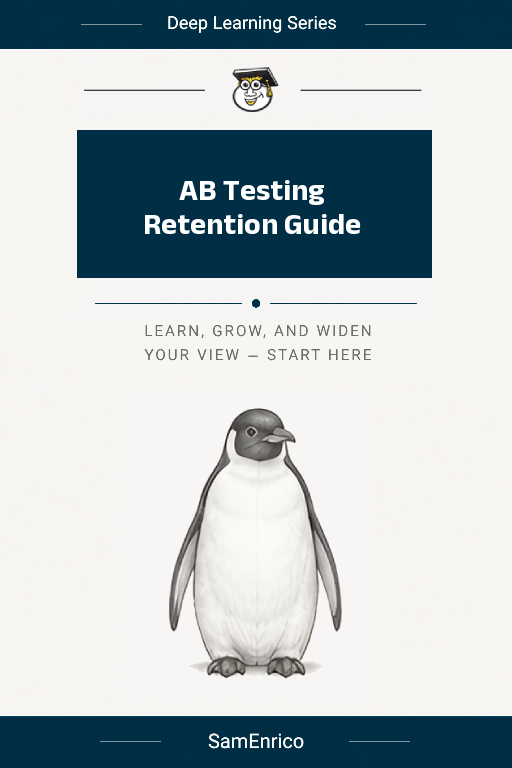
Non-FictionStrategic AtlasAB Testing
AB Testing Retention Guide eBook
Analyzes how top performers run A/B tests for rete
by Lash Noe
Analyzes how top performers run A/B tests for retention including onboarding variants, email cadence, and offer testing.
Formats
Free sample
Chapter 1: The Two Speeds--–- Sam was six months into her role as Head of Growth at a mid-sized Saa S company when she realized something wasn't adding up. Her team had run fourteen A/B tests that quarter. Fourteen. Each one meticulously designed, statistically rigorous, and blessed by the data science team. Each one took between four and six weeks to reach significance.
And each one, win or lose, felt like it arrived three months too late.The winning tests got implemented. The losing tests got archived. And the company's retention curve? It hadn't budged in eighteen months.Sam's story is not unusual. It is, in fact, the default state of most retention teams.
They are trapped in what I call the "single-speed fallacy" – the belief that there is one correct speed for experimentation, and that speed is "as rigorous as possible."This chapter dismantles that fallacy. It introduces the two-speed framework that separates top 1% retention teams from the 99% who are spinning their wheels. You will learn why speed alone is dangerous, why rigor alone is paralyzing, and how the most successful companies run two parallel testing tracks that together produce more learning in one quarter than most teams produce in a year.But first, we need to understand how most teams fail.The Graveyard of Perfect Tests Let me describe a scene that plays out in thousands of companies every week.A product manager named Alex has a hypothesis: simplifying the onboarding flow will improve retention. Alex writes a meticulous test plan. The data team validates the sample size calculation – they need 10,000 users per variant to reach statistical significance at 90% power.
Engineering implements the variant. QA signs off. The test launches.Four weeks later, Alex checks the results. The variant is flat. No significant difference.
Alex shrugs, archives the test, and moves on to the next hypothesis.Here is what Alex missed. During those four weeks, the competitive landscape shifted. A competitor launched a feature that made Alex's onboarding question irrelevant. The company's pricing changed. A major bug affected a subset of users.
The marketing team shifted acquisition channels. By the time the test reached significance, the question it was asking was no longer the right question.This is the graveyard of perfect tests. They are statistically pristine and commercially worthless.The single-speed fallacy assumes that the world stands still while you run your experiment. It does not. User behavior drifts.
Competitors move. Your own product changes. A four-week test is not measuring a static truth – it is measuring a moving target. By the time you have confidence in your answer, the question has changed.But the opposite extreme is equally dangerous.The Graveyard of Reckless Speed Now let me describe a different scene.A startup founder named Jamie demands velocity. "We need to run ten tests this week," Jamie announces on Monday morning.
The team scrambles. They throw together variants without proper tracking. They skip QA. They launch to 50% of users because "we'll see the signal fast."By Friday, they have results. Variant C won!
It produced a 15% lift in signups. The team celebrates, implements Variant C for everyone, and moves on.Three weeks later, Jamie notices that retention has dropped 22%. The 15% lift in signups was real – but those users were low-quality, signing up by accident (a misclick on a too-large button) or out of curiosity (a misleading headline). They churned within days. The "win" was a loss.This is the graveyard of reckless speed.
It prioritizes velocity over validity. It confuses short-term proxy metrics (signups, clicks, opens) with long-term outcomes (retention, lifetime value). And it produces a graveyard of "wins" that quietly destroy your business.The single-speed fallacy has two faces. One says "slow is safe." The other says "fast is smart." Both are wrong.The Two-Speed Framework Top performers reject the single-speed fallacy. They run two parallel testing tracks, each with its own purpose, duration, metrics, and decision rules.Tier 1: Discovery Tests Purpose: Generate hypotheses quickly.
Learn what moves the needle on proxy metrics. Fail fast, learn faster.Duration: 7 days (sometimes 3–5 days for high-traffic products).Sample size: Whatever you can get in 7 days – even if not "statistically significant" by academic standards.Metrics: Proxy metrics – Day 7 retention, completion rate, time-on-task, click-through rate. Not long-term retention.Decision rule: p < 0.10 is acceptable. More importantly: qualitative signal matters as much as quantitative. If the lift is 8% but the qualitative data (session replays, surveys) suggests confusion, the test is a "maybe," not a winner.Velocity: 50+ tests per year per full-time experimenter.Tier 2: Validation Tests Purpose: Confirm that Tier 1 winners produce lasting, meaningful retention improvement.Duration: 90 days (or two full customer lifecycles, whichever is longer).Sample size: Statistically significant for Day 30 and Day 90 retention metrics.Metrics: True retention metrics – Cumulative Retention Rate at Day 30 and Day 90, Churn Hazard Rate, Lifetime Value.Decision rule: p < 0.05.
Replicate the result twice before full rollout.Velocity: 4–6 tests per year per company (not per person).The Promotion Protocol A Tier 1 winner becomes a candidate for Tier 2 validation only if it meets three criteria:Statistical signal: p < 0.10 on a proxy metric, with a lift of at least 5% (lower lifts rarely survive Tier 2).No negative secondary signals: The variant did not decrease other proxy metrics (e.g., higher signups but lower email open rates).Qualitative sanity check: Session replays and micro-surveys confirm that users understood the variant and did not engage accidentally.Most Tier 1 winners – perhaps 80% – will fail Tier 2 validation. This is not a failure. This is the system working. The 20% that survive become permanent changes that compound over time.Why Two Speeds?The two-speed framework solves three problems that plague single-speed teams.Problem 1: The Sample Size Trap Most teams calculate sample size based on their desired statistical power and their expected lift. For a typical Saa S company expecting a 5% lift in Day 30 retention, the required sample size might be 50,000 users per variant.
If you acquire 10,000 new users per month, that test will take five months to reach significance.Five months.By the time you have an answer, your product, your pricing, and your competitive landscape have all changed. The test is obsolete before it concludes.The two-speed framework bypasses this trap. Tier 1 uses proxy metrics and shorter durations, requiring much smaller sample sizes. A 7-day test on Day 7 retention might need only 5,000 users per variant – achievable in days, not months. Tier 2 accepts longer durations because it runs only on the most promising variants.Problem 2: The Novelty Effect New features and onboarding flows often get a temporary boost simply because they are new.
Users click more, explore more, and convert more – for about 14 days. Then the novelty wears off, and the variant performs the same as (or worse than) the control.A 90-day Tier 2 test captures this decay. A 7-day Tier 1 test does not. This is intentional. Tier 1 is for discovery – it identifies candidates.
Tier 2 is for validation – it separates durable wins from novelty-driven false positives.Problem 3: The Paralysis of Perfection When every test must be perfect, you run fewer tests. When you run fewer tests, you learn less. When you learn less, your retention stagnates.The two-speed framework creates psychological safety for imperfection. Tier 1 tests are allowed to be messy. They can have small…
This is the end of the free sample. Get the eBook to keep going. Buy now
About this book
Details
- Author
- Lash Noe
- Publisher
- SamEnrico
- Language
- English
- Genre
- Non-Fiction, Strategic Atlas, AB Testing
- Released
- 2026-05-29
- Pages (approx.)
- 137
- Available as
- eBook, Audiobook

Read better in the ZLOADR app
Your eBooks on your phone or tablet. Sign in with your SamEnrico account and start reading.
More by Lash Noe
 Validating Difficult EmotionsLash Noe$11.99
 4x4 HIIT Norwegian ProtocolLash Noe$11.99
 The Peasant Revolt GuideLash Noe$11.99
 The Step Parent Anger GuideLash Noe$11.99
 Twelve Step Literature GuideLash Noe$11.99
 The Siege of Chittorgarh: Rajput Blood and Fire (1567-1568)Lash Noe$11.99
 The Breeder's Guide to Lincoln SheepLash Noe$11.99
 Japanese Bunching Onion HarvestingLash Noe$11.99
 Build Media List FreeLash Noe$12.99
 How to Start a Blown Glass Business (Beginners Guide)Lash Noe$11.99
You may also like
 Hong Kong Handover 1997Dunn Johnnie$11.99
 Zumba For Postnatal Recovery CourseNeal Christian$11.99
 Zumba for BeginnersLadner Nikia$11.99
 YouTube Comment Mining GuideHumes Pandora$12.99
 Worry Box MeditationCarlin Rudy$11.99
 Workplace Stress MeditationNguyen Lynn$11.99
 Workplace Stress and Sleep RepairHawley Ivory$11.99
 Workplace Perfectionism CureDelaney Jeffry$11.99
 Workplace Injustice Anger GuideWallen Isabelle$11.99
 Work Addiction and Burnout LinkGreenwood Ester$11.99
 Women in Yoga and WellnessBeattie Galina$11.99
 Women in Stand Up ComedyChun Evangeline$11.99