
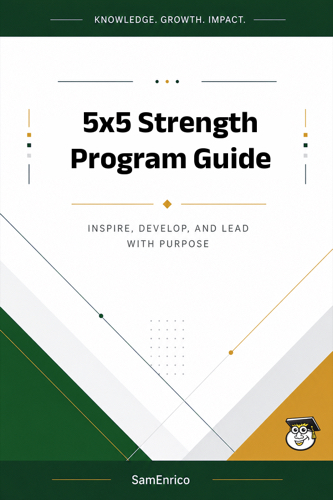
5x5 Strength Program Guide eBook
Execute the classic 5x5 program for rapid strength
Execute the classic 5x5 program for rapid strength gains in squat bench and deadlift.
Formats
Free sample
Chapter 1: The Day I Quit the Pec Deck--–- The first time I truly failed at strength, I wasn't even lifting heavy.I was twenty-seven years old, sitting on a padded machine in a commercial gym that smelled like stale sweat and overpriced protein shakes. The machine was called a "pec deck." You sit down, press your elbows against these padded levers, and squeeze them together in front of your chest. The movement isolates your pectoral muscles, or so the diagram on the side promised. I had just finished my fourth set of twelve reps. I was breathing hard.
My chest had that satisfying pump—that tight, swollen feeling that bodybuilding magazines told me meant I was growing.I looked in the mirror. I still looked exactly the same as I had six months ago.My name is Marcus Reid, and for six years, I was the king of doing everything right and going absolutely nowhere. I followed the routines from the magazines. I did the "chest day" and the "back day" and the "arm day" that every online influencer swore was the secret to transformation. I counted my protein grams.
I forced down chalky shakes. I showed up four, sometimes five days a week, and I ground through my sets with the grim determination of someone who believed that suffering was the same thing as progress.And after six years, I could barely squat two hundred pounds.Let me be more specific, because honesty matters here. On my best day, with my best form, after a perfect warm-up and a full night of sleep, I could squat one hundred ninety-five pounds for a single set of five reps. My bench press was stuck at one hundred sixty-five. My deadlift?
I didn't deadlift. I was told deadlifts were "dangerous" and "not for beginners" and "easy to mess up." So I did leg presses instead. Lots of leg presses. Twelve reps at a time, three or four sets, with a weight that made me feel strong but never actually made me stronger.I was the perfect example of a common tragedy: I was working harder than I needed to, on the wrong things, with no real understanding of why any of it worked.Frank saved me. Frank was the sixty-three-year-old janitor at that gym.
He mopped floors and emptied trash cans and wore a faded t-shirt that said "USAPL Masters Nationals 1989." I had seen him a hundred times and never once asked what that shirt meant. To me, he was just the old guy who cleaned up after people like me. I assumed he had always been the old guy who cleaned up. I assumed he had never been anything else.One night I was grinding through my fourth accessory exercise—some cable crossover nonsense that made me look busy without accomplishing anything—and Frank was mopping the floor behind me. He stopped.
He leaned on his mop. He watched me for a full minute without saying a word.Then he said something I have never forgotten."You ever gonna lift something heavy, son? Or you just gonna keep playing with the cables until your membership runs out?"I was offended. I was also, somewhere deep down, desperate to prove him wrong. So I asked him what he meant.Frank put down the mop.
He walked over to the squat rack—the one I had always been too intimidated to use—and pointed at the barbell. "Five sets of five reps," he said. "Squat, bench, deadlift. That's it. Three days a week.
Add five pounds every time you finish all your sets. Do that for three months, and you'll add a hundred pounds to your squat. Or keep doing what you're doing and stay exactly where you are."I laughed. I thought he was oversimplifying. I thought there had to be more to it—more exercises, more volume, more complexity.
That's what the industry had taught me. That more was always better. That if a routine wasn't complicated, it couldn't possibly work.Frank looked at me with the patience of someone who had seen a thousand young men make the same mistake. "You don't need a better program," he said. "You need to do the simple program harder than anyone else."That conversation changed my life.The Myth of More Here is what I learned over the next twelve months, and what I have since taught to over twelve hundred clients: the fitness industry has built an empire on convincing you that you need complexity.
You need different exercises for different "angles." You need "muscle confusion" to keep your body guessing. You need periodization schemes and metabolic conditioning and accessory work for your accessory work.It is almost all garbage.The scientific literature on strength training is remarkably consistent on one point: the most efficient way to get stronger is to perform compound, multi-joint movements in the low-to-moderate rep range, with progressive overload as the primary driver of adaptation. That's not my opinion. That is the conclusion of decades of research from labs at the University of Connecticut, the University of Nebraska, the Karolinska Institute in Sweden, and countless others.Let me translate that from academic language into something useful: if you want to get strong, you need to do a small number of exercises that work a large number of muscles at the same time. You need to do them for five sets of five reps.
And you need to add a little bit of weight every time you succeed.That is the 5x5 method. It is not new. It is not sexy. It does not have a mobile app with gamification and social sharing features. It is, in fact, almost boring in its simplicity.And that is exactly why it works.The 5x5 method was popularized in the 1960s by a bodybuilder named Reg Park, who used it to become the first person to bench press five hundred pounds.
It was later championed by Bill Starr, a strength coach who wrote the book "The Strongest Shall Survive" and trained some of the most powerful athletes of his generation. In the early 2000s, a lifter named Mehdi Hadim turned it into an online program called Strong Lifts, which has been downloaded millions of times.The method has survived for over sixty years because it works for almost everyone. The absolute beginner who has never touched a barbell. The intermediate lifter who has been spinning their wheels on "bro splits" for years. The returning athlete who used to be strong and wants to get back there.
The busy parent who has forty-five minutes, three days a week, and needs maximum return on minimum time investment.I have taken all of those people through this program. The youngest was sixteen. The oldest was sixty-eight. The weakest was a man who couldn't squat the empty barbell (forty-five pounds) without losing his balance. The strongest was a former Division One linebacker who wanted to rebuild after a back injury.Every single one of them got stronger.The Three Pillars of 5x5 Strength Before we go any further, I want to give you a framework that will organize everything in this book.
I call it the Three Pillars of 5x5 Strength. Every principle, every rule, every workout in this program rests on…
This is the end of the free sample. Get the eBook to keep going. Buy now
About this book
Details
- Author
- Peebles Cierra
- Publisher
- SamEnrico
- Language
- English
- Genre
- Non-Fiction, Health & Wellness, Popular Programs
- Released
- 2026-06-06
- Pages (approx.)
- 135
- Available as
- eBook, Audiobook

Read better in the ZLOADR app
Your eBooks on your phone or tablet. Sign in with your SamEnrico account and start reading.
More by Peebles Cierra
 The Wandering Mind WorkbookPeebles Cierra$11.99
 Twelve Step Promises GuidePeebles Cierra$11.99
 Roseburia Species GuidePeebles Cierra$11.99
 The Nun Who Fought PiratesPeebles Cierra$11.99
 Assertiveness ScriptbookPeebles Cierra$11.99
 Growing Up in a CarPeebles Cierra$11.99
 Telling Friends and FamilyPeebles Cierra$11.99
 Etsy Vintage Compulsion GuidePeebles Cierra$11.99
 The Velvet Underground: How a Band Built a Counterculture EmpirePeebles Cierra$11.99
 The Lost World of Borneo: Tom Harrisson and the Sarawak Museum Expedition (1947-1966)Peebles Cierra$11.99
 The Unseen Hands: How a Billionaire’s Secret Foundation Reshaped a NationPeebles Cierra$11.99
 Video Production for ProfessionalsPeebles Cierra$11.99