
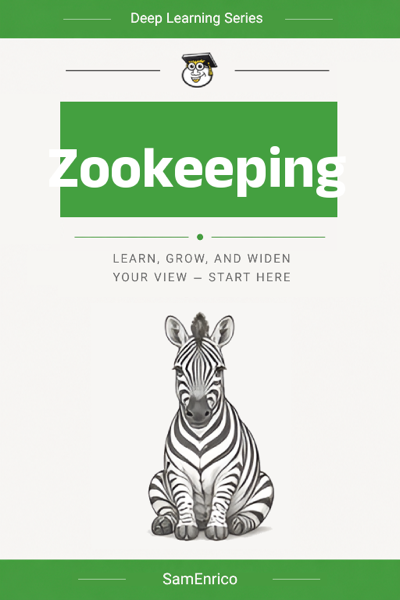
Non-FictionInformativeEducational
Zookeeping eBook
A Coursebook on Zookeeping
by Dunlap Lenna
A Coursebook on Zookeeping
Formats
Free sample
Chapter 1: First Blood...--–- The first time I got bit, I deserved it. The second time, I didn't. The third time saved my career. That is not the kind of thing you read in a zookeeping textbook, but it is the kind of thing that every zookeeper understands. We do not talk about the blood often enough.
We talk about conservation, about enrichment, about the sacred trust of caring for wild things. All of that is true. But beneath it, underneath the mission statements and the AZA certifications, there is a simpler truth: you cannot love an animal into cooperation. You cannot gentle a 400-pound cat with good intentions. And if you show up to this profession thinking that your affection for animals is your primary qualification, you will get hurt.
Worse, you will hurt the animals.This is a book about zookeeping. But this chapter is about something more fundamental: the difference between loving animals and serving them. I learned that difference in a lion house in 1985, three weeks into my first job, and I have been learning it ever since.The Lion House, 1985I was twenty-two years old, fresh out of a biology degree, and convinced that I was destined to save the world's large carnivores. The zoo was not a good zoo by today's standards. It was the kind of place where the lion exhibit had concrete floors and iron bars, where the public could throw popcorn into the enclosures, where the word "enrichment" meant throwing a raw chicken into the cage on Fridays instead of Tuesdays.
I did not know any of this at the time. I knew only that I had been hired as a junior keeper in the carnivore section, and that I was about to work with lions, and that I had never been happier.My mentor was a man named Red, short for Redmond, who had been keeping animals since before I was born. Red was sixty-three years old, missing the tip of his left index finger, and carried a limp from a zebra kick that had shattered his kneecap in 1972. He did not talk about animal welfare. He talked about respect.
"You can love a lion all you want," he told me on my first day, "but that lion does not love you back. That lion tolerates you. And the moment you forget that, the moment you start thinking you have a relationship instead of a working arrangement, that lion will remind you who is wild and who is not."I nodded as if I understood. I did not understand.The lion was named Sundance. He was a thirteen-year-old male, born in captivity, bottle-raised by humans, and supposedly "tame." I put that word in quotes because no lion is tame.
Sundance was habituated. He knew that humans brought food. He knew that certain humans in certain uniforms were not threats. But habituated is not domesticated, and domesticated is not safe, and every person who has ever been killed by a captive lion learned this distinction too late.Red assigned me to clean Sundance's enclosure. The protocol was simple: shift Sundance into the off-exhibit holding area using a sliding metal door, lock the door, check the lock twice, then enter the exhibit to scrub the concrete and remove waste.
I had watched Red do this three times. It looked easy.On my fourth day, I shifted Sundance into holding, locked the door, and walked into the exhibit. The door was not locked.I do not know how I made the mistake. I had checked once, not twice. I had been distracted by a visitor who asked me a question about the lions' ages.
I had assumed that Red had already done the second check. The reasons do not matter. What matters is that I was kneeling on the concrete, scraping dried meat residue off the floor, when I heard the holding door slide open behind me.I turned around. Sundance was standing twelve feet away, looking at me with the flat, assessing gaze of an animal that has not decided what to do yet. He was not aggressive.
He was not curious. He was simply present, in a space where I was not supposed to be present with him, and now we both had to figure out what happened next.The Physiology of Fear What happened next is burned into my memory. I did not run. I did not scream. I froze.
Not because I was brave—I froze because my brain stopped working. Later, when I studied the physiology of stress for this book (you will find a detailed discussion of acute versus chronic stress in Chapter 5, and an introduction to the Thriving Audit in Chapter 3), I learned what happened inside my body that day.Acute stress triggers the release of catecholamines—adrenaline and noradrenaline. Your heart rate spikes. Your blood vessels constrict. Your pupils dilate.
Your body prepares to fight or flee. But in extreme cases, when the threat is too close and too sudden, the parasympathetic nervous system can override that response. Some people faint. Some people freeze. Some people, like me, simply stop moving and wait for the animal to decide.Sundance walked toward me.
Not fast. Not slow. He walked like a cat walking across a living room, except that the living room was a concrete box and the cat was 450 pounds of muscle and teeth. He stopped when his nose was eighteen inches from my face. I could smell his breath—warm, meaty, slightly sour.
I could see the individual hairs on his muzzle. I could see the small scar on his left ear from a fight with his brother years earlier. I was close enough to touch him.He exhaled. I felt the air move across my face. Then he turned, walked back to the holding area, and lay down on his concrete slab as if nothing had happened.I crawled to the door on my hands and knees.
My legs would not support me. I locked the door—checked it twice, then three times—and sat in the keeper corridor hyperventilating for what felt like an hour. It was probably three minutes. Red found me there."You learned something today," he said. He did not ask what happened.
He already knew."I almost died," I said."No," Red said. "You almost got yourself killed. There's a difference. Dying is something that happens to you. Getting killed is something you participate in.
And you participated today by not checking that lock twice."The Four Pillars That day taught me the first of the four pillars that will appear throughout this book: safety. Not safety as a checklist, but safety as a mindset. Red used to say that safety is the only pillar that cannot be compromised for any other goal. You cannot save a species if you are dead. You cannot educate the public if you are in the hospital.
You cannot practice good stewardship if you are afraid to enter the enclosure because you have not built the right protocols.The other three pillars—science, storytelling, and stewardship—emerged in the years that followed. But safety came first. Safety came with a lion's breath on my…
This is the end of the free sample. Get the eBook to keep going. Buy now
About this book
Details
- Author
- Dunlap Lenna
- Publisher
- SamEnrico
- Language
- English
- Genre
- Non-Fiction, Informative, Educational
- Released
- 2026-06-02
- Pages (approx.)
- 131
- Available as
- eBook, Audiobook

Read better in the ZLOADR app
Your eBooks on your phone or tablet. Sign in with your SamEnrico account and start reading.
More by Dunlap Lenna
 Boundaries at Work GuideDunlap Lenna$11.99
 Cultivating A Learner IdentityDunlap Lenna$11.99
 Values And Mission Alignment Decision Making Framework HandbookDunlap Lenna$11.99
 Forgiveness Without ReconciliationDunlap Lenna$11.99
 The Menopause Melatonin GuideDunlap Lenna$11.99
 The Kushite Plaguebreakers: Ancient Africa's Medical PioneersDunlap Lenna$11.99
 Remote Business Plan Research GuideDunlap Lenna$12.99
 Scalable Business PlanDunlap Lenna$12.99
 Understanding Tremor Hereditary EssentialDunlap Lenna$17.99
 How to Start a Dough Dividers Business (Beginners Guide)Dunlap Lenna$11.99
You may also like
 Hong Kong Handover 1997Dunn Johnnie$11.99
 Zumba For Postnatal Recovery CourseNeal Christian$11.99
 Zumba for BeginnersLadner Nikia$11.99
 YouTube Comment Mining GuideHumes Pandora$12.99
 Worry Box MeditationCarlin Rudy$11.99
 Workplace Stress MeditationNguyen Lynn$11.99
 Workplace Stress and Sleep RepairHawley Ivory$11.99
 Workplace Perfectionism CureDelaney Jeffry$11.99
 Workplace Injustice Anger GuideWallen Isabelle$11.99
 Work Addiction and Burnout LinkGreenwood Ester$11.99
 Women in Yoga and WellnessBeattie Galina$11.99
 Women in Stand Up ComedyChun Evangeline$11.99