
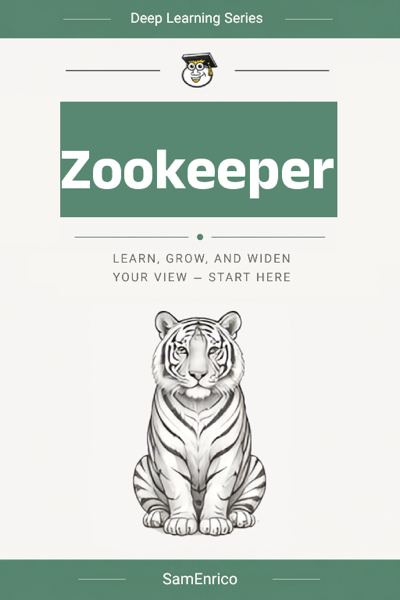
Non-FictionInformativeEducational
Zookeeper eBook
A Coursebook on Zookeeper
A Coursebook on Zookeeper
Formats
Free sample
Chapter 1: The Concrete Grave...--–- The polar bear had worn a perfect circle into the concrete. Seventeen feet in diameter, three inches deep, stained dark with urine and the gray-black grime of twenty-two years of pacing. The bear—her name was Nora, though no visitor ever bothered to learn it—moved in a figure-eight pattern, head swinging, mouth slightly open, tongue flicking in and out like a snake's. She had done this for so long that her footpads had cracked and calloused into something resembling weathered leather. Her fur, which should have been white shot with gold, was yellowed and bald in patches where she rubbed against the same seam in the concrete wall, day after day, year after year.I was nineteen years old, three weeks into my first zookeeping job at a roadside facility that called itself a "wildlife sanctuary" but was, in truth, a concrete graveyard.
I had taken the job because I loved animals—that naive, undifferentiated love that every aspiring keeper starts with, the kind that says "I just want to be near them" without understanding what "near them" actually means. I had volunteered at a humane society, raised orphaned squirrels in my dorm room, watched every nature documentary ever made. I thought I knew.I knew nothing.The polar bear's enclosure was two thousand square feet of grey concrete, a moat of murky green water that hadn't been cleaned in memory, and a single metal door behind which Nora disappeared every night into a holding cell so small she couldn't turn around without touching three walls. The USDA inspector had cited the facility for the enclosure size seven times in the past decade. The citations were always answered with a letter promising changes.
The changes never came.In my third week, the senior keeper—a man named Dale who had worked there since the Nixon administration and smelled perpetually of cigarette smoke and sardines—handed me a bucket of thawed herring and said, "Go feed the polar bear."I asked, "How do I get into the enclosure?"Dale laughed. It was a dry, rattling sound, like gravel being shaken in a can. "You don't, kid. Nobody goes in with Nora. She'd take your arm off.
Just dump the fish through that hatch." He pointed to a metal flap at the base of the enclosure wall. "And don't make eye contact. She hates eye contact."I fed Nora through the hatch for three weeks before I saw her change. It happened on a Tuesday, mid-afternoon, when a tour bus full of elementary school children pulled into the gravel parking lot. The children pressed their faces against the chain-link fence and screamed—not in fear or wonder, but the way children scream at anything: "Look, a bear!
A real bear! She's so big! Why is she walking in circles? Hey, bear! HEY, BEAR!"Nora stopped pacing.She turned her head toward the fence, and I saw something I had never seen in a captive animal before: she was counting them.
Her head moved slowly, deliberately, tracking each child's movement along the fence line. Her eyes were not the blank, exhausted eyes I had grown accustomed to. They were focused. Calculating. And for the first time, I understood that Nora was not a broken animal.
She was a prisoner, and she knew it, and she was doing the math on the distance between herself and those small, screaming, exposed throats on the other side of the fence.I quit that night. Not heroically—I didn't walk out mid-shift or deliver a speech about animal welfare. I finished my shift, drove home, sat in my car for an hour, and then called my mother and told her I needed to come back to her house. I never went back to the concrete graveyard.But I also never stopped thinking about Nora. And six months later, after a brutal rejection from a real zoo (they required a bachelor's degree, two years of experience, and a letter of recommendation from a veterinarian—none of which I had), I found myself enrolled in a community college biology program, taking night classes while working as a kennel assistant at a veterinary clinic.
I was determined to do this right. I was determined to understand how we had gotten to a place where a polar bear could spend twenty-two years walking in circles on concrete because humans couldn't be bothered to care properly.This book is the result of that determination, combined with fifteen years of zookeeping experience at three AZA-accredited institutions, a master's degree in zoo biology, and the painful, humbling recognition that I was not the hero of Nora's story. If anything, I was part of the system that failed her—a system that, for most of its history, treated animals as exhibits rather than individuals, as collections rather than lives.But the system changed. Not quickly, not easily, and not completely. But it changed because people—keepers, curators, veterinarians, activists, and yes, even visitors—demanded that it change.
This chapter is about that history. It is about how we got from the menageries of European kings to the concrete pits of the mid-twentieth century to the naturalistic, conservation-driven zoos of today. And it is about you—whether you are an aspiring keeper, a student, or simply someone who has ever stood at a zoo enclosure and wondered, "Is this animal happy?"—and your role in the next chapter of that history.The Menagerie Mindset: Animals as Currency To understand the modern zookeeper, you must first understand the zoo's original sin: the belief that animals exist for human entertainment, and that their capture, confinement, and display require no moral justification beyond human curiosity.The first zoos were not zoos at all but menageries—private collections of exotic animals owned by royalty and the ultra-wealthy. The earliest recorded menagerie dates to approximately 2500 BCE in Egypt, where pharaohs kept hippos, elephants, and giraffes as symbols of their dominion over the natural world. The Assyrian king Ashurnasirpal II (884–859 BCE) boasted of collecting "all the beasts of the field and the birds of the sky" for his palace at Nimrud.
The Roman Empire's menageries were used for public execution as much as display—Christians were thrown to lions not because the lions needed to eat but because watching a human being torn apart was, to Roman sensibilities, excellent entertainment.But the menagerie as most people imagine it—the medieval "king's beasts"—reached its zenith in Europe during the sixteenth and seventeenth centuries. The Tower of London housed polar bears (chained to the Thames so they could fish), lions, leopards, and an elephant given as a gift from the King of France. These animals were not cared for in any meaningful sense. They were fed irregularly, housed in cramped, filthy quarters, and died young—if they were lucky. Most died within months of arrival from disease, malnutrition, or sheer stress.The key insight here is not that these people were cruel.
It is that they did not see cruelty. The concept of animal welfare—the idea that animals have subjective experiences that matter morally—simply did not exist in the pre-modern world. Animals were machines, in Descartes's…
This is the end of the free sample. Get the eBook to keep going. Buy now
About this book
Details
- Author
- Calabrese Kristian
- Publisher
- SamEnrico
- Language
- English
- Genre
- Non-Fiction, Informative, Educational
- Released
- 2026-05-09
- Pages (approx.)
- 154
- Available as
- eBook, Audiobook

Read better in the ZLOADR app
Your eBooks on your phone or tablet. Sign in with your SamEnrico account and start reading.
More by Calabrese Kristian
 Workaholism And Family EstrangementCalabrese Kristian$11.99
 Music Playing Neuroplasticity GuideCalabrese Kristian$11.99
 Carrie Underwood Idol Winner GuideCalabrese Kristian$11.99
 Failure Fear in DiplomacyCalabrese Kristian$11.99
 Women In Science Franklin Statue Campaign CourseCalabrese Kristian$11.99
 The Lost People of Doggerland: Europe's Drowned CivilizationCalabrese Kristian$11.99
 The Jade Dragon’s Last Roar: China’s Forgotten Celestial UprisingCalabrese Kristian$11.99
 Understanding Frias SyndromeCalabrese Kristian$17.99
 AI Data Lineage GuideCalabrese Kristian$12.99
 Automated Brand Monitoring Workflow ManualCalabrese Kristian$12.99
 How to Become a Disc-pad-plate FillerCalabrese Kristian$11.99
You may also like
 Hong Kong Handover 1997Dunn Johnnie$11.99
 Zumba For Postnatal Recovery CourseNeal Christian$11.99
 Zumba for BeginnersLadner Nikia$11.99
 YouTube Comment Mining GuideHumes Pandora$12.99
 Worry Box MeditationCarlin Rudy$11.99
 Workplace Stress MeditationNguyen Lynn$11.99
 Workplace Stress and Sleep RepairHawley Ivory$11.99
 Workplace Perfectionism CureDelaney Jeffry$11.99
 Workplace Injustice Anger GuideWallen Isabelle$11.99
 Work Addiction and Burnout LinkGreenwood Ester$11.99
 Women in Yoga and WellnessBeattie Galina$11.99
 Women in Stand Up ComedyChun Evangeline$11.99