
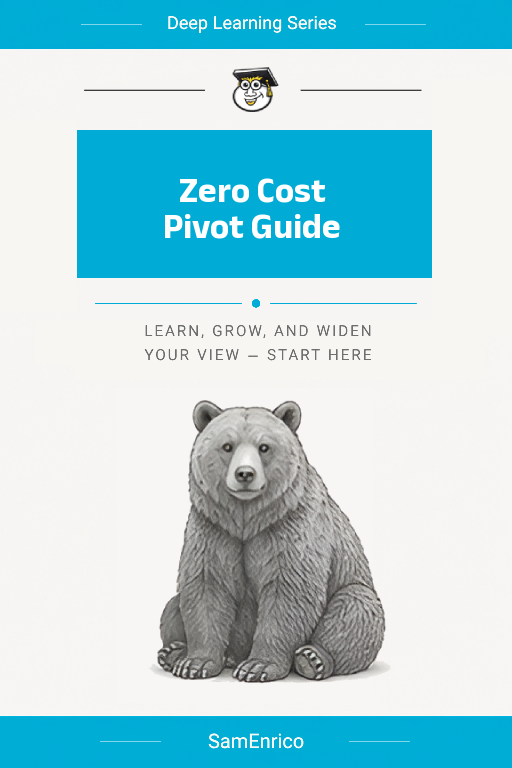
Zero Cost Pivot Guide eBook
Pivot your idea without spending money. Use free f
Pivot your idea without spending money. Use free feedback to change direction.
Formats
Free sample
Chapter 1: The Funded Fallacy--–- The first time my startup ran out of money, I did what every sensible founder does: I raised more. The second time, I raised even more. The third time, sitting on a pile of cash bigger than my childhood home, I realized the money wasn’t the solution—it was the anesthetic. We had built exactly what we promised our investors, exactly on schedule, and exactly nothing that anyone wanted to use. That was the moment I learned that a funded pivot is often just a funded death march wearing a nicer suit.This chapter dismantles the most dangerous myth in entrepreneurship: that capital solves directional problems.
It introduces the core philosophy of the Zero Cost Pivot Guide—that your runway isn’t measured in months of cash, but in the number of pivots you can afford to make. And when a pivot costs exactly zero dollars, you can pivot infinitely until you find product-market fit.We will explore why throwing money at a flawed idea only accelerates the construction of something nobody wants, why startups that raise money too early often stop listening to customers, and how to reframe “zero cost” not as poverty but as strategic freedom. By the end of this chapter, you will never again ask “How much money do we need to pivot?” You will ask only “What is the cheapest, fastest way to learn the truth?”The Million-Dollar Mistake In 2015, I consulted for a food-delivery startup that had raised $4.7 million. Their app was beautiful—sleek animations, real-time GPS tracking, predictive ordering algorithms. The engineering team was forty people strong.
The office had a kombucha tap. There was only one problem: after eighteen months and four million dollars in development, they had acquired exactly 213 active users. Not per day. Total.The founders called me in to help them “pivot.” They had $700,000 left in the bank and wanted to know how much more they would need to raise to change direction. I asked a different question: “What have you learned from the 213 users you already have?” There was a long silence.
Then the CEO said, “We haven’t really talked to them. We’ve been focused on building.”That startup died six months later, having spent its last $700,000 adding features nobody requested to a product nobody wanted. The kombucha tap was repossessed. The engineers went to Google. And four point seven million dollars evaporated into the fog of “we need more money to figure this out.”This story is not unusual.
It is the rule.The Funded Fallacy is the belief that the solution to a broken business model is more capital. It is seductive because it feels active—raising money feels like progress, hiring feels like momentum, spending feels like building. But as Eric Ries documented in The Lean Startup, most startups fail not because they run out of money, but because they run out of validated learning. They build things, measure nothing, and learn only at the very end, when the bank account hits zero and the mirrors shatter.The tragedy is that the learning could have been free.Why Money Masks the Truth Money does not solve directional problems. It amplifies them.Imagine you are lost in a forest.
You do not know which way leads to the village. A wealthy friend gives you a helicopter, a full tank of fuel, and a pilot. You take off and fly at top speed in a random direction. After six hours, you crash into a mountain. You had a great ride—comfortable seats, breathtaking views, in-flight snacks—but you are still lost, now with a destroyed helicopter and a pilot who will never work for you again.That is funded failure.
You went fast. You went expensively. You went precisely nowhere.Now imagine you have no helicopter. You have two feet and a stick. You walk a hundred yards in one direction.
You see no village, so you stop. You walk a hundred yards in another direction. Still no village. You ask a stranger for directions. You try again.
You learn. You adjust. You move slowly but deliberately toward the exit, spending nothing but time and attention.That is the zero-cost pivot. You cannot afford to go fast in the wrong direction, so you are forced to go slow in the right one.The venture capital industry has conditioned founders to believe that speed is the only virtue. Faster growth, faster hiring, faster fundraising.
But speed in the wrong direction is worse than standing still. Standing still at least preserves the option to learn. Speed in the wrong direction burns your runway—financial and psychological—on assumptions that were never tested.The hard truth: When you have money, you are tempted to spend it instead of listening. When you have no money, listening is all you have left. And listening, it turns out, is the only thing that has ever saved a failing business.The Land of the Living Dead (And Its Bootstrapped Cousin)Steve Blank, the godfather of customer development, coined a phrase that haunts every funded startup: the Land of the Living Dead.
These are companies that raised money early, built what they promised, and now drift aimlessly—alive enough to pay salaries, dead enough to never grow. They have revenue but no momentum. They have employees but no mission. They have board meetings but nothing to discuss.The Living Dead are not failures in the traditional sense. They do not explode dramatically.
They do not make the news. They simply… persist. Quarter after quarter, year after year, delivering mediocre results to unenthusiastic customers, burning the careers and spirits of everyone trapped inside.But here is what The Lean Startup and The Startup Owner’s Manual don’t emphasize enough: the Living Dead are almost always funded Living Dead. They raised money early, hired fast, and locked themselves into a trajectory they cannot escape because their investors demand a return on the capital already deployed.What about the bootstrapped founder with zero outside capital? What about the solo creator building on nights and weekends?
What about the small team living off revenue, not venture dollars?For these builders, there is a different trap: The Flatliner.A Flatliner is a zero-cost project that neither grows nor dies. It generates a tiny amount of revenue—maybe $500 a month from a handful of loyal users—or no revenue at all. The founder checks analytics every morning, sees the same flat line, and tells themselves, “I’ll work on it next weekend.” The months pass. Nothing changes. But unlike the Living Dead, the Flatliner has no investors demanding growth, no employees expecting raises, no office lease forcing expansion.
The Flatliner simply exists, a digital fossil preserved in amber, consuming nothing but the founder’s hope.The distinction matters enormously. A Zombie Startup (funded, revenue-flat, no growth) needs a hard pivot or an aggressive sunset within 90 days, because investor capital has an expiration date. A Flatliner (bootstrapped, zero-cost, flat metrics for six-plus months) may only need a tactical adjustment—a new channel, a different headline, a shelved feature—because time is the only resource at risk.Throughout this book, we will use these terms precisely:Zombie Startup: Raised…
This is the end of the free sample. Get the eBook to keep going. Buy now
About this book
Details
- Author
- Joyner Cammie
- Publisher
- SamEnrico
- Language
- English
- Genre
- Non-Fiction, Startup Guide, Lean Methodology
- Released
- 2026-06-01
- Pages (approx.)
- 144
- Available as
- eBook, Audiobook

Read better in the ZLOADR app
Your eBooks on your phone or tablet. Sign in with your SamEnrico account and start reading.
More by Joyner Cammie
 TM for Screen AddictionJoyner Cammie$11.99
 Remote Worker Imposter GuideJoyner Cammie$11.99
 Listening Without InterruptingJoyner Cammie$11.99
 Affirmations for ComparisonJoyner Cammie$11.99
 The Sociopath Impulsive CriminalJoyner Cammie$11.99
 The Visionaries of Stone: How Western Architects Shaped DemocracyJoyner Cammie$11.99
 Understanding T-lymphocytopeniaJoyner Cammie$17.99
 How to Become a Dry-house TenderJoyner Cammie$11.99
 Agriculture Invoice FactoringJoyner Cammie$12.99
 SleepingJoyner Cammie$11.99
You may also like
 Lean Business Plan TemplateSwart Jannette$11.99
 No Money Idea Validation GuideLevy Joel$12.99
 Solution Interview TechniqueCreech Blythe$12.99
 Reddit Validation MethodBarnette Ellie$12.99
 Quora Question ValidationMcmanus Jenifer$12.99
 Problem Interview TechniqueCordero Mafalda$12.99
 MVP Without Coding GuideRoche Alejandra$12.99
 LinkedIn Poll ValidationMojica Gavin$12.99
 Google Forms Survey GuidePuente Micah$12.99
 Free YouTube Channel GuideNixon Odette$12.99
 Free Video Validation GuideMcallister Tosha$12.99
 Free Validation Template PackGrubbs Delicia$12.99