
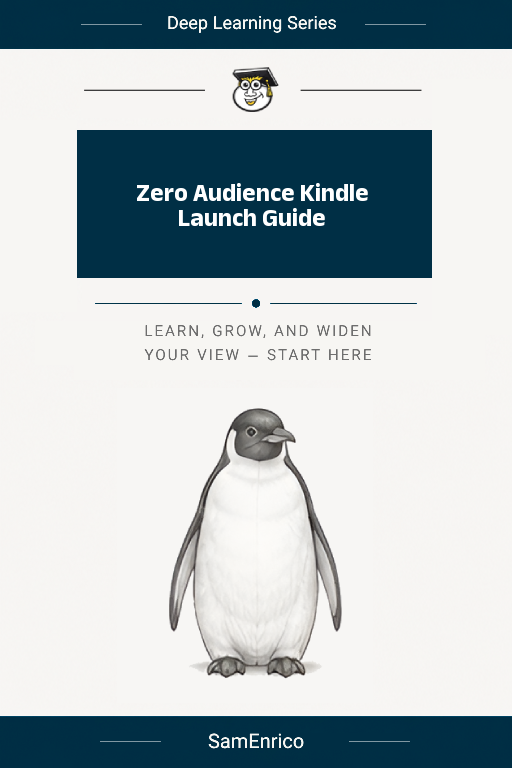
Non-FictionZero-to-One CreatorBook LaunchProduction Roadmap
Zero Audience Kindle Launch Guide eBook
Write, format, and publish your first ebook on Ama
Write, format, and publish your first ebook on Amazon KDP with zero following. Covers keyword research, cover design on Canva, and getting your first 10 sales without ads.
Formats
Free sample
Chapter 1: The Invisible Engine--–- The day I published my first Kindle book, I had exactly zero people on my email list. My Twitter account had been dormant for three years. My Facebook profile was locked down so tightly that even my mother couldn't find me. And my blog—the one every "expert" told me I absolutely needed before launching—had exactly three posts, the most recent of which was a photo of my cat sitting on a pizza box.I sold 347 copies in the first thirty days.No ads. No following.
No advanced reader team. No book tour. No podcast appearances. No "launch team" of superfans who didn't exist yet. Just a book, a cover I designed on Canva in two hours, and a deep understanding of something most aspiring authors get completely backwards.This book is not about building an audience.
This book is about bypassing the audience entirely.The Myth That Keeps Your Book Unpublished Everywhere you look, the message is the same. Before you publish a book, you need a platform. You need an email list. You need a blog with daily traffic. You need ten thousand followers on Instagram or Tik Tok or Threads or whatever platform is currently en vogue.
You need to "build your brand" before you dare to ask anyone to buy something you wrote.Here is the truth that bestselling authors don't want you to know: that advice is designed to sell you courses, coaching programs, and software subscriptions. It is not designed to help you publish a book.Let me be more specific. When a successful author tells you that you need an email list before launching, they are describing what worked for them after they were already successful. They are not describing what you actually need to sell your first copy. There is a massive difference between "this worked for me" and "this is required for you."The proof is hiding in plain sight on Amazon right now.
Go ahead. Open a new tab. Type in almost any nonfiction topic—"vegetable gardening," "weight loss for beginners," "small business marketing," "parenting toddlers"—and start clicking on the first few books you see. Look at the author names. Do you recognize any of them?
Probably not. Now scroll down to the reviews. Many of these books have fifty, a hundred, sometimes five hundred reviews from complete strangers who bought the book, read it, and took the time to write about it.Those authors did not have massive followings before they published. They had a book that solved a problem, and they used Amazon's search engine to get it in front of people who were actively looking for that solution.That is the invisible engine. And it is the only engine you actually need.Amazon Is Not a Bookstore.
It Is a Search Engine.Here is the single most important mindset shift you will make in this entire book. Ready?Amazon is not a bookstore. It is a search engine with a shopping cart.When you walk into a physical bookstore, you are surrounded by thousands of books arranged by category, with covers facing out, with staff recommendations on little handwritten cards, with endcaps featuring whatever the publisher paid to promote that month. The experience is designed to create discovery. You might walk in looking for a mystery novel and walk out with a memoir you never heard of because the cover caught your eye.Amazon does not work that way.Ninety percent of Amazon customers start their journey the exact same way: they type something into the search bar.
They type "how to fix a leaky faucet" or "romance novels with dogs" or "meal prep for shift workers" or "cryptocurrency for absolute beginners." They do not browse categories. They do not scroll through bestseller lists. They search.This means Amazon is fundamentally a direct-response search engine. People come to Amazon with an intent. They have a problem they want solved, a question they want answered, or a story they want to escape into.
They type their intent into the search bar. And Amazon returns a list of results.Your job as a zero-audience author is not to build a platform that drives people to Amazon. Your job is to make sure that when people type their problem into Amazon's search bar, your book is one of the first things they see.This is SEO. Search engine optimization. The same concept that governs Google, You Tube, and every other major search platform applies directly to Amazon.
And the beautiful thing about SEO is that it does not care how many Twitter followers you have. It does not care about your email list. It does not care if you have a blog, a podcast, or a Tik Tok dance challenge. It only cares about relevance.If your book is the most relevant result for a given search term, Amazon will show it. And if people click on it and buy it, Amazon will show it to even more people.
The algorithm rewards relevance and conversion. Not fame.The Zero-Audience Case Studies Let me give you real examples. Not hypotheticals. Not "imagine if." Real authors who started with nothing and sold books using exactly the principles in this guide.In 2022, a first-time author named Sarah published a book called "Keto Meal Prep for Beginners." She had never written a book before. She had zero social media presence.
She did not have an email list. She designed her cover on Canva. She formatted her manuscript using free software. And she followed a simple keyword strategy that targeted people searching for exactly what her book delivered.Her first week? Forty-seven sales.
Within thirty days, she had cracked the top twenty in three different categories. She did not run a single ad. She did not hire a publicist. She did not ask anyone to promote her book. She simply positioned her book where the search demand already existed.Or consider Marcus, who published a technical guide to a niche software called "Asana for Wedding Planners." Tiny audience, right?
That is precisely the point. There are only so many wedding planners using Asana. But the ones who are searching for that specific combination are highly motivated buyers. Marcus sold 212 copies in his first month at $9.99 each—over two thousand dollars in royalties—because he was the only book on Amazon that specifically addressed that intersection. No competition.
High demand. Zero audience required.These are not outliers. Every day, thousands of first-time authors publish books on Amazon and sell copies to complete strangers. Some of them sell five copies. Some sell fifty.
A handful sell five hundred. But every single one of them started with zero. And every single one of them succeeded or failed based on the same three factors: niche selection, book quality, and discoverability.Notice what is not on that list. Platform. Following.
Email list. Social media. Fame.What Actually Matters When You Have Zero Audience If Amazon does not care about your platform, what does it care about? Three things.First, it cares about relevance. When someone searches for a phrase, Amazon wants to show them the most relevant books.
Relevance is determined primarily by your title, subtitle, and the keywords you enter in the backend of KDP (which we…
This is the end of the free sample. Get the eBook to keep going. Buy now
About this book
Details
- Author
- Westmoreland Twila
- Publisher
- SamEnrico
- Language
- English
- Genre
- Non-Fiction, Zero-to-One Creator, Book Launch, Production Roadmap
- Released
- 2026-05-30
- Pages (approx.)
- 131
- Available as
- eBook, Audiobook

Read better in the ZLOADR app
Your eBooks on your phone or tablet. Sign in with your SamEnrico account and start reading.
More by Westmoreland Twila
 Trembling Voice ControlWestmoreland Twila$11.99
 Fishing Boat Crew GapWestmoreland Twila$11.99
 Resentment After No ApologyWestmoreland Twila$11.99
 The Holy Order of MANSWestmoreland Twila$11.99
 The Workaholism and Depression GuideWestmoreland Twila$11.99
 Bloodline of the Sun: The Nepotism That Built an EmpireWestmoreland Twila$11.99
 How to Start a Cesspools Emptying and Cleaning Business (Beginners Guide)Westmoreland Twila$11.99
 Blockchain Freight DocumentationWestmoreland Twila$12.99
 Understanding Leber's DiseaseWestmoreland Twila$17.99
 Claims ProcessingWestmoreland Twila$11.99
You may also like
 Hong Kong Handover 1997Dunn Johnnie$11.99
 Zumba For Postnatal Recovery CourseNeal Christian$11.99
 Zumba for BeginnersLadner Nikia$11.99
 YouTube Comment Mining GuideHumes Pandora$12.99
 Worry Box MeditationCarlin Rudy$11.99
 Workplace Stress MeditationNguyen Lynn$11.99
 Workplace Stress and Sleep RepairHawley Ivory$11.99
 Workplace Perfectionism CureDelaney Jeffry$11.99
 Workplace Injustice Anger GuideWallen Isabelle$11.99
 Work Addiction and Burnout LinkGreenwood Ester$11.99
 Women in Yoga and WellnessBeattie Galina$11.99
 Women in Stand Up ComedyChun Evangeline$11.99