
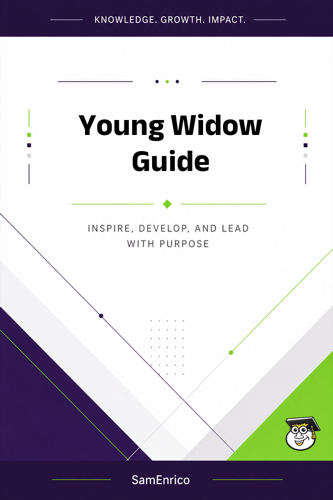
Free sample
Chapter 1: The Fog Machine...--–- The first thing you lose isn’t your husband. It’s your memory.Not all at once, like a light switching off. More like a fog rolling in—thick, disorienting, and utterly indifferent to your desperate need to see clearly. One moment you are a capable adult who knows your own phone number, your child’s pediatrician, and the route home from the grocery store. The next moment, you are standing in a hospital hallway, staring at a vending machine, unable to remember why you walked into this room or what year it is or whether you have eaten anything in the past two days.This is not a personal failing.
This is not weakness, hysteria, or the early onset of dementia. This is the neurobiology of acute grief, and it is about to become your unwanted roommate for the next several weeks—possibly months. Understanding how it works won’t make it stop, but it might stop you from believing you are losing your mind on top of everything else.I wrote this chapter for the version of you who is reading it in that fog. Maybe you are three hours out, sitting in a silent house that still smells like him. Maybe you are three days out, surrounded by casseroles you cannot stomach and people you cannot hear.
Maybe you are three weeks out, and the shock has worn off just enough for you to realize you have no idea what to do next. Wherever you are on that timeline, this chapter is designed to meet you there. You don’t need to have read the Introduction. You don’t need to have prepared. You just need to be here.Let’s start with what is happening inside your brain, because once you understand that, the rest of this chapter—the checklists, the scripts, the survival strategies—will make a terrible kind of sense.The Neurobiology of Shattering In the first hours after a traumatic loss, your brain floods with stress hormones: cortisol, adrenaline, and norepinephrine.
This is the same chemical cascade that occurs when you narrowly avoid a car accident or witness an act of violence. Your amygdala—the brain’s alarm system—takes over, treating the death of your spouse as an existential threat because, in evolutionary terms, losing a primary attachment figure is an existential threat. Your brain does not distinguish between your husband dying and a predator chasing you. It only knows that something has gone catastrophically wrong and that you must survive.The problem is that your prefrontal cortex—the part of your brain responsible for executive function, decision-making, memory retrieval, and impulse control—cannot operate under these conditions. It literally shuts down.
Blood flow decreases to that region. Neural firing slows. This is why you cannot remember what the doctor said ten minutes ago. This is why you cannot decide whether to call his mother or wait until morning. This is why you might find yourself standing in the shower, holding a shampoo bottle, unable to remember whether you have already washed your hair or not.This is called cognitive fog, and it is the single most universal and least-discussed symptom of early widowhood.Let me be very clear about what this fog is not.
It is not a sign that you are handling grief badly. It is not evidence that you didn’t love him enough or that you are somehow already “moving on.” It is a predictable, measurable, physiological response to overwhelming stress. Every widow experiences it to some degree. Some describe it as watching their own life through smudged glass. Others say it feels like wading through waist-deep cement.
A few report losing entire days—driving somewhere and having no memory of the route, sitting through a funeral and retaining nothing except the scent of lilies and the heat of the candles on their face.If you are in this fog right now, here is the only thing you need to do: stop trying to think your way through it. You can’t. Your thinking brain is offline. The more you struggle against the fog, the more exhausted and disoriented you will become. Instead, you are going to outsource your thinking to this chapter.
Treat it as a manual. Follow the steps in order. Don’t skip ahead. Don’t try to improvise.The First Seventy-Two Hours: A Trauma-Informed Checklist The following checklist is not comprehensive. It is not legally binding.
It is not even pretty. It is, however, the result of reading hundreds of widow testimonies and identifying what they wished someone had told them in the first three days. Some items will apply to you. Some will not. Take what you need and leave the rest.Step One: Call One Person Do not call his mother first.
Do not call your mother first unless she is exceptionally calm under pressure. Call one person who is rational, local, and not emotionally destroyed by this loss. This person could be a sibling, a close friend, a neighbor, or a coworker. Your instructions to them are simple: “Come to me now. Don’t ask questions.
Just come.”This person’s job is not to comfort you—not yet. Their job is to become your temporary executive function. They will make phone calls, write down what the hospital tells you, drive you home, and answer the door when people arrive. They will ask you what you need and then ignore your answer (because you will say “nothing”) and do what needs to be done anyway.If you cannot think of a single person to call, or if the person you call cannot come, call the hospital social worker or a grief hotline. They will help you find a volunteer or a paid advocate who can serve this role.
You are not alone even when you feel alone.Step Two: Don’t Make Any Major Decisions Here is where the Decision Matrix becomes your lifeline. Some decisions can wait. Some cannot. In the first seventy-two hours, the following decisions must be postponed for at least six months:Selling your house or breaking your lease Quitting your job (with the exception of taking emergency bereavement or medical leave)Moving to another city or state Remarrying (yes, people will ask you about this almost immediately—it is astonishing and cruel)Giving away his belongings Making large financial gifts or donations Changing your children’s schools The following decisions should be made immediately, and you will make them with the help of your designated person:Ordering death certificates (more on this in a moment)Notifying his employer (if he was working)Arranging for someone to care for children, pets, or elderly dependents Calling a funeral home or crematory (if he did not pre-arrange)Notifying close family members (but let your designated person make the actual calls—you just provide the list)Step Three: Get at Least Fifteen Death Certificates This sounds excessive. It is not.
Every institution that needs to know he has died will require an original, certified copy of the death certificate. Social Security will want one. The life insurance company will want one. His employer, his…
This is the end of the free sample. Get the eBook to keep going. Buy now
About this book
Details
- Author
- Zuniga Talisha
- Publisher
- SamEnrico
- Language
- English
- Genre
- Non-Fiction, Self-Help / Young Widow
- Released
- 2026-06-06
- Pages (approx.)
- 117
- Available as
- eBook, Audiobook

Read better in the ZLOADR app
Your eBooks on your phone or tablet. Sign in with your SamEnrico account and start reading.
More by Zuniga Talisha
 The Self Hypnosis for Public SpeakingZuniga Talisha$11.99
 Processing End of Life NightmaresZuniga Talisha$11.99
 Departure Knowledge Transfer Emergency KitZuniga Talisha$11.99
 Teenage Girl Confidence GuideZuniga Talisha$11.99
 Immigrant Coffee Roaster SuccessZuniga Talisha$11.99
 Stevie Wonder VisionZuniga Talisha$11.99
 TRT Therapy GuideZuniga Talisha$11.99
 The Jade Emperor's Celestial Trial: How a Mortal Outwitted the GodsZuniga Talisha$11.99
 Excalibur’s Shadow: The Forgotten Knights of the Round Table’s Darkest SecretZuniga Talisha$11.99
 How to Produce Automotive Plastic ProductsZuniga Talisha$11.99
 How to Produce Occupational and Physical Therapy EquipmentZuniga Talisha$11.99
 Citation for Websites WorkbookZuniga Talisha$12.99
You may also like
 Hong Kong Handover 1997Dunn Johnnie$11.99
 Zumba For Postnatal Recovery CourseNeal Christian$11.99
 Zumba for BeginnersLadner Nikia$11.99
 YouTube Comment Mining GuideHumes Pandora$12.99
 Worry Box MeditationCarlin Rudy$11.99
 Workplace Stress MeditationNguyen Lynn$11.99
 Workplace Stress and Sleep RepairHawley Ivory$11.99
 Workplace Perfectionism CureDelaney Jeffry$11.99
 Workplace Injustice Anger GuideWallen Isabelle$11.99
 Work Addiction and Burnout LinkGreenwood Ester$11.99
 Women in Yoga and WellnessBeattie Galina$11.99
 Women in Stand Up ComedyChun Evangeline$11.99