
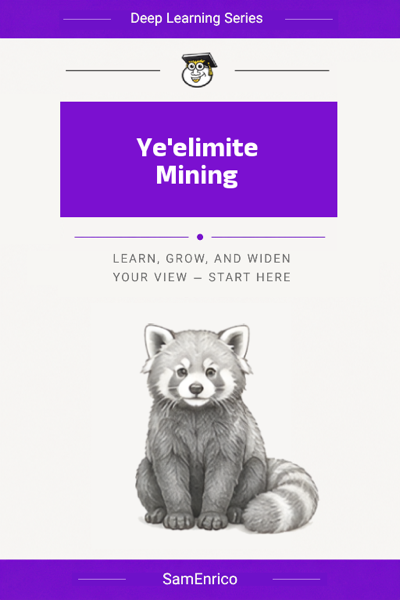
Non-FictionInformativeEducational
Ye'elimite Mining eBook
A Coursebook on Ye'elimite Mining
A Coursebook on Ye'elimite Mining
Formats
Free sample
Chapter 1: The Accidental Alchemist...--The year was 1978, and Shulamit Gross was lost.Not lost in the way a tourist loses their way in a foreign city—map upside down, gesturing helplessly at street signs—but lost in the way a geologist dreams of being lost. She was deep in the Hatrurim Formation of the Negev Desert, a surreal landscape of yellow-white hills that looked less like Earth and more like the surface of a dead planet. The heat shimmered off the fractured limestone. The silence was absolute. And somewhere beneath her boots, in rocks that had been baking under the Israeli sun for millions of years, lay a mineral that would eventually help rebuild America, clean poison from rivers, and make a handful of clever entrepreneurs very, very rich.Gross wasn't looking for ye'elimite.
She was mapping the complex metamorphic rocks of the Hatrurim, a geological oddity where natural combustion of bituminous chalk had created conditions so extreme—temperatures exceeding 1000°C, pressures and oxygen fugacities wildly different from the surface world—that ordinary limestone had been transformed into something entirely new. The area was already famous among mineralogists for hosting rare phases found almost nowhere else on Earth. But what Gross pulled from a dusty outcrop that afternoon would sit in a museum drawer for four decades before anyone realized what she had actually found.She sent the samples back to Jerusalem for analysis. The X-ray diffraction patterns came back with reflections that didn't match any known mineral in the existing databases. A new species.
She named it "ye'elimite" after the Arabic name for the region, Wadi Ye'elim. The crystal structure was isometric, space group I4132, with a formula that looked like alphabet soup: Ca₄Al₆O₁₂SO₄. In the dry language of mineralogy, it was a "calcium sulfoaluminate phase." In the real world, it was an accident of geology—a mineral that required such specific hellish conditions to form that it might as well have been impossible.And for thirty years, that's exactly what ye'elimite remained: an impossibility. A footnote in mineralogy textbooks. A trivia question for geology graduate students.
"Name a mineral discovered in Israel that no one has ever found a commercial use for." The type specimen sat in the Hebrew University collection. A few other researchers found traces of ye'elimite in similar natural combustion zones in Jordan and the United States. But no one was mining it. No one was even thinking about mining it. Because you can't mine something that barely exists.Then, in 2009, a cement chemist in China named Wang Yanmou did something either very stupid or very brilliant, depending on how you look at it.
He was trying to solve a different problem entirely: how to make cement from the toxic red mud that was accumulating in mountainous piles outside every aluminum smelter in the country. Red mud—the waste left over after bauxite ore is digested with caustic soda to extract aluminum—is one of industrial civilization's great embarrassments. For every ton of aluminum produced, approximately 1.5 tons of red mud are generated. It's alkaline enough to burn skin, rich in heavy metals, and almost completely useless. The global stockpile exceeds 4 billion tons.
And Xing'an County in Guangxi Province was drowning in the stuff.Wang's idea was straightforward, if not particularly elegant: take red mud, add limestone and gypsum, fire the mixture in a kiln, and see what happens. The goal was to produce ordinary Portland cement—the gray powder that holds the modern world together, the second-most-consumed substance on Earth after water. But the chemistry of red mud is complicated. It contains high levels of iron, titanium, and sodium, all of which are poison to ordinary cement kilns. Wang's first few experiments failed spectacularly.
The clinker came out soft, crumbly, full of cracks. The X-ray diffraction patterns showed phases that shouldn't have been there. One of them, a persistent contaminant that kept appearing no matter how Wang adjusted his mix, had reflections matching a mineral he'd never heard of: Ca₄Al₆O₁₂SO₄.Ye'elimite.Where Shulamit Gross had found it in a geological freak show, Wang had created it by accident in a lab kiln. And here is where the story gets interesting. Because Wang, unlike Gross, was not a mineralogist cataloging nature's curiosities.
He was an industrial chemist with a problem. And the problem was this: the contaminant phase—the "mistake"—was setting in fifteen minutes instead of fifteen hours. It was generating heat instead of requiring it. It was expanding slightly as it hardened instead of shrinking and cracking.Wang didn't bury the data. He didn't go back to the drawing board to eliminate the contamination.
Instead, he did something that looks obvious only in hindsight: he stopped trying to kill the yeast and started trying to raise it. What if, he wondered, we made the red mud cement from nothing but ye'elimite? What if the contaminant was the product?The Mineral That Shouldn't Exist Let me tell you why ye'elimite is special. And to understand that, you first need to understand the cement that built the modern world.Ordinary Portland cement, invented in 1824 by Joseph Aspdin, is a triumph of industrial chemistry. It's also a climate disaster, an engineering compromise, and a 200-year-old technology that we've mostly just tolerated because nothing better came along.
Here's how it works: you take limestone (calcium carbonate) and clay (aluminosilicates), grind them together, fire the mixture in a rotary kiln at 1450°C—hotter than molten lava—until the materials partially melt and fuse into marble-sized nodules called clinker, then grind the clinker into the fine gray powder we call cement. Add water, and a complex series of hydration reactions produces calcium silicate hydrate (C-S-H) gel, the glue that holds concrete together.The problems with this process are numerous, and they are not small.First, the temperature. 1450°C requires enormous amounts of energy. Cement manufacturing accounts for approximately 8% of global CO₂ emissions—more than the entire aviation industry. If the cement industry were a country, it would be the third-largest emitter on Earth, behind only China and the United States.Second, the chemistry.
Roughly 60% of those CO₂ emissions don't come from the fuel burned to heat the kiln. They come from the limestone itself. When calcium carbonate (Ca CO₃) decomposes at high temperatures, it releases CO₂ as a necessary byproduct of the reaction. You cannot make ordinary Portland cement without emitting CO₂ from the raw materials. It's baked into the equation.Third, the behavior.
Ordinary Portland cement shrinks as it dries. It cracks. It takes 28 days to reach its specified strength, which means construction projects sit idle for weeks waiting for concrete to cure. It doesn't set well in cold weather, requiring heated enclosures or chemical antifreezes. And it is vulnerable to sulfate attack and chloride ingress, which is why concrete bridges eventually crumble and parking garages need expensive repairs.Ye'elimite offers a path past all of these limitations.The hydration chemistry is completely different.
When ye'elimite meets water in the presence of calcium sulfate (gypsum), it doesn't form calcium silicate hydrate. It forms ettringite—a needle-like crystal that grows rapidly, interlocks tightly, and actually expands slightly as it forms. The reaction is exothermic, meaning…
This is the end of the free sample. Get the eBook to keep going. Buy now
About this book
Details
- Author
- Frierson Lyla
- Publisher
- SamEnrico
- Language
- English
- Genre
- Non-Fiction, Informative, Educational
- Released
- 2026-05-11
- Available as
- eBook, Audiobook

Read better in the ZLOADR app
Your eBooks on your phone or tablet. Sign in with your SamEnrico account and start reading.
More by Frierson Lyla
 Parenting with Chronic PainFrierson Lyla$11.99
 The Gaming Sensory OverloadFrierson Lyla$11.99
 Nonverbal Cues In Healthcare CourseFrierson Lyla$11.99
 Symmetry OCD Overcoming GuideFrierson Lyla$11.99
 Survey Response Validation Using AIFrierson Lyla$11.99
 Echoes of the Iron Curtain: The Spy Who Sang FreedomFrierson Lyla$11.99
 The Ghosts of the Andes: A 19th-Century Astronomer’s Descent into MadnessFrierson Lyla$11.99
 How to Become a Card Changer - Jacquard LoomFrierson Lyla$11.99
 Writing Sample for PhD Without PubsFrierson Lyla$12.99
 Citizenship Eligibility After PRFrierson Lyla$12.99
 Understanding CalciphylaxisFrierson Lyla$17.99
You may also like
 Hong Kong Handover 1997Dunn Johnnie$11.99
 Zumba For Postnatal Recovery CourseNeal Christian$11.99
 Zumba for BeginnersLadner Nikia$11.99
 YouTube Comment Mining GuideHumes Pandora$12.99
 Worry Box MeditationCarlin Rudy$11.99
 Workplace Stress MeditationNguyen Lynn$11.99
 Workplace Stress and Sleep RepairHawley Ivory$11.99
 Workplace Perfectionism CureDelaney Jeffry$11.99
 Workplace Injustice Anger GuideWallen Isabelle$11.99
 Work Addiction and Burnout LinkGreenwood Ester$11.99
 Women in Yoga and WellnessBeattie Galina$11.99
 Women in Stand Up ComedyChun Evangeline$11.99