
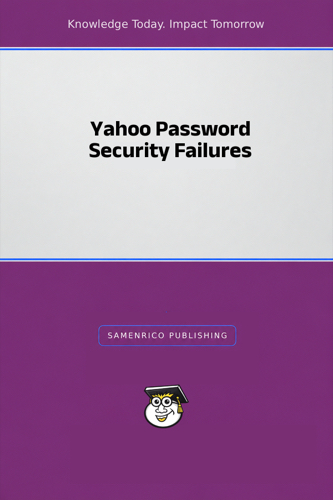
Yahoo Password Security Failures
Exposes how Yahoo stored passwords in outdated MD5
Exposes how Yahoo stored passwords in outdated MD5 format without salting.
Formats
About this book
Free sample
Chapter 1: The Silent Exodus...--On a warm September morning in 2016, the technology world woke to a headline that would forever change how we think about digital trust. Yahoo, one of the original giants of the internet, disclosed that at least five hundred million user accounts had been compromised by what it called a "state-sponsored actor." The news spread across trading floors, newsrooms, and dinner tables with the speed of a wildfire. But what the public did not yet know—what Yahoo’s own executives were still frantically trying to quantify—was that the real number was six times larger. The breach had not stolen five hundred million accounts. It had stolen three billion.
Every single Yahoo account that existed at the time of the attack. Every user who had ever signed up for Yahoo Mail, Yahoo Finance, Yahoo Fantasy Sports, or any of the company’s dozens of web properties. The attackers had walked away with the keys to the digital lives of nearly half the human population that had access to the internet.The disclosure, when it finally came, arrived not as a single thunderclap but as a slow, agonizing series of admissions. First came the five hundred million figure in September 2016. Then, three months later in December, Yahoo admitted that the breach had actually occurred in 2014, not 2016, meaning the company had sat on the knowledge for over two years.
Finally, in October 2017—after Verizon had already agreed to acquire Yahoo and was deep into due diligence—the truth emerged: the 2013 breach, separate from the 2014 incident, had compromised three billion accounts. The attackers had not needed sophisticated zero-day exploits or nation-state grade cryptanalysis. They had simply exploited a database that Yahoo had left vulnerable for over a decade. And at the heart of that vulnerability was a decision so fundamental, so basic, that it would become a case study taught in every computer security course for a generation: Yahoo had stored its users' passwords using MD5, a hashing algorithm that the cryptographic community had declared broken in 1996, and had done so without the most elementary protection known…
This is the end of the free sample. Get the eBook to keep going. Buy now
Contents
- Chapter 1
- Chapter 2
- Chapter 3
- Chapter 4
- Chapter 5
- Chapter 6
- Chapter 7
- Chapter 8
- Chapter 9
- Chapter 10
- Chapter 11
- Chapter 12
Details
- Author
- Peeples Esperanza
- Publisher
- SamEnrico
- Language
- English
- Genre
- Non-Fiction, True Crime, Cryptographic Errors
- Released
- 2026-06-06
- Pages (approx.)
- 151
- Available as
- eBook, Audiobook

Read better in the ZLOADR app
Your eBooks on your phone or tablet. Sign in with your SamEnrico account and start reading.
More by Peeples Esperanza
 Risk Based Thinking WorkbookPeeples Esperanza$11.99
 Growth Hormone and Heart MusclePeeples Esperanza$11.99
 Stephen Fry HumanismPeeples Esperanza$11.99
 Bedtime Self Talk for Letting GoPeeples Esperanza$11.99
 Service Commitments in Twelve StepsPeeples Esperanza$11.99
 Goal Setting for LeadersPeeples Esperanza$11.99
 Grief and Work After Parent LossPeeples Esperanza$11.99
 The Lion of Cairo: Hassan El-Shazly's Miraculous ComebackPeeples Esperanza$11.99
 The Last Flight of the Concorde: A Supersonic FarewellPeeples Esperanza$11.99
 How to Start a Cloth Dyeing Business (Beginners Guide)Peeples Esperanza$11.99
 How to Produce Memory CasesPeeples Esperanza$11.99
 A Collector's Handbook to the Packard EightPeeples Esperanza$11.99