
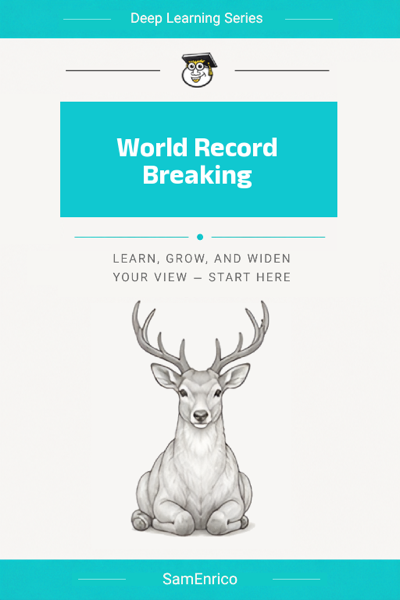
Non-FictionInformativeEducational
World Record Breaking eBook
A Coursebook on World Record Breaking
A Coursebook on World Record Breaking
Formats
Free sample
Chapter 1: The Bar Bet That Changed Everything...–- On a rainy night in 1951, in a small pub in County Wexford, Ireland, an argument broke out over a bird. Not a political argument, not a romantic squabble, but the kind of heated, pointless, wonderful debate that only happens between friends who have had just enough whiskey to care deeply about something that does not matter at all. The bird in question was the golden plover, a modest-looking wader known for its migratory stamina. The question was simple: Was it the fastest game bird in Europe? One man said yes.
Another man said no. And no one in that pub—not the bartender, not the farmer in the corner, not the retired schoolteacher who prided himself on knowing everything—could produce a single page of evidence to settle the matter.That argument, trivial as it was, would birth a global phenomenon. The man who lost the argument that night—or at least, the man who failed to win it—was Sir Hugh Beaver, the managing director of the Guinness Brewery. He was not accustomed to losing arguments, and he was certainly not accustomed to being unable to find an answer. As he walked back to his car that night, rain dripping from the brim of his hat, he had a thought that would change the way humanity measures itself: Why isn’t there a book that settles these arguments once and for all?This book you are holding is not that book.
That book—the first Guinness Book of Records—appeared four years later, in 1955, and it changed the world. But this book is something different. This is a coursebook, a field guide, a training manual for anyone who has ever looked at a world record and thought, I could do that. Or, more honestly, I wonder how they did that. Or, most honestly, I wonder if I could do that without looking like an absolute fool on the internet.Before you can break a record, you must understand what a record is.
And before you can understand what a record is, you must understand where the entire enterprise came from. Because the story of world record breaking is not a story of superhumans and freak athletes. It is a story of bar bets, encyclopedias, twin brothers with photographic memories, and a quiet revolution in how we define the word possible.The Anatomy of a Pub Argument Let us linger in that pub for a moment longer. The year is 1951. Ireland is still recovering from post-war rationing.
The Guinness Brewery is a national institution, its stout exported across the globe, its advertising campaigns already legendary. Sir Hugh Beaver is not a man who takes things lightly. He is an engineer by training, a problem-solver by temperament, and a perfectionist by reputation. When he argues about the speed of a game bird, he is not arguing for the sake of argument. He is arguing because he believes that every question has an answer, and that answers should be recorded, verified, and available on demand.The golden plover, as it turns out, is not the fastest game bird.
(That honor belongs to the red-breasted merganser, a duck that can reach speeds of 80 miles per hour in a dive, though ornithologists continue to debate the finer points of what counts as "flight" versus "falling with style.") But the accuracy of Beaver's position is not the point. The point is that he could not prove it. And for a man like Beaver, that was unacceptable.In the years that followed, Beaver discussed the idea with his colleagues at Guinness. What if the brewery published a reference book? Not a cookbook, not a history of beer, but a compendium of superlatives—the fastest, the tallest, the oldest, the heaviest, the most.
The book would settle arguments in pubs across Britain and Ireland. And, not incidentally, it would put the Guinness name into every home, every library, every schoolroom in the English-speaking world. It was marketing, yes, but it was also something more. It was an act of intellectual hospitality: We have gathered the answers so you do not have to fight about them.The first edition of the Guinness Book of Records was published in August 1955. It was a modest thing: 198 pages, bound in cardboard, priced at five shillings.
It sold out almost immediately. By Christmas, it was the best-selling book in Britain. Within a decade, it would be translated into dozens of languages and become one of the most successful copyright titles in publishing history. As of this writing, the Guinness World Records franchise has sold more than 150 million copies worldwide. That bar bet in County Wexford is now a global industry.But the story of record breaking is not merely the story of a book.
It is the story of the people who made that book possible: the Mc Whirter brothers.The Twins Who Could Not Be Fooled If Sir Hugh Beaver was the visionary, Norris and Ross Mc Whirter were the architects. They were identical twins, born in 1925, and from childhood they displayed an almost pathological commitment to accuracy. Their father was a newspaper editor; their mother was a former journalist. The household was one where dinner table conversations were fact-checked in real time, and where "I think" was considered a failure of character.Both brothers attended Oxford, where they excelled at athletics and academics. Norris was the faster runner; Ross was the more meticulous researcher.
Together, they formed a perfect unit. After university, they founded a fact-finding agency called Mc Whirter Twins Limited, which provided research services to newspapers, corporations, and government agencies. When Beaver approached them about the record book, they were the obvious choice.The brothers established the first formal verification protocols. They decided that every record would require two independent witnesses. They demanded photographic or video evidence.
They created a filing system that tracked every claim, every submission, every rejection. They were the world's first professional adjudicators, and they were ruthless.A story circulates—it may be apocryphal, but it should be true—about a man who claimed to have eaten the most eggs in one sitting. The man submitted a photograph of himself standing next to a mountain of eggshells. The Mc Whirter brothers rejected the claim because the photograph did not show the eggs being eaten, only the aftermath. The man wrote an angry letter: "What do you want, a video?" This was 1956.
Video barely existed. The brothers wrote back: "Yes."That is the spirit that built the institution. The Mc Whirter brothers understood something that most people do not: a world record is not an achievement. An achievement is something you do. A world record is something you do and then prove you did it, according to rules you did not write, to people who do not know you, using evidence that cannot be faked.
The verification is not a burden. The verification is the record. Without it, you have only a story.The Ethical Turn: When Records Go Too Far The early editions of the Guinness Book of Records contained categories that would be unthinkable today. Longest kiss. Heaviest pet.
Largest balloon release. Largest pie fight. Most cigarettes smoked in a row. Most live scorpions held in the mouth. (Yes…
This is the end of the free sample. Get the eBook to keep going. Buy now
About this book
Details
- Author
- Thomsen Rachell
- Publisher
- SamEnrico
- Language
- English
- Genre
- Non-Fiction, Informative, Educational
- Released
- 2026-06-02
- Pages (approx.)
- 153
- Available as
- eBook, Audiobook

Read better in the ZLOADR app
Your eBooks on your phone or tablet. Sign in with your SamEnrico account and start reading.
More by Thomsen Rachell
 TM Podcast Listening GuideThomsen Rachell$11.99
 Toddler Bedtime Battles GuideThomsen Rachell$11.99
 Brazilian Green Tax Credits CourseThomsen Rachell$11.99
 Men's Myocarditis Recovery GuideThomsen Rachell$11.99
 Summit of Shadows: The Forgotten Climbers of Everest's Golden AgeThomsen Rachell$11.99
 Innocence Project North Carolina CasesThomsen Rachell$11.99
 The Silent Choir: How a Music Cult Planned the End of the WorldThomsen Rachell$11.99
 Soft Skills Development GuideThomsen Rachell$12.99
 Police Certificate for EEThomsen Rachell$12.99
 Understanding Chromosome 17 DeletionThomsen Rachell$17.99
 How to Become a Calender-roll Press OperatorThomsen Rachell$11.99
You may also like
 Hong Kong Handover 1997Dunn Johnnie$11.99
 Zumba For Postnatal Recovery CourseNeal Christian$11.99
 Zumba for BeginnersLadner Nikia$11.99
 YouTube Comment Mining GuideHumes Pandora$12.99
 Worry Box MeditationCarlin Rudy$11.99
 Workplace Stress MeditationNguyen Lynn$11.99
 Workplace Stress and Sleep RepairHawley Ivory$11.99
 Workplace Perfectionism CureDelaney Jeffry$11.99
 Workplace Injustice Anger GuideWallen Isabelle$11.99
 Work Addiction and Burnout LinkGreenwood Ester$11.99
 Women in Yoga and WellnessBeattie Galina$11.99
 Women in Stand Up ComedyChun Evangeline$11.99