
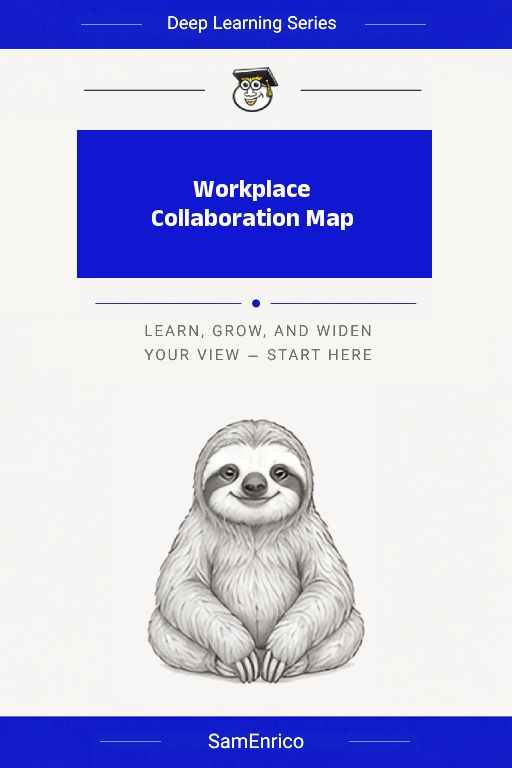
Non-FictionStrategic AtlasCollaboration
Workplace Collaboration Map eBook
Map Teams, Zoom, Slack, and Google Workspace on sy
Map Teams, Zoom, Slack, and Google Workspace on synchronous versus async communication emphasis.
Formats
Free sample
Chapter 1: The Great Hybrid Mistake--–- In the spring of 2020, the world’s workforce did something unprecedented. Nearly every knowledge worker who could work from home did so, often within a span of seventy-two hours. Companies that had spent years debating the merits of remote work suddenly became remote-first by force. IT departments that had resisted cloud tools rushed to buy Zoom licenses. Managers who had insisted on “butts in seats” found themselves leading distributed teams overnight.
And for a brief, chaotic moment, it felt like progress.Three years later, something unexpected happened. The same tools that saved work from collapse began to feel like a cage. The ping of Slack became a source of dread. The Zoom invitation became an interruption masquerading as a meeting. The Google Doc, once a liberating async canvas, became an infinite scroll of unread comments and unresolved suggestions.
Teams reported higher burnout than ever before—even as they spent less time in offices. Productivity metrics showed that people were working longer hours but delivering fewer meaningful outputs. The tools hadn’t failed. The map had.This book is not about how to use Slack, Zoom, or Google Workspace. If you are reading this, you already know how to send a message, start a call, or share a document.
The problem is not tool literacy. The problem is tool strategy. Most teams today are using a high-fidelity, high-interruption tool like Zoom to share a status update that could have been a three-sentence email. They are using an asynchronous tool like email to resolve a heated conflict that desperately needs facial expressions and tone of voice. They are drowning in modality mismatch.The $1.2 Trillion Problem Miscommunication is expensive.
Not in the abstract, touchy-feeling way that consultants like to cite—but in actual, audited, P&L-statement dollars. Research from organizational psychology firms and workplace productivity studies consistently estimates that large enterprises lose between 1.2trillionand1.2 trillion and 1.2trillionand1.5 trillion annually to miscommunication. That is not a typo. Trillion with a T. To put that number in perspective, it is roughly equivalent to the entire GDP of Australia or Mexico.
And the single largest driver of that loss is not language barriers or unclear instructions—it is modality mismatch.What is modality mismatch? It is the gap between the communication tool you choose and the communication task you need to accomplish. Every task has an ideal modality. Some tasks require real-time back-and-forth with emotional nuance. Others require delayed, reflective, well-documented exchange.
When you choose the wrong modality, you create friction. That friction translates into wasted time, repeated emails, follow-up calls, misinterpreted tone, rework, and ultimately, burnout.Consider a simple example. A product manager needs to share weekly progress on a feature launch. She has four options: send an email, type in a Slack channel, create a Google Doc, or schedule a Zoom call. Which one is correct?
Most teams default to the Zoom call because “we’ve always met on Tuesdays.” That meeting takes thirty minutes. Five people attend. That is two and a half hours of collective time. The product manager spends thirty minutes preparing slides. The team spends another fifteen minutes afterward catching up on the work they didn’t do during the meeting.
Total cost: nearly four hours for a status update. A well-structured Google Doc would have taken the product manager twenty minutes to write and each team member three minutes to read. Total collective time: less than forty minutes. The modality mismatch cost the team nearly three hours of productive work.Now multiply that by every weekly status meeting in every organization. The numbers become staggering.Synchronous Versus Asynchronous: A Spectrum, Not a Binary Before we can build a better map, we need to understand the terrain.
Most people think of communication as having two distinct modes: synchronous (real-time) and asynchronous (delayed). But this binary thinking is precisely what leads to modality mismatch. In reality, communication exists on a spectrum defined by three variables: timing, interruption cost, and emotional fidelity.Let us define the extremes clearly.Synchronous communication happens in real time. Both parties are present and attentive at the same moment. Examples include a Zoom call, a Slack huddle, a Google Meet, a phone call, or even a face-to-face conversation.
The advantages are high emotional fidelity (you can see facial expressions, hear tone of voice, and react immediately), rapid clarification (misunderstandings can be resolved in seconds), and social bonding (shared presence builds trust). The disadvantages are high interruption cost (you cannot do deep work while in a meeting), scheduling friction (finding a time that works for everyone is hard), and uneven participation (the loudest voice often wins).Asynchronous communication happens with a delay. Parties contribute when it is convenient for them, and responses come minutes, hours, or days later. Examples include email, Google Docs, Slack threads (with notifications muted), Loom videos, and project management tools like Asana. The advantages are low interruption cost (you can focus on deep work and batch responses), democratic participation (introverts and non-native speakers have equal voice), and searchable records (everything is documented by default).
The disadvantages are low emotional fidelity (tone is easily misinterpreted), slow resolution (urgent issues cannot be solved quickly), and the risk of over-documentation (endless threads that no one reads).The critical insight—and the one that most teams miss—is that most communication tasks fall somewhere in the middle of this spectrum. A task that requires moderate emotional nuance but not urgent resolution might be best served by a Slack thread with a promise to respond within two hours. A task that requires high urgency but low emotional nuance might be best served by a brief Slack DM. A task that requires high complexity and high emotional nuance might require a sequence: first an async document to align on facts, then a synchronous Zoom call to resolve remaining disagreements.The spectrum looks like this, moving from fully async to fully sync:Email / Google Doc (fully async) → Slack thread with notifications off → Slack DM with scheduled send → Slack huddle → Zoom with cameras off → Zoom with cameras on (fully sync)Most teams treat all tasks as either “send an email” or “schedule a Zoom call.” That is like trying to navigate a continent with only two cities on your map. You will get lost.Introducing the Collaboration Matrix This book is built around a single, unified decision-making framework that we will use in every chapter.
It is called the Collaboration Matrix, and it has two axes.Axis 1: Simple versus Complex. Simple tasks have clear inputs, known processes, and predictable outputs. Examples: sharing a status update, approving an expense report, scheduling a meeting, or confirming receipt of a document. Complex tasks have ambiguous inputs, unknown processes, or unpredictable outputs. Examples: resolving a design dispute, brainstorming a new product feature, negotiating a contract, or diagnosing a production outage.Axis 2: Emotional safety needed versus Speed needed.
Emotional safety matters when the task involves trust, vulnerability, hierarchy, or interpersonal risk. Examples: giving constructive feedback, apologizing for a mistake, or discussing layoffs. Speed matters when the task has a tight deadline, external customer impact, or cascading dependencies. Examples: fixing a broken build, responding to a client emergency, or approving a time-sensitive…
This is the end of the free sample. Get the eBook to keep going. Buy now
About this book
Details
- Author
- Castellano Carmelita
- Publisher
- SamEnrico
- Language
- English
- Genre
- Non-Fiction, Strategic Atlas, Collaboration
- Released
- 2026-06-01
- Pages (approx.)
- 141
- Available as
- eBook, Audiobook

Read better in the ZLOADR app
Your eBooks on your phone or tablet. Sign in with your SamEnrico account and start reading.
More by Castellano Carmelita
 Loving Kindness for OthersCastellano Carmelita$11.99
 Road Rage And Driving HistoryCastellano Carmelita$11.99
 Pezesha SME Lending ExitCastellano Carmelita$11.99
 The Ninety Five Theses AnalysisCastellano Carmelita$11.99
 Gossip Anger ManagementCastellano Carmelita$11.99
 The Naturalist Kings of Kongo: Science and Sovereignty in Central AfricaCastellano Carmelita$11.99
 Understanding Phosphoglucomutase Deficiency Type 4Castellano Carmelita$17.99
 How to Start a Hobby in TrollingCastellano Carmelita$11.99
 Philippines vs Kenya VA ComparisonCastellano Carmelita$12.99
 Admitting ClerkCastellano Carmelita$11.99
You may also like
 Hong Kong Handover 1997Dunn Johnnie$11.99
 Zumba For Postnatal Recovery CourseNeal Christian$11.99
 Zumba for BeginnersLadner Nikia$11.99
 YouTube Comment Mining GuideHumes Pandora$12.99
 Worry Box MeditationCarlin Rudy$11.99
 Workplace Stress MeditationNguyen Lynn$11.99
 Workplace Stress and Sleep RepairHawley Ivory$11.99
 Workplace Perfectionism CureDelaney Jeffry$11.99
 Workplace Injustice Anger GuideWallen Isabelle$11.99
 Work Addiction and Burnout LinkGreenwood Ester$11.99
 Women in Yoga and WellnessBeattie Galina$11.99
 Women in Stand Up ComedyChun Evangeline$11.99