
Non-FictionSelf-HelpChat Management
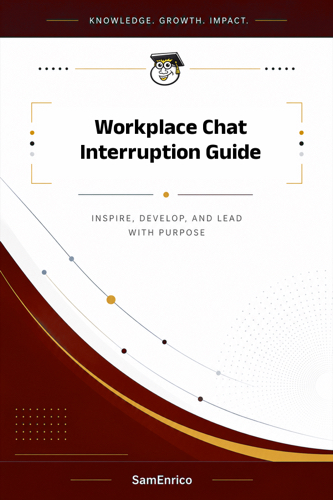
Workplace Chat Interruption Guide eBook
Sets Slack and Teams statuses, notification schedu
Sets Slack and Teams statuses, notification schedules, and response expectations.
Formats
Free sample
Chapter 1: The 11-Minute Lie--You check Slack or Teams seventy-six times per day. That is not an exaggeration pulled from the darkest corner of the internet. It is the average across knowledge workers studied by Rescue Time and Gloria Mark at the University of California, Irvine. Seventy-six times. Between each glance, you manage approximately eleven minutes of uninterrupted work.
Eleven minutes. Then a notification chirps, a dot blinks, a badge appears, and you are gone again.Here is the lie you have been sold: that these interruptions are minor, that the cost of switching from a spreadsheet to a chat message and back again is measured in seconds, that the green dot next to your name means you are working. None of this is true. The cost of a single interruption is not the ten seconds you spend reading the message. It is the twenty-three minutes it takes to return to your original task at full cognitive depth.
Twenty-three minutes. This is not opinion. This is the finding of Gloria Mark’s research at UCI, replicated across dozens of studies, confirmed by your own exhaustion at 5 PM when you realize you have answered two hundred messages but accomplished nothing of substance.Welcome to the 11-Minute Lie. It is the foundational deception of the modern workplace, and this chapter is where we dismantle it.The Birth of the Interruption Economy Let us travel back to 2013. Slack launched to the world with a promise: “Be less busy.” The tagline was almost poetic in its irony.
The founders believed that replacing email with persistent chat would reduce inbox clutter, speed up decisions, and make work feel more like play. For a brief window, they were right. Early adopters reported fewer emails, faster responses, and a strange new feeling called “transparency.”Then something changed. The same tools that liberated teams from email chains began to imprison them in notification hell. The culprit was not malice.
It was a complete failure to understand human cognition.The engineers who built Slack and Teams were brilliant at distributed systems, real-time messaging protocols, and API design. They were less brilliant at neuroscience. They built tools that mimicked the dopamine loops of slot machines—variable rewards, unpredictable scheduling, the seductive promise of a message that might be important—without realizing they were doing so. Former Slack designer Anna Pickard later admitted that the team borrowed heavily from gamification research. The green dot, the unread badge, the subtle sound of a new message: all were optimized for engagement, not for productivity.Microsoft Teams followed the same path but added a fresh layer of aggression.
Where Slack offered customization, Teams offered defaults that notify you about everything: every message in every channel, every reply to every thread, every reaction to every post. The default Teams installation is a firehose aimed directly at your prefrontal cortex.The result is the same across both platforms: you are now a part-time knowledge worker and a full-time notification triage nurse.The Twenty-Three Minute Tax Let me be precise about what an interruption costs you.You are writing a quarterly report. You have opened three source documents, a spreadsheet, and an email from your manager. In your head, you are holding a mental model of the report’s structure, the key data points, the narrative arc from problem to solution. This is called your “attentional spotlight.” It is a limited resource.A Slack message arrives.
It is not urgent. It is a colleague asking, “Hey, got a sec?” (We will address the crime of the “Hey” DM in Chapter 6.) But you look. Of course you look. The dot is blinking. Your dopamine system, trained over years of variable rewards, demands that you check.You read the message.
You decide it can wait. You close Slack and return to your report.You are not back to full focus. According to Mark’s research, it takes an average of twenty-three minutes and fifteen seconds to return to the same depth of concentration you had before the interruption. During those twenty-three minutes, you are working at partial capacity. You re-read sentences.
You check the spreadsheet again because you forgot the number. You open the email again because you lost the thread.Now multiply that by seventy-six glances per day. Do the math. Seventy-six interruptions, each costing twenty-three minutes of partial attention, equals twenty-nine hours of cognitive tax per week. You are losing nearly a full workday every single day to the cost of switching tasks.But wait, you protest.
I do not actually engage with every notification. Many glances are just checking. I do not open the message.The research is brutal on this point. Even glancing at the icon without opening the app causes a measurable drop in cognitive performance. The mere presence of a notification—the visual cue that a message awaits—is enough to split your attention.
Your brain cannot fully ignore the possibility of a new message. It holds a background process, like a computer keeping a tab open, consuming mental RAM even when you are not looking at it.This is the 11-Minute Lie in full force. You believe you are working. You believe the interruptions are minor. The data says you are wrong.The Green Dot Is Not Your Friend Let us talk about the green dot.This tiny LED indicator, no larger than a grain of rice, has caused more organizational dysfunction than any policy or personality conflict.
The green dot means “active on desktop or mobile in the last five minutes.” That is all. It does not mean “available for conversation.” It does not mean “not in deep work.” It does not mean “willing to drop everything for your question.”But the green dot has been interpreted, across thousands of companies, as a binding contract of availability. If you are green, you can be interrupted. If you are green and you do not respond within sixty seconds, you are ignoring your colleague. If you are green during a focus block, you are doing something wrong.This interpretation is catastrophic.
It converts a technical artifact into a social expectation. It punishes deep work, because deep work requires you to look away from the screen, to close the chat app, to disappear into the problem. Deep work makes you appear yellow or gray. The green dot rewards the opposite: shallow, reactive, interruptible work.I have interviewed dozens of knowledge workers who confess to keeping Slack open in the background even during intense focus sessions. Why?
Because they fear the judgment of a manager who checks the green dot. Because they have been told, explicitly or implicitly, that responsiveness is a proxy for productivity. Because the culture has confused “available” with “working.”This is the first assumption we must discard. The green dot is not your friend. It is a surveillance tool disguised as a convenience feature.
Turn it off. Ignore it. Do not let it govern your day.The Spectrum of Interruption Severity Not all interruptions are created equal. Some are genuinely urgent. Most are not.
To build a rational response system, we need a shared language for categorizing interruptions. Without this language, every message feels urgent, and every interruption carries the same weight…
This is the end of the free sample. Get the eBook to keep going. Buy now
About this book
Details
- Author
- Boykin Andera
- Publisher
- SamEnrico
- Language
- English
- Genre
- Non-Fiction, Self-Help, Chat Management
- Released
- 2026-06-09
- Pages (approx.)
- 132
- Available as
- eBook, Audiobook

Read better in the ZLOADR app
Your eBooks on your phone or tablet. Sign in with your SamEnrico account and start reading.
More by Boykin Andera
 Creative Starvation ArtsBoykin Andera$11.99
 Economics Essay GPT PromptsBoykin Andera$11.99
 Divorce and Tax FilingBoykin Andera$11.99
 The Language Learning Sleep MethodBoykin Andera$11.99
 The Golden Contract: How Pelé and His Agent Changed Football ForeverBoykin Andera$11.99
 Understanding Plague, BubonicBoykin Andera$17.99
 Audience Flywheel DesignBoykin Andera$11.99
 SaaS Consolidation GuideBoykin Andera$12.99
 QuickBooks Class Tracking GuideBoykin Andera$12.99
 How to Start a Opera Production Business (Beginners Guide)Boykin Andera$11.99
You may also like
 Hong Kong Handover 1997Dunn Johnnie$11.99
 Zumba For Postnatal Recovery CourseNeal Christian$11.99
 Zumba for BeginnersLadner Nikia$11.99
 YouTube Comment Mining GuideHumes Pandora$12.99
 Worry Box MeditationCarlin Rudy$11.99
 Workplace Stress MeditationNguyen Lynn$11.99
 Workplace Stress and Sleep RepairHawley Ivory$11.99
 Workplace Perfectionism CureDelaney Jeffry$11.99
 Workplace Injustice Anger GuideWallen Isabelle$11.99
 Work Addiction and Burnout LinkGreenwood Ester$11.99
 Women in Yoga and WellnessBeattie Galina$11.99
 Women in Stand Up ComedyChun Evangeline$11.99