
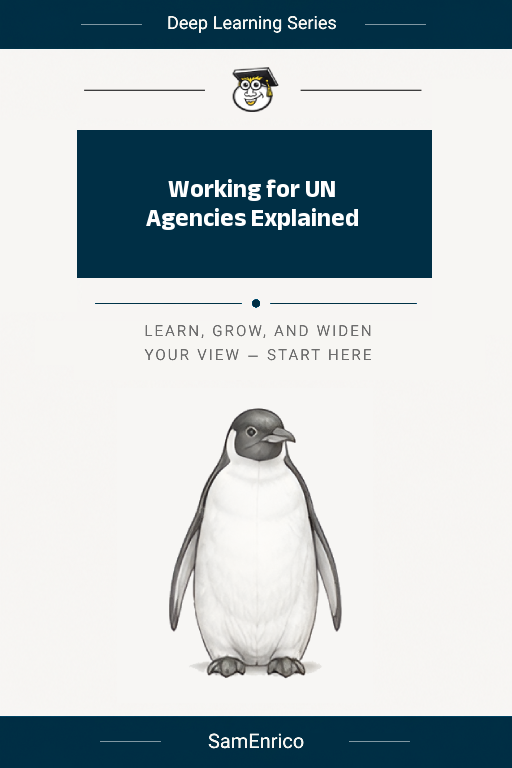
Non-FictionNon-Obvious CareerHumanitarian Work
Working for UN Agencies Explained eBook
Profiles career paths across UNDP, UNICEF, WHO, WF
Profiles career paths across UNDP, UNICEF, WHO, WFP, and UNHCR, including mission-specific skills and agency cultures.
Formats
Free sample
Chapter 1: The Architecture of Influence--–- The first mistake most UN job seekers make is treating the system like a single employer. You cannot apply to "the UN" any more than you can apply to "the government" without specifying which ministry, which department, and which role. The United Nations system comprises dozens of specialized agencies, funds, programs, and secretariats, each with its own mandate, culture, hiring process, and even its own personnel rules. This chapter builds the foundational framework you will need to navigate that complexity. By the end, you will understand how to distinguish between development agencies, humanitarian responders, and technical norm-setters, why funding models determine job security more than performance does, and how a single letter—H, B, or E—can reshape your entire quality of life.The Myth of the Single UNWhen job seekers say they want to work for "the UN," they are usually thinking of one of three things: the blue helmets in peacekeeping missions, the diplomats in New York debating resolutions, or the aid workers distributing food in refugee camps.
All three exist within the UN system, but they operate under completely different employment structures, reporting lines, and career trajectories.The UN is not a corporation with a single HR department. It is a confederation of independent organizations bound by a common brand and a shared commitment to the Charter. The Secretary-General does not hire staff for the World Health Organization. The UNDP Administrator has no authority over UNICEF recruitment. A person who spends fifteen years at WFP cannot simply transfer to UNHCR without applying, interviewing, and often starting at a lower grade.This decentralized reality is both a challenge and an opportunity.
The challenge is that you cannot submit one application and hope to be considered across the system. The opportunity is that you can apply to multiple agencies simultaneously, each with its own budget cycle, hiring timeline, and assessment process. A rejection from UNESCO does not affect your chances at WFP. A failed interview at UNDP does not go into a shared database that UNICEF can see.The first step in any successful UN job search is abandoning the phrase "the UN" as a singular noun. Replace it with specific agency names, specific mandates, and specific hiring pathways.
This chapter gives you the map to do exactly that.The Common System vs. The Specialized Agencies The UN system divides into two broad categories: the common system and the specialized agencies. This distinction matters for your salary, your pension, your contract stability, and your ability to move between organizations.The common system includes the major funds and programs such as UNDP (United Nations Development Programme), UNICEF (United Nations Children's Fund), WFP (World Food Programme), UNHCR (UN Refugee Agency), and UNFPA (Population Fund). These agencies operate under the International Civil Service Commission (ICSC), which sets standardized salary scales, post adjustments, and benefits. If you move from UNDP to UNICEF, your grade level and base salary remain the same.
Your accrued pension follows you. Your years of service count toward the same retirement thresholds.The specialized agencies include WHO (World Health Organization), ILO (International Labour Organization), UNESCO (UN Educational, Scientific and Cultural Organization), FAO (Food and Agriculture Organization), and ICAO (Civil Aviation Organization). These organizations have their own governing bodies, their own constitutions, and their own personnel rules. While they generally align with common system salary scales, they are not bound by them. A P4 at WHO may earn slightly more or less than a P4 at UNDP depending on that agency's budget cycle and cost-of-living adjustments.The practical implication is that mobility is easier within the common system than across the specialized agencies.
A UNDP staff member who wants to join WFP faces fewer administrative hurdles than a WHO staff member who wants to join UNICEF. This is not a reason to avoid specialized agencies—WHO hires experts in ways that UNDP cannot—but it is a factor to consider when planning a twenty-year career.Mandate vs. Method: Three Agency Types Beyond the legal distinction of common system versus specialized agencies lies a more practical distinction: mandate. Every UN agency exists to serve a specific purpose, and that purpose shapes everything from the types of jobs available to the personality traits that succeed there.Development Agencies: The Long Game The first category is development agencies, led by UNDP. These organizations focus on long-term capacity building with national governments.
A development project might last five, ten, or fifteen years. The goal is not to deliver immediate relief but to strengthen institutions so that countries can eventually solve their own problems.UNDP's work is organized around what it calls Signature Solutions: poverty and inequality, governance, resilience, environment, energy, and gender equality. Every UNDP job, from finance officer to policy advisor to program analyst, must connect explicitly to one of these six pillars. If you cannot articulate how your expertise advances one of these goals, you cannot get hired.The development agency culture rewards patience, political acumen, and a comfort with ambiguity. You will spend months negotiating with government ministries.
You will write reports that may never be read. You will attend coordination meetings that seem to produce nothing. Then, slowly, you will see a ministry adopt a new budgeting process you helped design, or a parliament pass a law you provided technical assistance on, and you will understand the value of the long game.Humanitarian Agencies: The Emergency Response The second category is humanitarian agencies, led by WFP and UNHCR. These organizations focus on saving lives in crisis settings. A humanitarian response might deploy within seventy-two hours of a disaster and operate for six months or six years depending on the duration of the emergency.WFP is the UN's logistics backbone.
Its job is to move food from ports to warehouses to distribution points to hungry people, often through active conflict zones. The agency values supply chain expertise, operational speed, and a willingness to sleep in shipping containers. UNHCR is the UN's protection agency. Its job is to ensure that refugees and displaced people have access to safety, shelter, legal documentation, and basic services. The agency values international refugee law, case management, and the ability to negotiate with border officials who may be hostile to your mission.The humanitarian agency culture rewards decisiveness, adaptability, and a high tolerance for chaos.
You will receive an email at 10pm telling you to be on a plane at 6am. You will manage budgets that change weekly as donor priorities shift. You will make life-and-death decisions with incomplete information. Some people thrive in this environment. Others burn out within eighteen months.Normative and Technical Agencies: The Standard Setters The third category is normative and technical agencies, led by WHO and UNICEF's policy arms.
These organizations focus on setting global standards, conducting research, and providing technical guidance to member states. A normative project might produce a set of treatment guidelines that influence medical practice for a decade.WHO does not generally run hospitals or distribute medicine. Instead, it tells governments and NGOs what medicine to distribute, how to distribute it, and how to measure whether distribution worked. The agency hires epidemiologists, health economists, implementation scientists, and policy analysts. It does not hire…
This is the end of the free sample. Get the eBook to keep going. Buy now
About this book
Details
- Author
- Savage Felice
- Publisher
- SamEnrico
- Language
- English
- Genre
- Non-Fiction, Non-Obvious Career, Humanitarian Work
- Released
- 2026-05-28
- Pages (approx.)
- 132
- Available as
- eBook, Audiobook

Read better in the ZLOADR app
Your eBooks on your phone or tablet. Sign in with your SamEnrico account and start reading.
More by Savage Felice
 Mindful Communication MBSR HandbookSavage Felice$11.99
 Mentorship RoadmapSavage Felice$11.99
 PTA Fluid Camera WorkSavage Felice$11.99
 FIFA Ultimate Team Pack FixSavage Felice$11.99
 The Gig Economy Savings Ratio GuideSavage Felice$11.99
 The Beast of Toronto: The 1880s Zoo Escape That Terrified a CitySavage Felice$11.99
 Understanding Mental RSavage Felice$17.99
 Project Management Integration StackSavage Felice$12.99
 How to Become a Splitting-machine TenderSavage Felice$11.99
 Ruby DeveloperSavage Felice$11.99
You may also like
 Hong Kong Handover 1997Dunn Johnnie$11.99
 Zumba For Postnatal Recovery CourseNeal Christian$11.99
 Zumba for BeginnersLadner Nikia$11.99
 YouTube Comment Mining GuideHumes Pandora$12.99
 Worry Box MeditationCarlin Rudy$11.99
 Workplace Stress MeditationNguyen Lynn$11.99
 Workplace Stress and Sleep RepairHawley Ivory$11.99
 Workplace Perfectionism CureDelaney Jeffry$11.99
 Workplace Injustice Anger GuideWallen Isabelle$11.99
 Work Addiction and Burnout LinkGreenwood Ester$11.99
 Women in Yoga and WellnessBeattie Galina$11.99
 Women in Stand Up ComedyChun Evangeline$11.99