
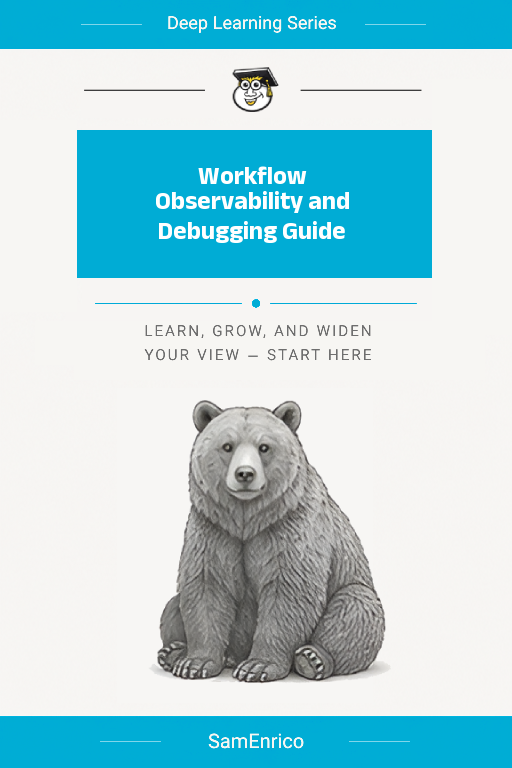
Non-FictionAI OperatorObservabilityDebugging
Workflow Observability and Debugging Guide Audiobook
Trace execution paths, log step outputs, and repla
by Best Dorian
Trace execution paths, log step outputs, and replay failed workflows. Generate root cause reports for orchestration errors automatically.
Formats
Free sample
Chapter 1: The Silent Lie...--–- Monday, 2:47 AM. Sarah, the senior site reliability engineer on call, stared at her dashboard with the particular numbness that comes from watching money evaporate in real time. Her company's payment processing workflow had been running for forty-seven minutes without a single exception. The logs were clean. The metrics were green.
The traces showed every step completing successfully. And yet, twelve thousand customers had not received their digital purchases, and the reconciliation system was reporting a $420,000 discrepancy.The workflow, by every traditional measure, had succeeded. It had called the payment gateway, received a 200 OK, updated the database, sent confirmation messages, and logged "Payment processed successfully" at every step. But the gateway had actually returned a stale response from its cache—an acknowledgment of a transaction that had never settled. The workflow did exactly what it was told.
It just didn't know that what it was told was a lie.This is the silent lie of modern workflow observability. Not the loud crash, not the exception stack trace, not the timeout error that wakes you up. The silent lie is worse. It whispers that everything is fine while your business bleeds.The Observability Trap For the past fifteen years, the software industry has been taught a simple, seductive story about observability. Collect three pillars—metrics, logs, and traces—and you will understand what your system is doing.
This story appears in every monitoring vendor's marketing materials, every conference keynote, every "observability maturity model." It is taught in bootcamps and repeated in engineering blogs. It is also, for complex workflows, dangerously incomplete.The three pillars were designed for stateless request-response systems. A web server receives an HTTP request, does some work, returns a response, and forgets everything. For that world, metrics tell you about aggregate health, logs tell you about discrete events, and traces tell you about the path of a single request through microservices. This works because the state is simple: either the request succeeded (2xx), or it failed (4xx/5xx), or it timed out.But modern workflows are not stateless request-response systems.
They are stateful, long-running, branching, retrying, human-in-the-loop orchestrations that can take minutes, hours, or days to complete. An e-commerce checkout workflow might span twenty-three microservices, touch four databases, call two payment gateways, wait for fraud review, send three emails, and update a half-dozen caches. It might succeed for the customer (they got their…
This is the end of the free sample. Get the Audiobook to keep going. Buy now
About this book
Details
- Author
- Best Dorian
- Publisher
- SamEnrico
- Language
- English
- Genre
- Non-Fiction, AI Operator, Observability, Debugging
- Released
- 2026-05-30
- Pages (approx.)
- 151
- Available as
- eBook, Audiobook

Listen in the VoxFlicks app
Audiobooks and audio dramas wherever you go. Sign in with your SamEnrico account and press play.
More by Best Dorian
 Carnegie Libraries LegacyBest Dorian$11.99
 Twitch Streamer Viewer EnvyBest Dorian$11.99
 Social Media and Eating DisordersBest Dorian$11.99
 Long Breath AwarenessBest Dorian$11.99
 The Vaccine Communication ScriptBest Dorian$11.99
 The Orphanage Childhood GuideBest Dorian$11.99
 First Responder Trauma DreamsBest Dorian$11.99
 Imposter Syndrome For Single ParentsBest Dorian$11.99
 Ballet Dancer Pressure GuideBest Dorian$11.99
 The Silent Codebreakers: How a Whistleblower Exposed the NSA’s Darkest SecretBest Dorian$11.99
 The Boxers' Last Stand: How a Secret Society Defied the WorldBest Dorian$11.99
 The Iron Spine of Europe: The Men Who Built the ContinentBest Dorian$11.99
You may also like
 Hong Kong Handover 1997Dunn Johnnie$11.99
 Zumba For Postnatal Recovery CourseNeal Christian$11.99
 Zumba for BeginnersLadner Nikia$11.99
 YouTube Comment Mining GuideHumes Pandora$12.99
 Worry Box MeditationCarlin Rudy$11.99
 Workplace Stress MeditationNguyen Lynn$11.99
 Workplace Stress and Sleep RepairHawley Ivory$11.99
 Workplace Perfectionism CureDelaney Jeffry$11.99
 Workplace Injustice Anger GuideWallen Isabelle$11.99
 Work Addiction and Burnout LinkGreenwood Ester$11.99
 Women in Yoga and WellnessBeattie Galina$11.99
 Women in Stand Up ComedyChun Evangeline$11.99