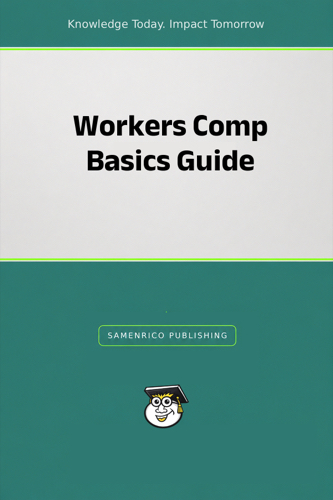
Workers Comp Basics Guide eBook
Explains state requirements, premium calculations,
Explains state requirements, premium calculations, and claims handling for employee injuries.
Formats
Free sample
Chapter 1: The Grand Bargain...--Every year, American employers write checks totaling more than $60 billion for workers' compensation insurance. Some of those checks are for $500. Some are for $5 million. But here is what almost none of those employers understand: they are not paying for "insurance" in the way they think they are paying for insurance.When you buy general liability insurance, you are buying a promise. If someone slips on your wet floor, the carrier will pay their medical bills and legal fees.
When you buy property insurance, you are buying a guarantee. If your warehouse burns down, the carrier will write you a check for the replacement cost. But workers' compensation is different. It is not really insurance at all. It is a prepaid legal defense fund wrapped in a social contract, and the moment you understand that distinction, everything about how you run your business changes.This chapter opens with the single most important concept in this entire book: the Grand Bargain.
If you learn nothing else from these pages, learn this. The Grand Bargain explains why workers' comp exists, why you are required to carry it, why your employees cannot sue you when they get hurt, and why trying to "fight" every claim is often the dumbest possible strategy. More importantly, understanding the Grand Bargain gives you a lens through which to view every decision you will make about reporting injuries, choosing doctors, and settling claims.Let us go back to the world before workers' comp. It is a world you need to see clearly, because it explains why the system we have today is so strange, so expensive, and so worth understanding.The Bloody Origins of No-Fault Before 1911, if an employee was injured at work, they had exactly one option: sue their employer in civil court. The employee had to prove that the employer was negligent—that the employer failed to provide a safe workplace, failed to maintain equipment, or failed to train properly.
This sounds reasonable until you understand the three legal defenses that employers could deploy, defenses so powerful that employees almost never won.The first defense was contributory negligence. If the employee was even 1% at fault for their own injury—if they took a shortcut, if they didn't follow a safety rule, if they simply weren't paying attention—they lost. Entirely. Zero compensation. In many states, this was an absolute bar to recovery.
An employee could be crushed by a collapsing wall because the employer used substandard materials, but if the employee had chosen to walk on the left side of the hallway instead of the right, they were barred from recovery.The second defense was the fellow-servant rule. If a coworker caused the accident—if two employees were horsing around, if one employee failed to lock out a machine, if a supervisor gave a bad order—the employer could argue that they were not responsible for the actions of a "fellow servant." The injured employee had to sue their coworker, who almost certainly had no money to pay a judgment. This rule was specifically designed to protect employers from liability for the inevitable errors of their workforce.The third defense was assumption of risk. If the employee knew or should have known that the job was dangerous, they assumed that risk when they accepted employment. A coal miner knows that mines collapse.
A roofer knows that roofs are high. A fisherman knows that the sea is unpredictable. Under assumption of risk, employers could argue that the employee had voluntarily accepted the dangers of the trade and therefore could not complain when those dangers materialized.These three defenses were not loopholes. They were the core of nineteenth-century employment law, and they worked exactly as intended: employees almost never won. When they did win, however, the results could be catastrophic for employers.
Juries, sympathetic to a grievously injured worker, would award massive sums for pain and suffering, lost wages, and punitive damages. A single verdict could bankrupt a company. So both sides were unhappy. Employees were unhappy because they received nothing in 95% of cases. Employers were unhappy because the 5% of cases they lost could destroy them.Something had to change.The Deal That Changed Everything Between 1911 and 1948, every state enacted a workers' compensation law.
These laws were not designed by insurance companies. They were not designed by labor unions. They were designed by a coalition of progressives, industrialists, and economists who recognized that the litigation system was failing everyone. The solution was a grand bargain, a trade-off so fundamental that it reshaped the relationship between capital and labor for the next century.Here is the deal.On the employee's side of the bargain, they give up the right to sue their employer for negligence. They cannot collect pain and suffering.
They cannot collect punitive damages. They cannot bring a civil claim for emotional distress. In exchange, they receive guaranteed, no-fault benefits for any work-related injury. Medical care is paid for. Lost wages are replaced at a fixed percentage (typically two-thirds of pre-injury wages).
If the injury causes permanent disability, they receive a scheduled payment based on the body part injured. If the injury causes death, their family receives death benefits.On the employer's side of the bargain, they give up the three common law defenses. They cannot argue contributory negligence. They cannot invoke the fellow-servant rule. They cannot claim assumption of risk.
In exchange, they receive exclusive remedy immunity. The employee cannot sue them in civil court. The employee cannot collect pain and suffering damages. The employee's only recourse is the workers' compensation system. That is the bargain.Let me repeat this because it is the single most important sentence in this book: When an employee is injured at work, their only remedy against you is workers' compensation, and your only defense is workers' compensation.This is why fighting every claim to "prove the employee is faking" is often terrible business strategy.
The moment you dispute compensability—the moment you say "this injury didn't happen at work" or "this injury isn't as bad as they say"—you are threatening to break the Grand Bargain. You are telling the employee that they might need to sue you after all. And when employees feel that the bargain is being broken, they hire lawyers. When they hire lawyers, claims costs triple. When claims costs triple, your Experience Modifier rises and your premiums rise with it.I am not saying you should never dispute a claim.
Clear fraud exists. Injuries that occur off-site and off-the-clock are not covered. But the default position of a smart employer is acceptance, not warfare. Accept the claim. Control the medical care.
Return the employee to work. Preserve the exclusive remedy. That is the path to lower premiums.What Is Actually Covered? Two Key Phrases Now that you understand the Grand Bargain, you need to understand its boundaries. Not every injury that happens near a workplace is covered.
Not every injury that happens during work hours is covered. The law uses two phrases to define the scope of coverage, and every dispute you will ever have turns on their interpretation.The first phrase is "arising out of" employment. This means the injury must be caused…
This is the end of the free sample. Get the eBook to keep going. Buy now
About this book
Details
- Author
- Langlois Glenna
- Publisher
- SamEnrico
- Language
- English
- Genre
- Non-Fiction, Business Brief, Employee Benefits
- Released
- 2026-06-06
- Pages (approx.)
- 140
- Available as
- eBook, Audiobook

Read better in the ZLOADR app
Your eBooks on your phone or tablet. Sign in with your SamEnrico account and start reading.
More by Langlois Glenna
 Insecure Attachment HealingLanglois Glenna$11.99
 Bezos World DominationLanglois Glenna$11.99
 Apology Conversation GuideLanglois Glenna$11.99
 Twitter Personal Brand GuideLanglois Glenna$11.99
 Advanced Sleep Phase DisorderLanglois Glenna$11.99
 Working Memory For Adhd AdultsLanglois Glenna$11.99
 Japanese American Internment CampLanglois Glenna$11.99
 Ethel Smyth: The Composer Who Defied Victorian NormsLanglois Glenna$11.99
 The Phantom Games of Athens: The Secret War to Save the First Modern Olympics (1896)Langlois Glenna$11.99
 How to Trade LeadLanglois Glenna$11.99
 How to Produce RugbyLanglois Glenna$11.99
 Cooperative Value Addition PlaybookLanglois Glenna$12.99