
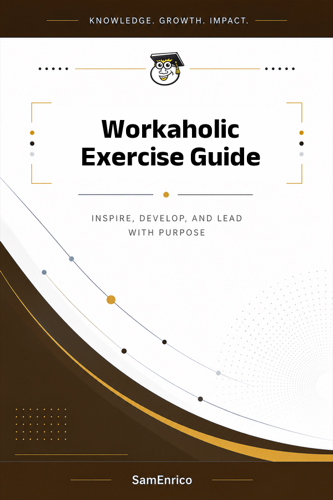
Workaholic Exercise Guide eBook
Incorporate movement into your packed schedule usi
Incorporate movement into your packed schedule using this practical wellness workbook.
Formats
Free sample
Chapter 1: The Energy Lie--–- Let me begin with a confession that would make any productivity guru wince: For eleven years, I believed I didn’t have enough time to exercise. I was a management consultant working eighty-hour weeks, living on airport coffee and hotel scrambled eggs, and genuinely convinced that a workout would cost me a client, a promotion, or my reputation. I told myself that when the project ended, when the quarter closed, when I finally caught up, I would start moving. That day never came. Instead, my energy collapsed.
My focus fragmented. By three o’clock each afternoon, I was reading the same paragraph of a financial model six times without comprehension. I was working more but achieving less. And like so many workaholics, I had confused the symptom—exhaustion—with the solution: more work.This chapter dismantles the most expensive lie you have ever been sold. The lie is not that exercise is good for you.
You already know that. The lie is that you need a full hour, special clothes, a gym membership, and a block of uninterrupted time to benefit from movement. The lie is that exercise is a separate task to check off your to-do list, competing with real work for your limited attention. The lie is that when you are overloaded, the first thing to cut is your workout.The truth is far stranger and far more profitable. Movement is not a distraction from high performance.
It is a direct input to it. Ten minutes of elevated heart rate changes your brain chemistry in ways that no productivity app, no amount of caffeine, and no willpower hack can replicate. And the most successful executives, lawyers, founders, and creators you admire are not working out despite their schedules. They are working out because of their schedules. They have discovered what you are about to learn: exercise is not a leisure activity.
It is a cognitive investment with a return that would embarrass your 401(k).The Hourglass Trap: Why the Traditional Model Fails Workaholics Most people approach exercise like an hourglass. They flip it over once per day, watch the sand drain for forty-five or sixty minutes, and then consider themselves done. This model works for retirees, for people with dedicated lunch breaks, for anyone whose calendar includes empty spaces. It does not work for you.The hourglass model makes three false assumptions. First, it assumes you have a contiguous block of time when you are not working, not commuting, not answering emails, and not recovering from exhaustion.
Second, it assumes that the quality of exercise scales linearly with duration—that a sixty-minute workout is twice as good as a thirty-minute workout. Third, it assumes that the benefits of exercise are limited to the hour you spend moving.All three assumptions are wrong. And believing them has cost you more energy than you realize.Let me show you what the research actually says. A landmark study from the Journal of Applied Physiology found that three ten-minute bouts of high-intensity exercise spread throughout the day produced greater improvements in cardiovascular fitness and insulin sensitivity than a single thirty-minute continuous session. Another study from the University of Missouri discovered that breaking up sitting time with just two minutes of walking every thirty minutes reduced post-meal blood sugar spikes by nearly thirty percent compared to sitting continuously.
And a meta-analysis published in the British Journal of Sports Medicine concluded that accumulating physical activity in short bursts—even bursts as short as one minute—was associated with the same mortality reduction as longer sessions.The hourglass is a lie. The real model is a dripping faucet: small, frequent, almost unnoticeable releases of movement that accumulate into a flood of energy, focus, and resilience.Exercise ROI: Why Ten Minutes Is Worth More Than an Hour Let me introduce a concept that will appear throughout this book. I call it Exercise ROI—return on investment measured not in calories burned or miles logged, but in cognitive output and energy returned.Every minute you spend moving generates a return. The return comes in three forms: immediate, short-term, and long-term. Understanding these returns is the first step toward reframing exercise as something you cannot afford to skip.The Immediate Return.
Within ninety seconds of starting moderate to vigorous movement, your heart rate increases, blood flow to the brain rises, and your body releases a protein called brain-derived neurotrophic factor. BDNF is sometimes called Miracle-Gro for the brain. It strengthens existing neurons, encourages the growth of new ones, and improves synaptic plasticity—which is the scientific way of saying it makes you smarter, faster, and more adaptable. The immediate return also includes a surge of dopamine and norepinephrine, neurotransmitters that sharpen focus and elevate mood. You do not have to wait hours or weeks for these effects.
They begin within minutes.The Short-Term Return. In the three to four hours following exercise, your executive function—the cognitive system responsible for planning, problem-solving, inhibition, and mental flexibility—operates at a measurably higher level. Researchers at the University of British Columbia found that people who exercised before a cognitive test performed significantly better than those who did not, regardless of their baseline fitness level. The short-term return is why CEOs schedule workouts before board meetings, why trial attorneys go for a run before closing arguments, and why the most productive people you know refuse to skip movement on important days.The Long-Term Return. Over weeks and months, regular movement increases the volume of your hippocampus (the brain region responsible for memory), reduces systemic inflammation (a known enemy of cognitive function), and improves sleep quality (which is when your brain consolidates memories and clears metabolic waste).
The long-term return is the difference between burning out at fifty and thriving at seventy.Now let me give you the numbers that matter. Based on a synthesis of studies in exercise physiology and occupational psychology, I have calculated a conservative estimate of Exercise ROI: every minute of high-yield movement generates two to three minutes of high-quality work later in the day. This is not magic. It is biology. When you move, you improve blood flow, elevate neurotransmitters, reduce fatigue, and sharpen decision-making.
The person who spends ten minutes moving at two o’clock in the afternoon will accomplish more between two-thirty and five o’clock than the person who grinds through without moving. The ten minutes are not lost. They are invested.The Guilt Paradox: Why You Feel Bad About Not Exercising If movement is so valuable, why do workaholics consistently cut it first? The answer is guilt, and guilt operates in a strange, self-reinforcing loop.Here is how the loop works. You are busy.
You look at your calendar and see no room for a workout. You feel a small pang of guilt—you should exercise, you know it is good for you, but you simply cannot find the time. To relieve that guilt, you work harder. You answer more emails. You take on one more task.
You stay late. And because you are working harder, you are even more tired and even more busy tomorrow. The guilt that began as a signal to change has become fuel…
This is the end of the free sample. Get the eBook to keep going. Buy now
About this book
Details
- Author
- Ramirez Billy
- Publisher
- SamEnrico
- Language
- English
- Genre
- Non-Fiction, Self-Help, Fitness
- Released
- 2026-06-06
- Pages (approx.)
- 140
- Available as
- eBook, Audiobook

Read better in the ZLOADR app
Your eBooks on your phone or tablet. Sign in with your SamEnrico account and start reading.
More by Ramirez Billy
 Forensic Glass Density GuideRamirez Billy$11.99
 Emotional Needs GuideRamirez Billy$11.99
 Peak Performance Cycle GuideRamirez Billy$11.99
 Taekwondo Hypnosis GuideRamirez Billy$11.99
 The Molybdenum GuideRamirez Billy$11.99
 Law School SRS GuideRamirez Billy$11.99
 Pregnancy Loss Support WorkbookRamirez Billy$11.99
 The Royal Bards of Axum: Africa's Forgotten Court ComposersRamirez Billy$11.99
 Stoic Warriors: The Unshakable Philosophy of Marcus AureliusRamirez Billy$11.99
 How to Produce ScaffoldingRamirez Billy$11.99
 How to Start a Commercial Banking BusinessRamirez Billy$11.99
 How to Produce Flash Memory CardsRamirez Billy$11.99
You may also like
 Hong Kong Handover 1997Dunn Johnnie$11.99
 Zumba For Postnatal Recovery CourseNeal Christian$11.99
 Zumba for BeginnersLadner Nikia$11.99
 YouTube Comment Mining GuideHumes Pandora$12.99
 Worry Box MeditationCarlin Rudy$11.99
 Workplace Stress MeditationNguyen Lynn$11.99
 Workplace Stress and Sleep RepairHawley Ivory$11.99
 Workplace Perfectionism CureDelaney Jeffry$11.99
 Workplace Injustice Anger GuideWallen Isabelle$11.99
 Work Addiction and Burnout LinkGreenwood Ester$11.99
 Women in Yoga and WellnessBeattie Galina$11.99
 Women in Stand Up ComedyChun Evangeline$11.99