
Non-FictionSelf-HelpJournaling
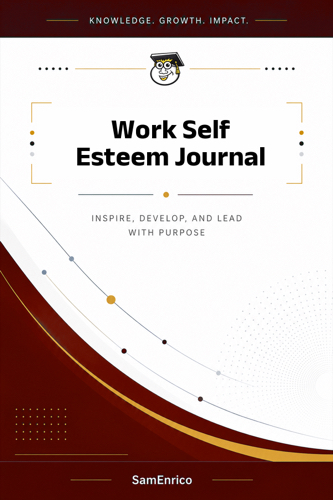
Work Self Esteem Journal eBook
Write daily confidence building entries.
Write daily confidence building entries.
Formats
Free sample
Chapter 1: The Observer Awakens...--You are not the voice in your head. You are the one who hears it.This single sentence is the most important thing you will read in this entire book. If you forget every exercise, every prompt, every technique that follows—but you remember this sentence—the twelve weeks you spend with this journal will have been worth it. Because here is the uncomfortable truth that most self-esteem books dance around: you have been walking around believing that your inner critic is you. That the voice saying “I’m not good enough,” “I’m going to be fired,” “Everyone knows I’m faking it”—that voice is your authentic self, telling you the hard truth.It is not.
And believing that it is has been the source of your suffering.Let me say it again, more directly: the voice that tells you that you are failing, that you don’t belong, that your colleagues are smarter, that your boss secretly regrets hiring you—that voice is not your ally. It is not your conscience. It is not keeping you humble. It is a faulty alarm system, a smoke detector that goes off every time you toast bread. And you have been evacuating the building every single morning.This chapter is called “The Observer Awakens” because your first and most essential task is not to silence the critic.
That will come later. Your first task is to realize that you are not the critic. You are the one watching the critic. You are the sky; the critic is just weather. And the sky is never harmed by the storm passing through it.The False Equation of Workplace Self-Esteem Before we go any further, let’s name the specific shape your self-doubt takes.
Because workplace self-esteem is different from general self-esteem. You might feel perfectly confident in your relationships, your parenting, your hobbies—and then walk into a meeting and feel like a child wearing adult clothes. This is not a coincidence. The workplace amplifies a specific kind of self-doubt because it ties your worth to things that can be measured, compared, and found wanting.Here is the false equation that most professionals live by without ever questioning it:My worth = my output + their praise + my paycheck When output dips, worth dips. When praise is withheld, worth craters.
When a colleague gets promoted and you don’t, worth evaporates. This equation is a trap. And it begins with the inner critic, which is the voice that enforces this equation.The inner critic learned its lines somewhere. Maybe it was a parent who only praised achievements. Maybe it was a teacher who valued the right answer over the effort.
Maybe it was a first boss who confused kindness with weakness. The origin doesn’t matter as much as the pattern: somewhere along the way, you learned that your value as a human being is conditional on your performance. And now your brain runs that program automatically, without your permission, hundreds of times a day.The first step to breaking that program is not to fight it. Fighting your own mind is exhausting and counterproductive. The first step is to watch it.
To notice it. To say, “Oh, there is that thought again,” without believing it. This is called metacognition—thinking about your thinking. And it is the single most powerful skill you can develop for workplace confidence.The Brain Dump: Externalizing the Internal Noise Open your journal now. Find the first page of the “Daily Entries” section.
You are going to do something that will feel uncomfortable, possibly even dangerous. You are going to write down every single fearful thought you have about your work performance—without filtering, without editing, without judging yourself for having the thought.This is called a brain dump. And it is the opposite of toxic positivity. You are not going to “think positive.” You are not going to “manifest success.” You are going to take the messy, tangled, shameful knot of self-doubt that lives in your chest and you are going to pull it out, strand by strand, and put it on the page.Set a timer for five minutes. Write continuously.
Do not stop. Do not correct spelling. Do not cross anything out. If the thought is “I am a fraud,” write “I am a fraud.” If the thought is “Everyone knows I don’t belong here,” write it. If the thought is something so shameful you have never said it aloud—write it.When the timer goes off, stop.
Close the journal. Breathe.What you have just done is externalized the internal noise. Before this moment, those thoughts were swimming around in your head, feeling like objective truth. Now they are on paper. And paper can be examined.
Paper can be challenged. Paper cannot hurt you.The Separation: You Are Not Your Thoughts Here is a fundamental truth from cognitive behavioral therapy that will change everything: just because you think something does not make it true.You might think “I am going to be fired.” That is a thought. It is not a prophecy. You might think “I am the least competent person on my team.” That is a thought. It is not a fact.
You might think “Everyone can see that I don’t know what I’m doing.” That is a thought. It is not a security camera feed.The problem is that your brain does not automatically distinguish between thoughts and facts. Evolution did not design your brain for happiness or accuracy; it designed your brain for survival. And from a survival perspective, it is better to mistake a stick for a snake than a snake for a stick. So your brain leans toward false positives—seeing threats that aren’t there.
The inner critic is a false positive generator. It is doing what it evolved to do: keep you safe by assuming the worst.But you are not a caveman anymore. You are a professional in a complex workplace. The threats you face are not saber-toothed tigers. They are emails, meetings, deadlines, and performance reviews.
And the “worst case” your brain keeps showing you—humiliation, firing, public shame—is almost never as bad as the prediction.The brain dump you just completed is the first step in teaching your brain a new skill: distinguishing between thoughts and facts. Right now, your brain treats them as identical. Over the next twelve weeks, you will train it to pause, examine, and choose.Fact vs. Fiction: The Core Cognitive Restructuring Tool Now go back to your brain dump. Read it slowly.
As you read, ask yourself one question for each sentence: “Is this a fact or a story?”A fact is something that could be entered as evidence in a court of law. “I forgot to attach the file to the email I sent at 2:00 PM” is a fact. It is verifiable. There is a record.A story is an interpretation, a prediction, a judgment, or a feeling dressed up as a fact. “I am a failure” is a story.
“My boss thinks I’m incompetent” is a story (unless your boss has said those exact words, in which case it becomes…
This is the end of the free sample. Get the eBook to keep going. Buy now
About this book
Details
- Author
- Rafferty Corazon
- Publisher
- SamEnrico
- Language
- English
- Genre
- Non-Fiction, Self-Help, Journaling
- Released
- 2026-06-07
- Pages (approx.)
- 140
- Available as
- eBook, Audiobook

Read better in the ZLOADR app
Your eBooks on your phone or tablet. Sign in with your SamEnrico account and start reading.
More by Rafferty Corazon
 Breathing Space for PainRafferty Corazon$11.99
 Hackathon for BusinessRafferty Corazon$11.99
 Alcoholism Recovery Nutrition GuideRafferty Corazon$11.99
 Roam Research Graph ViewRafferty Corazon$11.99
 Pain Journal for MeditationRafferty Corazon$11.99
 Karakum Desert NomadsRafferty Corazon$11.99
 Weekly Review for HealthcareRafferty Corazon$11.99
 The Vanishing of the Chateau d'If Inmates: France's Dark Prison MysteryRafferty Corazon$11.99
 Symphony of the Sun: The Black Composers Who Shaped Classical MusicRafferty Corazon$11.99
 The Essential Guide to PopRafferty Corazon$11.99
 How to Start a Machinery (undefined) (wholesale) Business (Beginners Guide)Rafferty Corazon$11.99
 Philippines SSS and PhilHealth GuideRafferty Corazon$12.99
You may also like
 Hong Kong Handover 1997Dunn Johnnie$11.99
 Zumba For Postnatal Recovery CourseNeal Christian$11.99
 Zumba for BeginnersLadner Nikia$11.99
 YouTube Comment Mining GuideHumes Pandora$12.99
 Worry Box MeditationCarlin Rudy$11.99
 Workplace Stress MeditationNguyen Lynn$11.99
 Workplace Stress and Sleep RepairHawley Ivory$11.99
 Workplace Perfectionism CureDelaney Jeffry$11.99
 Workplace Injustice Anger GuideWallen Isabelle$11.99
 Work Addiction and Burnout LinkGreenwood Ester$11.99
 Women in Yoga and WellnessBeattie Galina$11.99
 Women in Stand Up ComedyChun Evangeline$11.99