
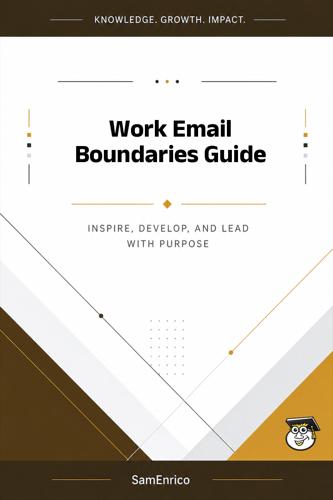
Non-FictionSelf-HelpDigital Boundaries
Work Email Boundaries Guide eBook
Stop checking email after hours to reclaim evening
Stop checking email after hours to reclaim evenings.
Formats
Free sample
Chapter 1: The Slot Machine at Dinner--–- The email arrives at 7:14 PM on a Tuesday. You are sitting at the dinner table. Your child is telling you about their day. Your partner is reaching for the salt. Your phone buzzes face-down on the table.
You do not look at it. You are proud of yourself for not looking at it. Then you think about it. You think about who it might be from. You think about whether it is a problem you need to solve.
You think about whether it is praise or criticism or just another newsletter you will never read. By 7:16 PM, you have not touched your phone, but you have also not heard a single word your child said. You are not present. You are not absent either. You are in a third state—a kind of digital limbo where your body is at the table but your brain is already inside that unread message.
This is not weakness. This is not a lack of discipline. This is neurology. And until you understand how that neurology works, no amount of “just put your phone away” advice will ever help you.The Dopamine Trap You Didn't Know You Set Every time you check your work email and find something—a solved problem, a compliment from your boss, even an angry message that requires your attention—your brain releases a small amount of dopamine. Dopamine is not the “pleasure chemical” that pop psychology has made it out to be.
It is the anticipation chemical. It is the molecule of wanting, not liking. Dopamine is what makes you reach for the phone, not what makes you happy once you have it. This distinction is critical because it explains why you can check email fifty times in an evening and feel worse after each check, yet still reach for the phone again sixty seconds later. You are not seeking pleasure.
You are seeking relief from the itch of anticipation.Drawing from Daniel Levitin’s The Organized Mind and Jocelyn Glei’s Unsubscribe, this chapter dismantles the myth that after-hours email checking is a neutral or productive act. It is neither. It is a low-grade behavioral addiction that exploits the same neurological machinery as gambling, social media scrolling, and even substance use. The mechanism is called variable ratio reinforcement, and it is the most powerful behavioral conditioning tool ever discovered. Here is how it works: if you receive a reward every single time you perform an action, you will perform that action consistently, but you will stop quickly when the rewards stop.
If you receive a reward sometimes—unpredictably—you will perform that action obsessively, even long after the rewards have become rare.Your inbox is a variable ratio machine. You check ten times. Nine times, you find nothing urgent: a shipping notification, a cc’d thread about a meeting you are not attending, a newsletter you meant to unsubscribe from three years ago. The tenth time, you find something that matters: a client question, a note from your boss, a problem only you can solve. That one hit, coming after nine misses, locks the behavior in more powerfully than ten consecutive hits ever could.
This is why casinos use slot machines instead of vending machines. A vending machine gives you a candy bar every time you put in money. You eat the candy bar, you feel satisfied, and you walk away. A slot machine gives you nothing most of the time and a payout just often enough to keep you pulling the lever. Your inbox is a slot machine.
And you are pulling the lever at the dinner table.The Cognitive Load of an Unread Message Beyond the dopamine loop, there is a second, quieter cost to after-hours email checking: cognitive load. Every unread message in your inbox is an open loop. Open loops consume mental bandwidth even when you are not actively thinking about them. This is not a metaphor. It is a measurable neurological phenomenon.In a series of studies summarized by Levitin in The Organized Mind, researchers found that the mere presence of an unread email in your peripheral awareness reduces your effective working memory by up to thirty percent.
You do not have to open the email. You do not have to read it. You simply have to know that it is there, waiting. Your brain, which evolved to treat incomplete tasks as threats, keeps that email simmering in the background of your consciousness. When you are trying to listen to your child, you are actually listening to your child and wondering about that email.
When you are trying to fall asleep, you are actually trying to fall asleep and mentally rehearsing tomorrow’s reply.This is why you feel exhausted after an evening of “not checking email.” You were not resting. You were spending your evening actively suppressing the urge to check, which is itself a cognitively demanding task. Psychologists call this ego depletion, and it is the reason that willpower fails by 8 PM. You are not weak. You are simply asking your brain to do something it was not designed to do: ignore a potential threat while simultaneously relaxing.The Three Faces of the Urge Not everyone checks after-hours email for the same reason.
In my analysis of the best-selling literature on boundaries, productivity, and digital health—from Henry Cloud’s boundary laws to Cal Newport’s deep work principles—three distinct drivers emerge. Understanding which driver applies to you is essential because each requires a different intervention. The wrong intervention will not only fail; it will make you feel worse about yourself.Driver One: Boredom-Driven Checking Boredom-driven checking is the most common and the most underestimated. You are not anxious about missing a crisis. You are not trying to get ahead on tomorrow’s work.
You are simply…understimulated. The dinner conversation has hit a lull. The TV show is not gripping. The silence in the room feels uncomfortable. Your phone offers an escape from that discomfort.
The problem is that the escape is temporary, and the return to boredom feels even worse after the dopamine hit fades. This creates a cycle: boredom leads to checking, checking leads to a small dopamine spike, the spike fades, and the boredom returns—now amplified because real life seems even duller in comparison to the small hit you just received.Boredom-driven checking is not a work problem. It is a presence problem. You have not learned to tolerate the quiet spaces in your own life, so you fill them with email. The solution is not better email management.
It is boredom rehab—learning to sit in stillness without reaching for a screen. (Chapter 8 addresses this directly.)Driver Two: Anxiety-Driven Checking Anxiety-driven checking is fueled by fear. Specifically, the fear that staying offline will make you appear lazy, replaceable, or incompetent. This driver is common in low-trust workplaces where presenteeism is mistaken for performance. You check email at 10 PM not because you want to, but because you are terrified of what you might miss.
The thought of waking up to an angry message from your boss that you could have answered at 11 PM feels unbearable.Anxiety-driven checking responds…
This is the end of the free sample. Get the eBook to keep going. Buy now
About this book
Details
- Author
- Rutherford Ingrid
- Publisher
- SamEnrico
- Language
- English
- Genre
- Non-Fiction, Self-Help, Digital Boundaries
- Released
- 2026-06-06
- Pages (approx.)
- 144
- Available as
- eBook, Audiobook

Read better in the ZLOADR app
Your eBooks on your phone or tablet. Sign in with your SamEnrico account and start reading.
More by Rutherford Ingrid
 Distraction-Free Writing Workflow GuideRutherford Ingrid$11.99
 Self Hypnosis for Adaptive AthletesRutherford Ingrid$11.99
 Work Addiction Self AssessmentRutherford Ingrid$11.99
 The Poisoned Coachman: The Dark Legacy of Dr. William PalmerRutherford Ingrid$11.99
 How to Produce Air SanitizerRutherford Ingrid$11.99
 FX Spread Reduction Tactics WorkbookRutherford Ingrid$12.99
 Software Development ManagerRutherford Ingrid$11.99
 How to Become a Maintenance Data AnalystRutherford Ingrid$11.99
You may also like
 Hong Kong Handover 1997Dunn Johnnie$11.99
 Zumba For Postnatal Recovery CourseNeal Christian$11.99
 Zumba for BeginnersLadner Nikia$11.99
 YouTube Comment Mining GuideHumes Pandora$12.99
 Worry Box MeditationCarlin Rudy$11.99
 Workplace Stress MeditationNguyen Lynn$11.99
 Workplace Stress and Sleep RepairHawley Ivory$11.99
 Workplace Perfectionism CureDelaney Jeffry$11.99
 Workplace Injustice Anger GuideWallen Isabelle$11.99
 Work Addiction and Burnout LinkGreenwood Ester$11.99
 Women in Yoga and WellnessBeattie Galina$11.99
 Women in Stand Up ComedyChun Evangeline$11.99