
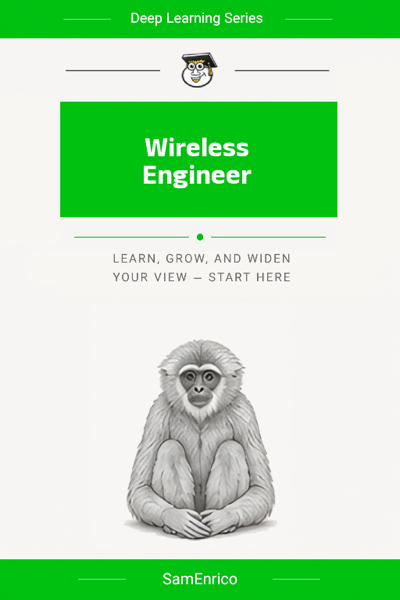
Non-FictionInformativeEducational
Wireless Engineer eBook
A Coursebook on Wireless Engineer
A Coursebook on Wireless Engineer
Formats
Free sample
Chapter 1: The Invisible River...–- The first lesson of wireless engineering is one most beginners learn the hard way: the air is a liar. Unlike copper or fiber optics, where signals follow predictable paths inside shielded insulation, the electromagnetic spectrum behaves like a turbulent river—invisible, uncontainable, and shared by every transmitter within range. You cannot see interference. You cannot touch attenuation. You cannot hear the collision of two packets on the same frequency.
Yet these invisible forces determine whether a video call connects, whether an industrial sensor reports its data, or whether an emergency call reaches first responders. This chapter establishes the essential paradox of wireless engineering: the medium is simultaneously the most convenient and the most hostile environment for communication. Before you write a single line of code or solder a single connector, you must understand where wireless came from, how the spectrum is governed, and why physics makes wireless fundamentally harder than wired.The problem begins with a simple fact: wired networks enjoy physical containment. When you send an electrical signal down an Ethernet cable, that signal stays inside the copper conductors, shielded from external interference, and arrives at the intended receiver with minimal corruption. Wireless, by contrast, broadcasts energy in all directions (or focused directions, as we will explore in Chapter 3), and that energy does not stop at property lines, walls, or even national borders.
Your Wi-Fi signal reaches your neighbor’s apartment. Your cellular phone’s transmission reaches a tower kilometers away. A rogue transmitter on the same frequency can destroy your link from a distance you cannot see. The air is a shared, contested, and fundamentally unreliable medium. Mastering wireless engineering means learning to work within these constraints, not against them.This first chapter traces the historical arc that brought us from James Clerk Maxwell’s equations to the crowded spectrum of today, explains the regulatory framework that governs who can transmit where, and introduces the fundamental trade-offs of frequency selection.
By the end, you will understand why wireless is not simply “wired without the cables” but a distinct discipline with its own physics, its own economics, and its own design principles. Every subsequent chapter in this book—from RF physics to modulation, from antennas to site surveys—builds on the foundation laid here. Let us begin where all wireless engineering begins: with the invisible river of electromagnetic waves.The Electromagnetic Spectrum: A Finite Resource The electromagnetic spectrum is the range of all possible frequencies of electromagnetic radiation, from the very low frequencies (3 k Hz) used for submarine communication to the extremely high frequencies (300 GHz and above) used for experimental terahertz systems. In between lie the radio frequencies that power every wireless device you have ever used: AM and FM radio, television broadcasts, cellular phones, Wi-Fi, Bluetooth, GPS, satellite communications, radar, and microwave links. The spectrum is not infinite.
It is not expandable. And it is not replaceable. Every new wireless service must find its place within this finite range, often sharing frequencies with existing services or displacing them entirely.The relationship between frequency and wavelength is given by the fundamental equation c=λfc = \lambda fc=λf, where ccc is the speed of light (approximately 3 × 10^8 meters per second in free space), λ\lambdaλ (lambda) is the wavelength in meters, and fff is the frequency in hertz. This inverse relationship has profound practical implications. Lower frequencies (longer wavelengths) tend to diffract around obstacles, penetrate buildings and foliage, and travel longer distances for the same transmit power.
However, they offer limited bandwidth because the total available spectrum at low frequencies is relatively narrow. Higher frequencies (shorter wavelengths) can carry vastly more data—a single millimeter-wave channel at 28 GHz can be 400 MHz wide, enough for multi-gigabit-per-second links—but they suffer from high atmospheric attenuation, poor penetration through solid objects, and susceptibility to rain fade.Consider the difference between a 700 MHz cellular band and a 28 GHz 5G band. The 700 MHz signal from a tower can travel several kilometers, penetrate multiple walls, and maintain a usable connection inside a basement parking garage. The 28 GHz signal, by comparison, struggles to pass through a single exterior wall, can be blocked by a tree canopy, and requires line-of-sight or near-line-of-sight to achieve its promised data rates. Neither is inherently better; they serve different purposes.
Low frequencies provide coverage; high frequencies provide capacity. Understanding this trade-off is the first principle of wireless system design, and we will return to it throughout this book, particularly when we discuss link budgets in Chapter 4 and cellular architecture in Chapter 7.The spectrum is not a continuous, unbroken range of usable frequencies. Different portions are allocated to different services, often with guard bands (unused frequency ranges) between them to prevent interference. Some frequency ranges are reserved for government and military use (e.g., certain bands around 1.5 GHz for GPS). Others are allocated for satellite communications, weather radar, amateur radio, or scientific research.
The job of allocating these frequencies belongs to national and international regulatory bodies, which we will examine in the next section. For now, it is enough to understand that the spectrum is a scarce natural resource, like water or oil, and that every wireless engineer must work within the boundaries set by physics and regulation.A Brief History of Radio: From Maxwell to 5GThe story of wireless engineering begins not with a practical device but with a set of equations. In 1864, the Scottish physicist James Clerk Maxwell published his dynamische Theorie des elektromagnetischen Feldes (Dynamic Theory of the Electromagnetic Field), unifying electricity, magnetism, and light into a single theoretical framework. Maxwell’s equations predicted the existence of electromagnetic waves that travel at the speed of light and can propagate through a vacuum—no medium required. This was a radical departure from the prevailing understanding, which held that light required the hypothetical “luminiferous aether” to travel.
Maxwell’s work was purely theoretical; he did not generate or detect these waves experimentally. That task fell to others.In 1887, the German physicist Heinrich Hertz built the first apparatus to generate and detect electromagnetic waves in the radio frequency range. Using a spark-gap transmitter (a high-voltage discharge across a gap) and a simple loop antenna with a micrometer spark gap as a receiver, Hertz demonstrated that these waves exhibited the same properties as light: reflection, refraction, diffraction, and polarization. He measured their wavelength (approximately 66 cm, corresponding to a frequency of about 455 MHz) and showed that they could be reflected from metal surfaces. Hertz’s experiments proved Maxwell’s theory correct, but he famously saw no practical application for his discovery, remarking that “It is of no use whatsoever.”It took an Italian inventor, Guglielmo Marconi, to transform Hertzian waves into a commercial technology.
Marconi began his experiments in 1894 at his family’s estate in Bologna, using a coherer (a primitive detector consisting of metal filings that clumped together when a radio frequency signal passed through them) to receive signals from a spark-gap transmitter. By 1896, he had patented a system for wireless telegraphy and demonstrated it to the British Post Office. In 1901, Marconi achieved the seemingly impossible: he transmitted the letter “S” in Morse code (three dots) from Poldhu, Cornwall, across the Atlantic Ocean to St. John’s, Newfoundland—a distance of…
This is the end of the free sample. Get the eBook to keep going. Buy now
About this book
Details
- Author
- Adamson Kevin
- Publisher
- SamEnrico
- Language
- English
- Genre
- Non-Fiction, Informative, Educational
- Released
- 2026-05-04
- Pages (approx.)
- 153
- Available as
- eBook, Audiobook

Read better in the ZLOADR app
Your eBooks on your phone or tablet. Sign in with your SamEnrico account and start reading.
More by Adamson Kevin
 Caregiver Palliative Care CopingAdamson Kevin$11.99
 Sugar Addiction Recovery Without WillpowerAdamson Kevin$11.99
 ADHD Emotional RegulationAdamson Kevin$11.99
 Workplace Stress and BreathingAdamson Kevin$11.99
 Silent Deals: The Ransomware Heist That Shook AustraliaAdamson Kevin$11.99
 Assignment and Merger Terms GuideAdamson Kevin$12.99Assignment and Merger Terms GuideAdamson Kevin$12.99Assignment and Merger Terms GuideAdamson Kevin$12.99Assignment and Merger Terms GuideAdamson Kevin$12.99Assignment and Merger Terms GuideAdamson Kevin$12.99Assignment and Merger Terms GuideAdamson Kevin$12.99Assignment and Merger Terms GuideAdamson Kevin$12.99
You may also like
 Hong Kong Handover 1997Dunn Johnnie$11.99
 Zumba For Postnatal Recovery CourseNeal Christian$11.99
 Zumba for BeginnersLadner Nikia$11.99
 YouTube Comment Mining GuideHumes Pandora$12.99
 Worry Box MeditationCarlin Rudy$11.99
 Workplace Stress MeditationNguyen Lynn$11.99
 Workplace Stress and Sleep RepairHawley Ivory$11.99
 Workplace Perfectionism CureDelaney Jeffry$11.99
 Workplace Injustice Anger GuideWallen Isabelle$11.99
 Work Addiction and Burnout LinkGreenwood Ester$11.99
 Women in Yoga and WellnessBeattie Galina$11.99
 Women in Stand Up ComedyChun Evangeline$11.99