
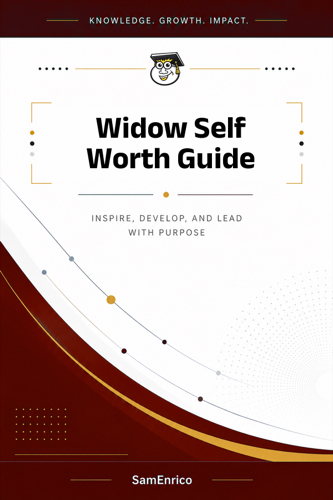
Widow Self Worth Guide eBook
Rebuild identity and confidence after losing a lon
by Woodard Elin
Rebuild identity and confidence after losing a long term partner.
Formats
Free sample
Chapter 1: The Vanished Mirror--–- The first time you catch your own reflection after your partner dies, you may not recognize the person staring back. It is not just grief carving new lines around your eyes or the hollowing of your cheeks from sleepless nights. It is something deeper, more unsettling. You look into the mirror expecting to see the woman you were yesterday, last week, last year—the wife, the partner, the other half of a whole. Instead, you see a stranger.
And the worst part is not the unfamiliar face. The worst part is the question that rises unbidden from somewhere inside you, a question you never thought you would have to ask: Who am I now?This chapter is written for the hours, days, and early weeks after that question first appears. If you are reading this in the immediate aftermath of loss—the first few days or first few months—you are exactly where you need to be. If you are further along but still haunted by that question, you are also welcome here. The goal of this chapter is not to heal you.
The goal is to stabilize you, to give you a rope when you are drowning, and to name the terrifying experience of losing not just your partner but the identity you built around them.The Identity Earthquake Let us name what you are feeling, because naming is the first rescue. You are experiencing what psychologists call the collapse of a coupled identity. For years, perhaps decades, your brain has used your partner as a reference point for nearly every decision, memory, and future plan. Where will we retire? What should we have for dinner?
Who will pick up the kids? What do we think about that news story? Your sense of self was not dependent on your partner in a weak or codependent way—it was simply intertwined. That is what long-term partnership does. It weaves two lives into a shared fabric.When your partner dies, that fabric does not just tear.
It vanishes. And what remains is you, alone, without the familiar weight of the other side of the bed, without the automatic second opinion, without the person who knew the ending of every story you ever told. Your brain, which evolved to predict the future based on past patterns, suddenly cannot predict anything. This is not a character flaw. It is neurology.
And it is terrifying.You may find yourself walking into a room and forgetting why. You may pick up your phone to text your partner about something mundane—a funny sign, a frustrating call with the cable company—only to remember, again, that there is no one to text. Each of these tiny amnesias is a fresh wound. They are not signs that you are losing your mind. They are signs that your brain is frantically searching for a reference point that no longer exists.Consider this: research on couples who have been together for more than a decade shows that their brains actually begin to function as a distributed system.
One partner remembers the family birthdays; the other remembers how to fix the dishwasher. One partner knows the route to the doctor's office; the other knows which brand of toothpaste the family prefers. When one partner dies, it is not just emotional loss. It is cognitive loss. Your brain has lost a hard drive.
Of course you are disoriented. Of course you cannot remember things. You were never supposed to remember everything alone. No one is.Magical Thinking Is Not Madness Joan Didion, writing in her masterpiece The Year of Magical Thinking, described the irrational beliefs that took hold after her husband's sudden death. She could not bring herself to give away his shoes, because he would need them when he came back.
She saved his medical records, because the next of kin would need them. She knew, intellectually, that he was gone. But some deeper part of her brain kept preparing for his return.You may be doing something similar. Perhaps you have not changed the voicemail greeting on his phone. Perhaps you still set a place for him at the table, or you buy his favorite coffee at the grocery store before catching yourself.
Perhaps you hear a car outside and think, He's home, before the truth crashes in again. This is called magical thinking, and it is not a symptom of denial or weakness. It is your brain's protective mechanism against full-scale trauma. It doles out the reality of your loss in small, survivable doses rather than all at once.Do not fight the magical thinking. Do not shame yourself for it.
Let it be there, like a low-grade fever that tells you your body is fighting an infection. Over time, the magical thinking will fade on its own. For now, it is keeping you alive. In fact, psychologists have found that a certain amount of magical thinking in the early months of bereavement is actually a predictor of better long-term outcomes. It buffers the nervous system from a shock that would otherwise be unsurvivable.
Your brain is not broken. It is brilliantly, mercifully, protecting you.The First Thirty Days: A Stabilization Protocol The following sections are not about healing. They are about surviving. Healing comes later, after the ground stops shaking. For now, your only job is to keep yourself fed, rested, and sheltered.
That is enough. That is more than enough. Many widows report that the first thirty days feel like being underwater—sounds are muffled, time is distorted, and every movement requires immense effort. This protocol is designed to help you breathe underwater.The Rule of Small Decisions In the immediate aftermath of loss, your brain's decision-making capacity is severely compromised. Grief floods the prefrontal cortex—the part of your brain responsible for rational planning—with stress hormones.
You are, quite literally, not yourself. This is why widows are told not to make major life changes in the first year. Do not sell the house. Do not quit your job. Do not move across the country.
Do not enter a new serious relationship. These decisions require a brain that is functioning at full capacity, and yours is not.Instead, adopt the Rule of Small Decisions: Make only decisions that affect the next twenty-four hours. What will you eat today? Will you shower? Will you call one friend or let the calls go to voicemail?
That is the scope of your authority right now. Anything larger than that can wait. Write it down on a piece of paper—Decide about the house later—and put the paper in a drawer. Your future self will thank you. I have worked with widows who sold their homes in the first month out of a desperate desire to escape their memories, only to regret it deeply a year later.
The house will still be there in six months. The job will still be there. The decision will still be there. You do not have to make it now.The Body-First Protocol Grief is not merely emotional. It is physiological.
Your body is flooded with cortisol and adrenaline, the stress hormones that prepare you for fight or flight. But there…
This is the end of the free sample. Get the eBook to keep going. Buy now
About this book
Details
- Author
- Woodard Elin
- Publisher
- SamEnrico
- Language
- English
- Genre
- Non-Fiction, Self-Help, Widowhood
- Released
- 2026-06-09
- Pages (approx.)
- 131
- Available as
- eBook, Audiobook

Read better in the ZLOADR app
Your eBooks on your phone or tablet. Sign in with your SamEnrico account and start reading.
More by Woodard Elin
 Loneliness Board Game GroupWoodard Elin$11.99
 Technology Failure Recurring DreamsWoodard Elin$11.99
 Boardroom Difficult TalksWoodard Elin$11.99
 The Energy Recovery MethodWoodard Elin$11.99
 The Interruption HourWoodard Elin$11.99
 Test Anxiety TranceWoodard Elin$11.99Test Anxiety TranceWoodard Elin$11.99
 The Bizarre Clothing PileWoodard Elin$11.99
 Antwerp Heist Forensic EvidenceWoodard Elin$11.99
 The Underground Riders: How BMX Smuggled Freedom Across the Iron CurtainWoodard Elin$11.99
 Echoes of the First Dawn: The Indian Ocean's Cosmic ConnectionWoodard Elin$11.99
 Boombox Beats: The Rise of Hip-Hop’s First Mobile MiracleWoodard Elin$11.99
You may also like
 Hong Kong Handover 1997Dunn Johnnie$11.99
 Zumba For Postnatal Recovery CourseNeal Christian$11.99
 Zumba for BeginnersLadner Nikia$11.99
 YouTube Comment Mining GuideHumes Pandora$12.99
 Worry Box MeditationCarlin Rudy$11.99
 Workplace Stress MeditationNguyen Lynn$11.99
 Workplace Stress and Sleep RepairHawley Ivory$11.99
 Workplace Perfectionism CureDelaney Jeffry$11.99
 Workplace Injustice Anger GuideWallen Isabelle$11.99
 Work Addiction and Burnout LinkGreenwood Ester$11.99
 Women in Yoga and WellnessBeattie Galina$11.99
 Women in Stand Up ComedyChun Evangeline$11.99