
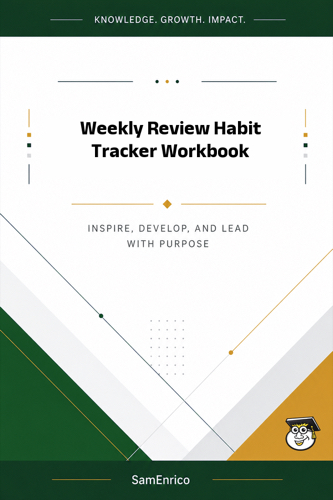
Non-FictionSelf-HelpHabit Tracking
Weekly Review Habit Tracker Workbook eBook
Track habit streaks and break loops using a weekly
Track habit streaks and break loops using a weekly review framework.
Formats
Free sample
Chapter 1: The X That Lied--You have probably done it yourself. Printed a pretty habit tracker from Pinterest. Bought a fancy dotted journal. Downloaded an app with a satisfying checkbox animation. And for nineteen days—or twenty-two, or maybe just eleven—you marked that X every single day.
You felt powerful. In control. Like someone who had finally figured it out.Then came day twenty.Maybe you were tired. Maybe you had a late meeting. Maybe you just forgot.
Whatever the reason, you did not do the habit. And you did not mark the X. That blank square stared at you like an accusation. By day twenty-one, something strange happened. The blank square was still there, but now it had company.
You missed another day. Then another. By the end of the week, you stopped opening the tracker entirely. The page went from a battlefield of green X’s to an empty graveyard of good intentions.You told yourself you lacked willpower. You told yourself you were not disciplined enough.
You told yourself that next month—next January, next Monday—would be different.Here is the truth the habit industry does not want you to hear: The problem was never your willpower. The problem was the X itself.This chapter will dismantle the most famous habit-tracking strategy in the world—the “Seinfeld Strategy,” also known as “Don’t Break the Chain”—and reveal why it fails for almost everyone past the first few weeks. More importantly, this chapter will introduce a completely different way of thinking about streaks, one that will serve as the foundation for everything else in this workbook. By the time you finish reading, you will understand why a thirty-day streak with three intentional resets is more valuable than a one-hundred-day streak maintained by lowering your standards. And you will never look at a blank checkbox the same way again.The Origin Story of a Productivity Myth The Seinfeld Strategy has achieved near-mythic status in productivity circles.
The story goes like this: back in the 1990s, a young comedian named Jerry Seinfeld was asked by a fellow comic for advice on how to write better jokes. Seinfeld reportedly replied that the secret was a simple calendar. Get a wall calendar with a full year on one page. For every day you write new material, put a big red X over that day. After a few days, you will have a chain.
Your only job is not to break the chain.That is it. No complex systems. No morning routines. No special apps. Just a calendar, a red marker, and the single-minded goal of never seeing a blank square.The strategy became famous because it works—for a very specific type of person in a very specific set of circumstances.
Professional comedians. Elite athletes. Writers on deadline. People whose entire identity and livelihood depend on daily output. For the rest of us?
The strategy works exactly long enough to make us feel like failures.But before we throw the baby out with the bathwater, let us give credit where it is due. The Seinfeld Strategy gets one thing profoundly right: visibility matters. When your progress is invisible, it is easy to ignore. When your missed days are as visible as your successes, something shifts. You cannot lie to a calendar.
That is powerful.The problem is not the visibility. The problem is everything else.The Three Hidden Flaws of “Don’t Break the Chain”After watching hundreds of clients and readers try—and fail—to maintain Seinfeld-style streaks, I have identified three fatal flaws in the strategy. These flaws are not edge cases or minor quibbles. They are structural problems baked into the very premise of “don’t break the chain.” And until you understand them, you will keep abandoning your trackers in March.Flaw One: All-or-Nothing Thinking The first and most destructive flaw is that the Seinfeld Strategy creates a binary world. You either marked the X or you did not.
You are either “on the chain” or you have broken it. There is no room for partial credit, no space for a bad day that still counts, no acknowledgment that a five-minute walk is better than no walk at all.This is what psychologists call all-or-nothing thinking, also known as dichotomous or black-and-white reasoning. It is a cognitive distortion that strips away all nuance and declares that if something is not perfect, it is a total failure. And here is the kicker: all-or-nothing thinking is a known predictor of goal abandonment. When you define success as perfection, you guarantee that the first imperfection will feel like total failure.
And when you feel like a total failure, why bother continuing?Let me give you a concrete example. Imagine you have a goal to meditate for ten minutes every day. You do it perfectly for eighteen days. On day nineteen, you are exhausted and can only manage two minutes of deep breathing before falling asleep. In the Seinfeld framework, that day does not get an X.
The chain is broken. Everything you built over eighteen days is now, according to the logic of the chain, worthless. You are back to zero.But are you really back to zero? Of course not. You meditated for two minutes.
That is infinitely more than zero minutes. You maintained the identity of someone who meditates, even on a hard day. You proved to yourself that you will show up even when conditions are not perfect. None of that shows up in the chain. The chain only sees zero.The all-or-nothing trap is so pervasive and so destructive that it will appear throughout this workbook.
In Chapter 9, we will discuss how heatmap tracking defeats binary thinking. In Chapter 7, we will explore the “Don’t Miss Twice” rescue protocol specifically designed for the moment the chain breaks. And in Chapter 4’s Sunday Review, we will practice separating observation from judgment—a skill that directly counteracts all-or-nothing cognition. For now, simply recognize that the Seinfeld Strategy’s greatest apparent strength—its simplicity—is also its greatest weakness. Life is not binary.
Your habit tracker should not be either.Flaw Two: Zero Diagnostic Power The second flaw is perhaps even more damning. The Seinfeld Strategy tells you that you failed, but it offers absolutely no insight into why you failed. A blank square is a question without an answer. Was the cue missing? Was the reward unsatisfying?
Was your environment working against you? Were you simply exhausted from poor sleep? The X knows nothing. The X cannot help you.This is not a minor oversight. It is a catastrophic omission.
Consider how any other domain handles failure. If a pilot crashes a plane, they do not simply say “well, I crashed” and go back to flying. They conduct an investigation. They pull the black boxes. They interview witnesses.
They examine weather conditions and maintenance records. They identify the specific cause of the failure so they can prevent it from happening again.Your habits deserve the same rigor. When you miss a day, that blank square is not a judgment. It is data. The question is not “How could you be so weak?” The question is “What specific part…
This is the end of the free sample. Get the eBook to keep going. Buy now
About this book
Details
- Author
- Corcoran Caprice
- Publisher
- SamEnrico
- Language
- English
- Genre
- Non-Fiction, Self-Help, Habit Tracking
- Released
- 2026-06-07
- Pages (approx.)
- 139
- Available as
- eBook, Audiobook

Read better in the ZLOADR app
Your eBooks on your phone or tablet. Sign in with your SamEnrico account and start reading.
More by Corcoran Caprice
 Verbal De escalation on RoadCorcoran Caprice$11.99
 Hawking Party for Time TravelersCorcoran Caprice$11.99
 Gambling Addiction and Anger WorkbookCorcoran Caprice$11.99
 Minimalist Stretching Equipment GuideCorcoran Caprice$11.99
 The Unlikely Alliance: How a Rapper and a Neuroscientist Changed Music ForeverCorcoran Caprice$11.99
 The Frozen Mirage: Bedouin Guides and the Arctic's Hidden SecretsCorcoran Caprice$11.99
 Understanding Bardet–biedl Syndrome, Type 2Corcoran Caprice$17.99
 Baby Boomer Charitable Giving GuideCorcoran Caprice$12.99
 One Page Community Building GuideCorcoran Caprice$12.99
 Game ProgrammerCorcoran Caprice$11.99
 10 Ways to Use Chili Sauce (Recipe Book)Corcoran Caprice$11.99
You may also like
 Hong Kong Handover 1997Dunn Johnnie$11.99
 Zumba For Postnatal Recovery CourseNeal Christian$11.99
 Zumba for BeginnersLadner Nikia$11.99
 YouTube Comment Mining GuideHumes Pandora$12.99
 Worry Box MeditationCarlin Rudy$11.99
 Workplace Stress MeditationNguyen Lynn$11.99
 Workplace Stress and Sleep RepairHawley Ivory$11.99
 Workplace Perfectionism CureDelaney Jeffry$11.99
 Workplace Injustice Anger GuideWallen Isabelle$11.99
 Work Addiction and Burnout LinkGreenwood Ester$11.99
 Women in Yoga and WellnessBeattie Galina$11.99
 Women in Stand Up ComedyChun Evangeline$11.99