
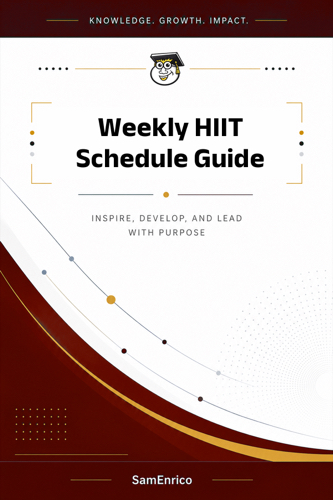
Non-FictionHealth & WellnessWorkout Planning
Weekly HIIT Schedule Guide eBook
Plan interval training sessions with adequate reco
Plan interval training sessions with adequate recovery.
Formats
Free sample
Chapter 1: The More Myth--–- Sarah was the model fitness enthusiast. At 34, she owned three sets of expensive workout clothes, a gym membership she actually used, and a motivational quote about "no days off" framed on her bathroom mirror. She had been doing 45-minute HIIT classes six days per week for eight weeks. She was also exhausted, irritable, and confused about why her waistband felt tighter than when she started.Her doctor ran blood work. The results showed elevated cortisol, low thyroid function, and markers of systemic inflammation.
"You're overtraining," the doctor said. Sarah laughed. "But I'm doing everything right. More is better, isn't it?"That question is the central lie of modern fitness culture. And this chapter will dismantle it completely.The Dirty Secret of the Fitness Industry Walk into any gym, scroll through any fitness influencer's page, or watch any infomercial after midnight, and you will encounter the same message: more is better.
More sessions per week. More minutes per session. More rounds, more reps, more sweat, more pain. The equation seems simple: effort in equals results out.But HIIT does not follow that equation. It follows the law of diminishing returns, and beyond a certain point, the returns become aggressively negative.The fitness industry knows this.
The researchers who study high-intensity interval training have known it for decades. But it is not profitable to tell people to do less. There is no million-dollar supplement line for "strategic rest." No influencer gains followers by posting videos of themselves walking slowly on a treadmill. So the message of "more" continues to spread, and people like Sarah continue to suffer the consequences.This book exists because that message is not just wrong—it is dangerous. The #1 reason HIIT fails is not lack of effort, lack of discipline, or lack of grit.
The #1 reason HIIT fails is too much effort, too often, without adequate recovery.The Science of Diminishing Returns in HIITTo understand why more is not better, you need to understand what HIIT actually does to your body. When you sprint, row, or cycle at maximum effort, you are not building fitness during the work interval. You are creating a disturbance—a metabolic and mechanical shock that your body must then adapt to. The adaptation happens during recovery, not during the workout.This is the most important concept in this entire book: training is the stimulus; recovery is the adaptation.Researchers at Mc Master University, led by Dr. Martin Gibala, have spent years quantifying exactly how much stimulus is needed to produce maximum adaptation.
Their findings are striking. In a landmark study, participants who did just 20 minutes of hard effort per week (split into three 20-second all-out sprints with rest) showed the same VO₂ max improvements as participants who did five hours of moderate cardio per week.But the more important finding came from the dose-response curve. When Gibala's team tested different volumes of high-intensity work, they found that increasing hard minutes from 10 per week to 20 per week produced significant gains. Increasing from 20 to 30 produced minimal additional gains. And increasing beyond 40 hard minutes per week actually produced worse results than doing 20.The shape of that curve is not unique to HIIT.
It appears in every form of exercise, every drug, every intervention. There is a minimum effective dose, a maximum effective dose, and a toxic dose. In HIIT, the toxic dose is surprisingly low.The Sweet Spot Chart: Evidence-Based Standards Based on the research literature—including Gibala, Billat, and the extensive periodization work of Haff—the optimal weekly volume of hard minutes is 20 to 25. Here is what that looks like in practice:Weekly Hard Minutes VO₂ Max Improvement Fat Loss Outcome Injury Risk Cortisol Status10+8%Minimal Very low Normal20-25+15-18%Optimal Low Slightly elevated (normal post-exercise)30+16%Moderate Moderate Chronically elevated40+14%Minimal (fat gain possible)High Chronically high60++10%Fat gain likely Very high Pathological A few things to notice about this chart. First, the difference between 20-25 hard minutes and 30 hard minutes is only one or two additional intervals per week, but the cost in cortisol elevation and injury risk is substantial.
Second, at 40 hard minutes and above, you are actually getting worse results than someone doing half your volume while also increasing your risk of injury, illness, and metabolic dysfunction.This is the law of diminishing returns in action. And it applies to everyone—beginner or advanced, male or female, young or old.The Cortisol Catastrophe: Why More Becomes Less Cortisol is a glucocorticoid hormone produced by the adrenal glands. It has a bad reputation, but it is not inherently evil. Cortisol is essential for waking you up in the morning, regulating blood sugar, and reducing inflammation. Acute spikes in cortisol during exercise are normal and beneficial.The problem is chronic elevation.When you do HIIT, your body releases cortisol to mobilize glucose and fatty acids for energy.
That is a normal, healthy response. After the session ends, cortisol levels should return to baseline within a few hours. But when you do HIIT again before cortisol has returned to baseline, you create a stacking effect. Each session adds another wave of cortisol on top of the last. After a few days of this, your baseline cortisol creeps higher and higher.Chronic high cortisol does three terrible things to your body.First, it is catabolic.
Cortisol breaks down muscle tissue into amino acids for gluconeogenesis (creating new glucose). This is the opposite of what you want from exercise. You are literally losing muscle while training harder.Second, chronic cortisol signals your body to store visceral fat—the dangerous fat around your organs. This is an evolutionary holdover. To your ancient nervous system, chronic stress means famine is coming.
The body responds by packing on emergency fuel reserves right where they are most accessible: around the liver and intestines. This is why over-trained athletes often gain belly fat while eating the same diet.Third, chronic cortisol suppresses your immune system, disrupts sleep architecture, and reduces libido. The symptoms of overtraining—frequent colds, insomnia, low sex drive, persistent fatigue—are not signs that you need to "push through." They are signs that your training is actively harming you.The Minimum Effective Dose Philosophy The concept of the minimum effective dose comes from pharmacology. It is the smallest dose of a drug that produces the desired effect. Anything above the minimum effective dose is waste at best and poison at worst.
The same principle applies to HIIT.The minimum effective dose for HIIT, based on the research, is 20 to 25 hard minutes per week. That is not a target to exceed. It is a target to hit and then stop. If you are doing more than 25 hard minutes per week and not seeing progress, the solution is not to do more. The solution is to do less.This is a hard pill for many people to swallow.
We have been culturally conditioned to believe that suffering equals virtue, that pain equals progress, that more is always better. But the physiology does not care about your conditioning. Your body responds to the minimum effective dose with maximum efficiency. Anything beyond that triggers a stress response that undermines your goals.Defining "Hard Minutes" Precisely Throughout this book…
This is the end of the free sample. Get the eBook to keep going. Buy now
About this book
Details
- Author
- Curran Idalia
- Publisher
- SamEnrico
- Language
- English
- Genre
- Non-Fiction, Health & Wellness, Workout Planning
- Released
- 2026-06-06
- Pages (approx.)
- 137
- Available as
- eBook, Audiobook

Read better in the ZLOADR app
Your eBooks on your phone or tablet. Sign in with your SamEnrico account and start reading.
More by Curran Idalia
 Senior Housing Occupancy RatesCurran Idalia$11.99
 Conflict and Self Worth GuideCurran Idalia$11.99
 Franchising Your Local Brand Across Borders Pandemic PreparednessCurran Idalia$11.99
 Caregiver Burnout CoupleCurran Idalia$11.99
 Alcoholism Recovery for VeteransCurran Idalia$11.99
 Invoice And Payment Tracking GuideCurran Idalia$11.99
 Retail Worker Food AddictionCurran Idalia$11.99
 The Silent Killer of Jutland: The Torpedo's Deadly EvolutionCurran Idalia$11.99
 The Clockwork Cosmos: Galileo, Kepler, and the Birth of Modern AstronomyCurran Idalia$11.99
 How to Produce Stairs and Stair PartsCurran Idalia$11.99
 How to Become a Print InspectorCurran Idalia$11.99
 A Collector's Handbook to the Delage D8cCurran Idalia$11.99
You may also like
 Hong Kong Handover 1997Dunn Johnnie$11.99
 Zumba For Postnatal Recovery CourseNeal Christian$11.99
 Zumba for BeginnersLadner Nikia$11.99
 YouTube Comment Mining GuideHumes Pandora$12.99
 Worry Box MeditationCarlin Rudy$11.99
 Workplace Stress MeditationNguyen Lynn$11.99
 Workplace Stress and Sleep RepairHawley Ivory$11.99
 Workplace Perfectionism CureDelaney Jeffry$11.99
 Workplace Injustice Anger GuideWallen Isabelle$11.99
 Work Addiction and Burnout LinkGreenwood Ester$11.99
 Women in Yoga and WellnessBeattie Galina$11.99
 Women in Stand Up ComedyChun Evangeline$11.99