
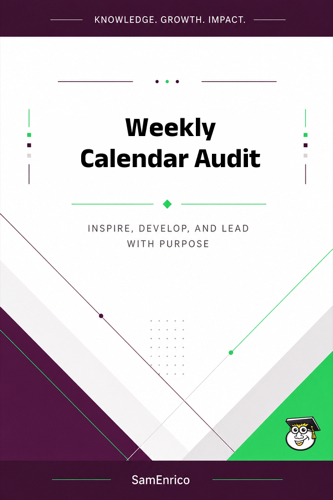
Non-FictionSelf-HelpTime Audit
Weekly Calendar Audit
Review how you spent time and adjust for better al
by Swank Veola
Review how you spent time and adjust for better allocation.
Formats
About this book
Free sample
Chapter 1: The 168-Hour Lie--–- You are about to discover something uncomfortable. Not because the information is complex or technical, but because it challenges a story you have been telling yourself for years. The story goes something like this: you are busy. Overwhelmed, even. There are not enough hours in the day.
If you just had more time, you would finally get to the important things—the strategic work, the family dinners, the exercise, the reading, the projects that actually matter. But week after week, Friday arrives and you realize another seven days have vanished into a blur of meetings, emails, interruptions, and urgent-but-trivial tasks that someone else decided were important.Here is the truth that most productivity books are afraid to tell you: you already have enough time. Every single person on this planet receives exactly 168 hours per week. No one gets more. No one gets less.
The difference between people who feel in control of their lives and people who feel perpetually behind is not a matter of hours available. It is a matter of awareness, allocation, and the courage to look honestly at where those 168 hours actually go versus where you think they go.This book is called The Weekly Calendar Audit, and before we do anything else—before we talk about time blocking, delegation, energy mapping, or any of the other tools that will fill the coming chapters—we need to confront the single biggest obstacle to better time management: the gap between your intention and your reality. That gap is wider than you think. And closing it begins with understanding why your to-do list is a work of fiction and your calendar is the only truth that matters.The Fiction of the To-Do List Let us start with a simple experiment. Think back to your to-do list from yesterday morning.
How many items did it contain? Now think about what you actually accomplished. Be honest. Was there a gap? For most people, the gap is not small.
Studies on the planning fallacy—a cognitive bias first identified by Daniel Kahneman and Amos Tversky—show that humans consistently underestimate how…
This is the end of the free sample. Get the eBook to keep going. Buy now
Contents
- Chapter 1
- Chapter 2
- Chapter 3
- Chapter 4
- Chapter 5
- Chapter 6
- Chapter 7
- Chapter 8
- Chapter 9
- Chapter 10
- Chapter 11
- Chapter 12
Details
- Author
- Swank Veola
- Publisher
- SamEnrico
- Language
- English
- Genre
- Non-Fiction, Self-Help, Time Audit
- Released
- 2026-06-08
- Pages (approx.)
- 142
- Available as
- eBook, Audiobook

Read better in the ZLOADR app
Your eBooks on your phone or tablet. Sign in with your SamEnrico account and start reading.
More by Swank Veola
 Calf and Ankle Flexibility PlanSwank Veola$11.99
 Guided Sleep Meditation HandbookSwank Veola$11.99
 Franchise Builder's Franchise Funding PitchSwank Veola$11.99
 The Secret Sauce: How Colonel Sanders Built a Fast Food Empire from ScratchSwank Veola$11.99
 The Last Letter of Cleopatra: A Queen’s Unseen LegacySwank Veola$11.99
 Material SpecialistSwank Veola$11.99
 Podcast Niche Selection WorkbookSwank Veola$12.99
 How to Become a Dip-lube OperatorSwank Veola$11.99
 Understanding Hypertropic Neuropathy of Dejerine-sottasSwank Veola$17.99
You may also like
 Hong Kong Handover 1997Dunn Johnnie$11.99
 Zumba For Postnatal Recovery CourseNeal Christian$11.99
 Zumba for BeginnersLadner Nikia$11.99
 YouTube Comment Mining GuideHumes Pandora$12.99
 Worry Box MeditationCarlin Rudy$11.99
 Workplace Stress MeditationNguyen Lynn$11.99
 Workplace Stress and Sleep RepairHawley Ivory$11.99
 Workplace Perfectionism CureDelaney Jeffry$11.99
 Workplace Injustice Anger GuideWallen Isabelle$11.99
 Work Addiction and Burnout LinkGreenwood Ester$11.99
 Women in Yoga and WellnessBeattie Galina$11.99
 Women in Stand Up ComedyChun Evangeline$11.99