
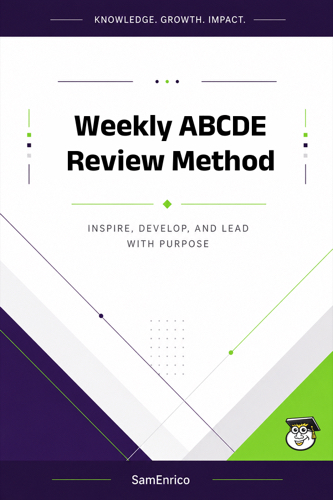
Non-FictionSelf-HelpWeekly Review
Weekly ABCDE Review Method eBook
Reviews completed priorities and reassigns letters
Reviews completed priorities and reassigns letters for next week.
Formats
Free sample
Chapter 1: The Loop Debt--–- The Sunday night dread is not a personality flaw. It is not a sign that you are lazy, undisciplined, or somehow broken. It is, quite simply, a symptom of an untreated cognitive condition—what this book will call loop debt—and like any financial debt, it compounds interest the longer you leave it unpaid.You know the feeling. It is Sunday evening, somewhere between 7:00 and 9:00 PM. The weekend is technically still alive, but the joy has drained out of it.
You are not actively working, but you are not truly resting either. You are somewhere in between—a gray zone of low-grade anxiety where your brain is quietly, persistently running through a list of everything you did not finish last week. The proposal you promised to send. The email you avoided answering. The conversation you need to have with a colleague.
The task that has rolled over for the third week in a row, now heavy with its own weight of accumulated shame.You are not doing any of these things. But you are not free of them either. They hover at the edge of your awareness like unpaid bills on a desk—not urgent enough to demand immediate action, but present enough to prevent genuine peace. This is the open-loop crisis, and it is the single most expensive form of invisible waste in modern knowledge work.Before this book teaches you a single technique for prioritization, before we touch the ABCDE method or the weekly review ritual, we must first name the enemy. The enemy is not your lack of willpower.
The enemy is not your overflowing inbox or your demanding boss or your family obligations. The enemy is not even the tasks themselves. The enemy is the accumulated weight of unfinished tasks living rent-free in your head, consuming cognitive bandwidth that should be devoted to creativity, presence, and deep work.The Zeigarnik Effect: Why Your Brain Won't Let Go In the 1920s, a young Russian psychologist named Bluma Zeigarnik made a discovery that would fundamentally change how we understand memory, motivation, and mental load. While observing waiters in Vienna cafes, she noticed something remarkable: the waiters could remember complex drink orders with astonishing accuracy—but only until the order was fulfilled. Once the drinks were delivered and payment was made, the waiters could barely recall what they had carried moments earlier.
The completed transaction vanished from memory; the open transaction lingered.Zeigarnik took this observation into the laboratory. She designed a series of simple tasks—solving puzzles, stringing beads, performing arithmetic calculations. Participants worked through these tasks one by one. For half the tasks, Zeigarnik allowed participants to finish without interruption. For the other half, she interrupted them just before completion, giving them a different task to work on instead.
Later, when asked to recall all the tasks they had worked on, participants remembered the interrupted tasks nearly twice as well as the completed ones.This became known as the Zeigarnik effect: uncompleted tasks occupy memory more persistently than completed ones. Your brain holds onto open loops because, from an evolutionary perspective, an unfinished task might represent a threat to survival. Did you finish gathering firewood before nightfall? Did you fully secure the shelter against predators? Did you check every direction for danger before resting?
The hominid brain that remembered unfinished business was the brain that survived to pass on its genes.In the modern world, this ancient cognitive mechanism works directly against your productivity and peace. Your brain does not meaningfully distinguish between "finish that quarterly report by Friday" and "avoid being eaten by a saber-toothed tiger." Both register as open loops. Both consume precious cognitive bandwidth. Both trigger a low-grade stress response that keeps you from resting fully.The Zeigarnik effect explains why you cannot simply "relax" on Sunday evening when you have a dozen unfinished tasks from the previous week still floating in your mental space. Your brain will not let you.
It is doing its job—faithfully, relentlessly, and without any concern for your peace of mind or your desire to watch a movie without guilt. The only way to close the loop is either to complete the task or to make a conscious, trusted, externally recorded decision about exactly when and how you will complete it.The Anatomy of an Open Loop Before we can close loops, we must understand what they are made of. An open loop has three distinct components: a trigger, a commitment, and a gap.The trigger is whatever brought the task into your awareness. It might be an email from a colleague, a note you wrote to yourself, a deadline on your calendar, or simply a thought that arose while you were brushing your teeth. The trigger says, "Something needs attention."The commitment is the implicit or explicit promise you made to yourself or others about this task.
"I will send that proposal by Friday." "I need to call the doctor back." "I should finally organize the garage." The commitment creates obligation, and obligation creates cognitive load.The gap is the space between the trigger and the completion. It is the open space where the task lives, unresolved, pinging your awareness at random intervals. The wider the gap, the more cognitive energy the loop consumes.Most people try to manage open loops through sheer willpower—they simply try harder to remember. This is like trying to hold water in your cupped hands. It works for a while, but eventually, your attention slips, and the water drips through.
The only sustainable solution is to build an external system that captures, organizes, and reviews every open loop on a regular cadence.The Real Cost of Open Loops: Beyond the Obvious Most people dramatically underestimate the cost of open loops. They think, "It's just a few small things I didn't get to. No big deal." But the research on attention residue and context switching tells a very different and much more alarming story.When your brain holds multiple open loops, it does not simply stack them neatly in a mental queue, processing one at a time in orderly fashion. Instead, it cycles through them constantly, unconsciously, like a computer operating system running dozens of background processes that slow down everything else. Every time a task pops into your awareness—I still need to call the plumber —you experience a micro-interruption.
And every micro-interruption, no matter how brief, carries a measurable cost.Studies on task switching have consistently found that when you interrupt a focused work session to attend to a different task, it takes an average of twenty-three minutes to return to the original task at full cognitive capacity. Twenty-three minutes. Now multiply that by the dozens of open loops that ping your awareness throughout a typical day. The math becomes staggering. A conservative estimate suggests that open loops and the context switching they generate reduce productive output by 30 to 40 percent for the average knowledge worker.But the cost is not merely quantitative.
It is also deeply qualitative and emotional. Open loops create a low-grade hum of anxiety that never quite turns off, even during leisure time. This hum manifests in predictable and measurable ways:Difficulty falling…
This is the end of the free sample. Get the eBook to keep going. Buy now
About this book
Details
- Author
- Lafferty Darrick
- Publisher
- SamEnrico
- Language
- English
- Genre
- Non-Fiction, Self-Help, Weekly Review
- Released
- 2026-06-06
- Pages (approx.)
- 137
- Available as
- eBook, Audiobook

Read better in the ZLOADR app
Your eBooks on your phone or tablet. Sign in with your SamEnrico account and start reading.
More by Lafferty Darrick
 Fear Of Failure In WritingLafferty Darrick$11.99
 Happy Ring Sleep GuideLafferty Darrick$11.99
 The Walking Meditation Audio GuideLafferty Darrick$11.99
 The Black Dahlia Georgette Bauerdorf ConnectionLafferty Darrick$11.99
 Letters from the Spice Wars: Love and Gunpowder in the Indian OceanLafferty Darrick$11.99
 How to Become a DulserLafferty Darrick$11.99
 UAE VAT Compliance GuideLafferty Darrick$12.99
 Student Testimonials TurkeyLafferty Darrick$12.99
 Understanding Rheumatoid ArthritisLafferty Darrick$17.99
 Manager of Software EngineeringLafferty Darrick$11.99
You may also like
 Hong Kong Handover 1997Dunn Johnnie$11.99
 Zumba For Postnatal Recovery CourseNeal Christian$11.99
 Zumba for BeginnersLadner Nikia$11.99
 YouTube Comment Mining GuideHumes Pandora$12.99
 Worry Box MeditationCarlin Rudy$11.99
 Workplace Stress MeditationNguyen Lynn$11.99
 Workplace Stress and Sleep RepairHawley Ivory$11.99
 Workplace Perfectionism CureDelaney Jeffry$11.99
 Workplace Injustice Anger GuideWallen Isabelle$11.99
 Work Addiction and Burnout LinkGreenwood Ester$11.99
 Women in Yoga and WellnessBeattie Galina$11.99
 Women in Stand Up ComedyChun Evangeline$11.99