
Non-FictionSelf-HelpWebinar Skills
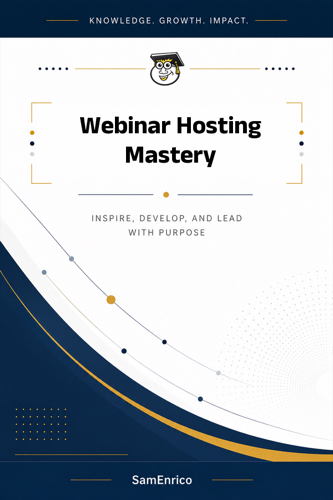
Webinar Hosting Mastery eBook
Covers webinar specific skills including screen sh
by Amaya Elmira
Covers webinar specific skills including screen sharing, chat management, and virtual hand raising.
Formats
Free sample
Chapter 1: The Invisible Audience--Imagine standing alone on a darkened stage, a single spotlight on your face, while two hundred people sit in complete silence somewhere beyond the glare. You cannot see them. You cannot hear them breathe. You cannot tell if they are leaning forward in fascination or scrolling through their email under the table. Every few seconds, you glance at a small monitor that shows only a grid of blank nameplates and the occasional flicker of a muted microphone icon.This is the reality of every webinar host.
And it is terrifying.The first time I hosted a webinar for five hundred registered attendees, I made a mistake that nearly ended my career before it began. I prepared for three weeks. I rehearsed my slides until I could recite them backward. I had backup internet, backup power, and even a backup shirt in case I spilled coffee on myself five minutes before going live. What I did not prepare for was the silence.When the timer hit zero and my face appeared on screen, I launched into my opening with the enthusiasm of a game show host.
I smiled. I projected. I asked my first engagement question: "Who here has struggled with virtual meetings?" I waited for the familiar murmur of agreement, the nodding heads, the energy of a live room.Nothing happened.The chat remained empty. No hands rose. No one typed "Yes" or "Me too." For five full seconds—which felt like five hours—I stared at a screen that gave me nothing.
My confidence evaporated. My pacing sped up. I started rambling about features no one had asked about. By minute twelve, I watched the attendee count drop from 210 to 87. By minute twenty, I was talking to myself.Afterward, the recording revealed the painful truth: I had treated the webinar like a broadcast.
I performed at my audience instead of connecting with them. The technology had not failed. I had failed to understand the fundamental psychological difference between a physical room and a virtual one.That failure taught me the single most important lesson in this entire book: A webinar is not a poor substitute for an in-person event. It is a completely different medium that requires a completely different set of skills.Most hosts never learn this lesson. They step in front of their webcams, click through their slides, and wonder why their engagement rates hover below ten percent.
They blame Zoom fatigue or short attention spans or the wrong day of the week. But the real problem is much simpler and much more fixable.You are competing with email. You are competing with Slack notifications. You are competing with the laundry in the next room and the delivery person at the door and the quiet temptation to open a second browser tab and check the news. Every person on your webinar has approximately seven other things they could be doing at that exact moment.
And unlike a physical meeting where social pressure keeps them in their seats, the virtual audience has a one-click escape hatch.The only thing keeping them there is you.The Core Problem: Death by Power Point Ninety percent of webinars feel like "death by Power Point" not because the content is bad, but because the host has confused information delivery with engagement. Let me be blunt: your slides are not the problem. Your slides are a tool. The problem is that you are using that tool to deliver a lecture when you should be facilitating an experience.Consider the last webinar you attended that made you want to close your laptop. What happened?
Probably some variation of this: a host appeared on screen, welcomed everyone, then immediately launched into a dense slide deck filled with bullet points. They read each bullet aloud. They occasionally asked "Any questions?" into the void. No one responded because no one had been given a reason to respond. The chat remained a ghost town.
After forty-five minutes, the host said "Thanks for coming" and the screen went black.That host made three fatal assumptions:Assumption One: "If I say it, they will hear it." False. Hearing is passive. Listening requires engagement. Without interaction, your audience will filter your voice into background noise within approximately ninety seconds. This is not a character flaw in your audience—it is how the human brain works.
We are wired to tune out repetitive, non-interactive stimuli.Assumption Two: "The chat is optional." False. In a physical room, you can read body language to gauge understanding. In a webinar, the chat is your only window into the audience's mind. Ignoring the chat is like giving a speech while blindfolded. You have no idea if people are with you, ahead of you, or already gone.Assumption Three: "Silence means agreement." False.
In a webinar, silence usually means confusion, distraction, or abandonment. When no one responds to your question, it is rarely because everyone agrees. It is because they have already mentally checked out.These assumptions are killing your webinars. And they are fixable.The Visibility Gap: Why You Feel Like You Are Talking to a Wall Every webinar host eventually experiences what I call the "Invisible Audience Syndrome." You speak. No one responds.
You ask a question. The chat stays empty. You make a joke. No one laughs. After twenty minutes, you start to wonder if anyone is even there.This feeling is not paranoia.
It is a natural consequence of the medium. In a physical room, you receive constant feedback: head nods, eye contact, posture shifts, whispered comments, laughter. Your brain uses these cues to adjust your pacing, your tone, and your content in real time. Without them, your brain begins to panic. It interprets the absence of feedback as rejection.The research on this phenomenon is striking.
Studies of virtual communication have found that presenters experience significantly higher cortisol levels (the stress hormone) when speaking to a camera compared to speaking to a live audience. Your body does not know the difference between "they cannot respond" and "they do not want to respond." It assumes the worst.So what do most hosts do in response to this anxiety? They speed up. They fill the silence with more words. They click to the next slide before anyone has processed the current one.
They talk at the audience instead of with them. This is exactly what I did in my disastrous first webinar—and it made everything worse.The solution is not to eliminate silence. Silence, when used intentionally, is one of your most powerful tools. The solution is to replace the missing physical cues with intentional engagement triggers. You cannot see your audience, so you must force them to show themselves through chat responses, poll answers, and hand raises.Every time an attendee types something, clicks something, or raises a virtual hand, they are giving you a heartbeat.
That heartbeat tells you they are still there. It also tells them that you see them, which reinforces their decision to stay.This is the first principle of webinar mastery: You cannot wait for engagement to happen. You must architect it into every segment of your presentation.The Hosting Mindset: From Presenter to Facilitator Most…
This is the end of the free sample. Get the eBook to keep going. Buy now
About this book
Details
- Author
- Amaya Elmira
- Publisher
- SamEnrico
- Language
- English
- Genre
- Non-Fiction, Self-Help, Webinar Skills
- Released
- 2026-06-08
- Pages (approx.)
- 146
- Available as
- eBook, Audiobook

Read better in the ZLOADR app
Your eBooks on your phone or tablet. Sign in with your SamEnrico account and start reading.
More by Amaya Elmira
 Probiotics For Ulcerative ColitisAmaya Elmira$11.99
 Lake Meditation MBSR GuideAmaya Elmira$11.99
 Outsourcing FulfillmentAmaya Elmira$11.99
 Amina Zoubir: Painting the Soul of a ContinentAmaya Elmira$11.99
 Performance Based Pricing Without FearAmaya Elmira$12.99
 How to Start a Loudspeaker Business (Beginners Guide)Amaya Elmira$11.99
 Natural Language Understanding and GenerationAmaya Elmira$11.99
 How to Produce Cat Furniture AccessoriesAmaya Elmira$11.99
You may also like
 Hong Kong Handover 1997Dunn Johnnie$11.99
 Zumba For Postnatal Recovery CourseNeal Christian$11.99
 Zumba for BeginnersLadner Nikia$11.99
 YouTube Comment Mining GuideHumes Pandora$12.99
 Worry Box MeditationCarlin Rudy$11.99
 Workplace Stress MeditationNguyen Lynn$11.99
 Workplace Stress and Sleep RepairHawley Ivory$11.99
 Workplace Perfectionism CureDelaney Jeffry$11.99
 Workplace Injustice Anger GuideWallen Isabelle$11.99
 Work Addiction and Burnout LinkGreenwood Ester$11.99
 Women in Yoga and WellnessBeattie Galina$11.99
 Women in Stand Up ComedyChun Evangeline$11.99