
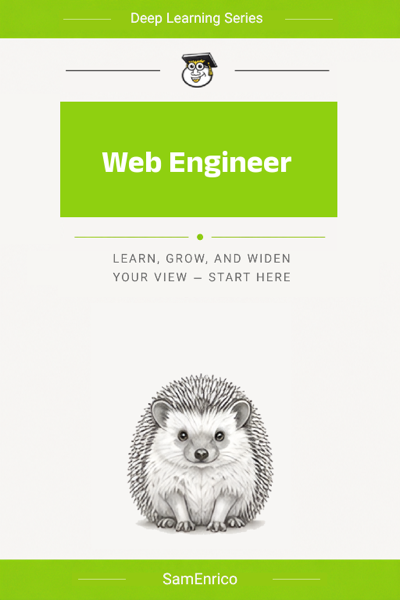
Non-FictionInformativeEducational
Web Engineer eBook
A Coursebook on Web Engineer
A Coursebook on Web Engineer
Formats
Free sample
Chapter 1: The Seven Deadly Sins--–- The email arrived at 2:47 AM on a Tuesday. Sarah, a senior developer with six years of experience, had just finished what she thought was her team's finest work: a beautifully crafted dashboard for a fast-growing logistics startup. The code was clean. The tests passed. The design was pixel-perfect.
She closed her laptop feeling proud.By 3:00 AM, her phone was vibrating off the nightstand. The dashboard had collapsed under the weight of... well, nobody knew exactly what. The database was locked. The API was returning 500 errors faster than it could log them.
The CEO was tweeting apologies. And somewhere in the chaos, a competitor was quietly picking up their disgruntled customers.Sarah had built exactly what the product manager asked for. She had followed every best practice from her bootcamp. She had even written unit tests—more than most of her colleagues. So why was she now the one waking up the entire on-call rotation?Because Sarah was a developer.
And this book is about becoming something more.The Confusion at the Heart of the Industry Let's be honest with each other. The title "Web Engineer" gets thrown around like confetti at a tech conference. Job postings use it interchangeably with "Web Developer," "Full-Stack Engineer," and occasionally "Code Wizard" (a real title I once saw, and a real red flag). This confusion isn't just semantic pedantry. It costs companies millions of dollars and costs developers their weekends, their sleep, and their confidence.I've interviewed hundreds of candidates who could recite React hooks in their sleep but couldn't explain what happens when a user types a URL into a browser and presses Enter.
I've watched teams ship "working software" that fell over the moment real users—with real latency, real browsers, and real malice—showed up. I've debugged production fires started by brilliant developers who simply didn't know what they didn't know.This book is not another framework tutorial. It will not teach you the syntax of the hottest new library, because that library will be obsolete before the book reaches its second printing. Instead, this book teaches you how to think like an engineer working on hypertext-based distributed systems—systems that never stop running, never stop changing, and never forgive carelessness.Before we build anything, we need to understand what we're building and who we're becoming. Let's start with the seven deadly sins of web development.
These are the patterns, habits, and assumptions that keep developers as developers. Avoid these, and you'll already be halfway to engineering.Sin #1: The "It Works on My Machine" Fallacy The first sin is believing that local development mirrors production. It doesn't. It never has. It never will.Your laptop has no network latency.
It has unlimited bandwidth to localhost. It has one user (you). It has no CDN, no load balancer, no database connection pool, no authentication service, no caching layer, no third-party API with rate limits. Your laptop is a pristine, controlled, optimistic fantasy.Production is a war zone. Production has users on 3G connections in moving trains.
Production has bots scraping your content. Production has coordinated attacks. Production has database replicas that fall behind, memory leaks that accumulate over days, and dependencies that silently update and break everything at 4 AM.The engineering antidote: Build production parity into your development environment from day one. Use containerization (Docker) to replicate production dependencies. Test with network throttling enabled in Dev Tools.
Run your integration tests against a real database, not an in-memory mock. Assume that every assumption you make about performance, security, and reliability is wrong until proven otherwise in a production-like environment.I once watched a team spend three weeks debugging a memory leak that only appeared after 72 hours of continuous uptime. Their staging environment recycled containers every night. They never saw the leak until customers started complaining. The fix: run staging on the same recycle schedule as production.
It took thirty minutes to configure and saved three weeks of hair-pulling.Sin #2: The "Requirements Are What the PM Wrote Down" Mistake The second sin is treating requirements as immutable documents handed down from on high. This is the fastest path to building the wrong thing correctly.Here's a truth that will save your career: Most web projects fail because of vague requirements, not bad code. The famous CHAOS report from the Standish Group has been saying this for three decades. "Make it pop," "like Netflix but for dogs," "just build a simple dashboard"—these are not requirements. They are invitations to disaster.The problem is that non-technical stakeholders don't know what they don't know.
They don't think about offline mode until a user is on an airplane. They don't think about concurrent editing until two people try to update the same task at the same time. They don't think about rate limiting until a malicious actor sends a million requests per second. These are not their failures. They are yours.
Your job as an engineer is to ask the questions they didn't know to ask.The engineering antidote: Treat requirements as a negotiation, not an order. Create user personas—specific, named archetypes with goals, technical literacy, and environmental constraints. Distinguish between functional requirements ("the system shall do X") and non-functional requirements ("the system shall be Y under Z conditions"). Write acceptance criteria as testable statements. And always, always ask about the edge cases: What happens offline?
What happens at 2 AM on Christmas? What happens when two users click the same button at the exact same millisecond?A senior engineer I worked with had a superpower. Whenever a product manager gave her a vague requirement, she would say, "Let me play that back to you in a specific scenario." Then she would narrate a user story with a named persona, a concrete action, and a measurable outcome. The product manager would inevitably say, "Well, not exactly..." and the real requirements would emerge. This is engineering.Sin #3: The "Microservices Will Fix Everything" Delusion The third sin is reaching for distributed systems before you've exhausted the simplicity of a monolith.
Microservices are wonderful for certain problems. They are also a great way to turn a simple ten-line bug into a cross-team, multi-day, dependency-graph nightmare.I cannot count how many startups I've seen with three engineers and thirty microservices. Their reasoning is always the same: "We're preparing for scale." No, you're not. You're preparing for a nervous breakdown. You're adding network latency, serialization overhead, eventual consistency, service discovery, distributed tracing, and a dozen other complexities before you have even one paying customer.Netflix uses microservices because Netflix has hundreds of millions of users, thousands of engineers, and a tolerance for operational complexity that would crush a smaller team.
Netflix also has a culture of chaos engineering, automated canary analysis, and on-call rotations that can handle paging the right person at 3 AM. Do you have those things?The engineering antidote: Start with a well-structured monolith. Use modularity inside the codebase—separate packages, clear interfaces, bounded contexts. When you genuinely need to scale a specific function (maybe video encoding, maybe payment processing), extract that function into a service. Leave everything else together.
This is called "incremental decomposition," and it is the adult way to build systems.I once advised a team that spent…
This is the end of the free sample. Get the eBook to keep going. Buy now
About this book
Details
- Author
- Cleveland Fonda
- Publisher
- SamEnrico
- Language
- English
- Genre
- Non-Fiction, Informative, Educational
- Released
- 2026-06-02
- Pages (approx.)
- 158
- Available as
- eBook, Audiobook

Read better in the ZLOADR app
Your eBooks on your phone or tablet. Sign in with your SamEnrico account and start reading.
More by Cleveland Fonda
 Failure Fear for WomenCleveland Fonda$11.99
 Thunberg Climate Justice Intersectionality GuideCleveland Fonda$11.99
 Menopause Dizziness GuideCleveland Fonda$11.99
 Tammy Wynette Stand By Your ManCleveland Fonda$11.99
 Purpose and Meaning Brain ProtectionCleveland Fonda$11.99
 The Deep-Sea Gold Rush: Discovering the Atlantic's Hidden TreasuresCleveland Fonda$11.99
 Operation Midnight Sun: The Arctic Spy Who VanishedCleveland Fonda$11.99
 Understanding Franceschetti–Klein SyndromeCleveland Fonda$17.99
 AI Automated Close GuideCleveland Fonda$12.99
 Elizabeth Warren Personal Finance ManualCleveland Fonda$12.99Elizabeth Warren Personal Finance ManualCleveland Fonda$12.99Elizabeth Warren Personal Finance ManualCleveland Fonda$12.99
You may also like
 Hong Kong Handover 1997Dunn Johnnie$11.99
 Zumba For Postnatal Recovery CourseNeal Christian$11.99
 Zumba for BeginnersLadner Nikia$11.99
 YouTube Comment Mining GuideHumes Pandora$12.99
 Worry Box MeditationCarlin Rudy$11.99
 Workplace Stress MeditationNguyen Lynn$11.99
 Workplace Stress and Sleep RepairHawley Ivory$11.99
 Workplace Perfectionism CureDelaney Jeffry$11.99
 Workplace Injustice Anger GuideWallen Isabelle$11.99
 Work Addiction and Burnout LinkGreenwood Ester$11.99
 Women in Yoga and WellnessBeattie Galina$11.99
 Women in Stand Up ComedyChun Evangeline$11.99