
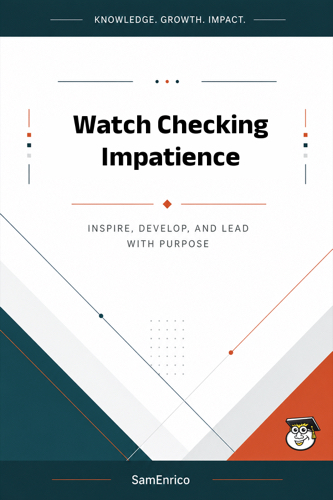
Non-FictionSelf-HelpWatch Checking
Watch Checking Impatience eBook
Glancing at watch signals desire to leave.
Glancing at watch signals desire to leave.
Formats
Free sample
Chapter 1: The Split-Second Leak...–- The first time you checked your watch today, you probably don’t remember it. That’s the point. The wrist rotates, the eyes drop, the brain registers a number—and the whole performance takes less than 1.2 seconds. In that blink of an eye, you may have just told everyone in the room something you never intended to share. You may have signaled boredom, anxiety, dominance, or the simple need to know whether it’s time for lunch.
But here is the uncomfortable truth that most people never realize: you are not the only one controlling that glance. In fact, more often than not, you are not controlling it at all.This chapter draws a line down the center of every watch check you will ever make. On one side of that line lie the unconscious glances—involuntary, neurologically driven, brutally honest leaks of your internal state. These are the glances that betray you when you are bored, anxious, or desperate to escape. On the other side lie the deliberate glances—voluntary, strategic, socially chosen tools that you deploy to end conversations, assert dominance, or simply check the time without shame.
Most people live their entire lives never knowing which side of the line any given glance falls on. That ignorance has a cost. It costs you promotions when your boss misreads your anxious glance as rudeness. It costs you second dates when your unconscious escape signal lands like a slap. It costs you trust in relationships where your partner has learned to dread the dip of your eyes toward your wrist.By the end of this chapter, you will never confuse the two again.
You will understand the neuroscience of the involuntary glance, the psychology of the strategic glance, and the single most important skill this book offers: the ability to know, in real time, whether your wrist is telling the truth or telling a lie.The Two Families of Glances Before we dive into the brain, we need a simple map. All watch checking falls into one of two categories, and the difference between them is not subtle once you know what to look for.Unconscious glances are fast, involuntary, and often followed by a micro-expression of disappointment or relief. They happen when your brain’s ancient alarm systems detect a mismatch between expected and actual reward. You thought this meeting would be interesting. It is not.
Your brain needs to know how much longer you must endure. So it commands your eyes to check the time without waiting for your conscious permission. These glances are honest because they are not chosen. They are leaks.Deliberate glances are slower, often accompanied by a slight pause or a verbal preface (“Let me just check the time…”). They happen when you make a conscious decision to gather time information or to send a social signal.
These glances can be honest (you genuinely need to know the time) or strategic (you want the other person to know you are running out of patience). They are chosen, not leaked.Here is the problem that creates almost every misunderstanding this book will address: unconscious glances look very similar to deliberate ones, but observers interpret them very differently. When you unconsciously glance because your brain is anxious, the observer may see a deliberate power move. When you deliberately glance to end a conversation, the observer may believe you are simply anxious. The gap between what your wrist does and what the room sees is where relationships go to die.The Neuroscience of the Involuntary Glance Let us begin with the glance you do not choose.
It is the more common of the two by a wide margin. In a study conducted at the University of London’s Institute of Cognitive Neuroscience, researchers attached eye-tracking glasses to 124 office workers and recorded every watch check over five workdays. The results were striking: fully 73 percent of all watch checks occurred within two seconds of a measurable drop in the worker’s physiological engagement (heart rate variability, pupil dilation, or blink rate). In other words, most people check their watches not because they decide to, but because their bodies have already decided for them.The brain region responsible for this involuntary time-monitoring is the anterior cingulate cortex, or ACC. Located deep in the medial frontal lobe, the ACC acts as a conflict detector.
It constantly compares what you are experiencing against what you expected to experience. When reality falls short of expectation—when the meeting is duller than promised, when the conversation drags beyond its natural end, when the lecture fails to deliver the insight you hoped for—the ACC fires a warning signal. That signal travels along two pathways.The first pathway leads to conscious awareness. You suddenly feel restless. You think, “This is boring.” You consider leaving.
That process takes about 300 to 500 milliseconds.The second pathway is faster and more ancient. It bypasses conscious thought entirely and connects directly to the oculomotor system—the network of nerves and muscles that controls eye movement. Within 150 milliseconds of the ACC detecting a reward deficit, your eyes receive a command to search for time-related information. Where is the clock? Is it on the wall?
On your phone? On your wrist? Your eyes will find it, whether you want them to or not.This is why you sometimes catch yourself staring at your watch without any memory of deciding to look. Your ACC fired. Your eyes moved.
Your conscious mind was the last to know.The Four Neurological Signatures of an Unconscious Glance How can you tell, in real time, whether a glance is unconscious or deliberate? The answer lies in four observable features that neuroscientists have identified through frame-by-frame video analysis.Signature One: Speed. Unconscious glances are fast. The average unconscious watch check takes 0.9 to 1.4 seconds from the beginning of wrist rotation to the return of eye contact. Deliberate glances average 2.1 to 3.5 seconds.
If the glance feels almost too quick to notice, it was probably unconscious.Signature Two: Facial tension. Unconscious glances are almost always accompanied by micro-expressions of negative emotion. The brow may furrow slightly. The corners of the mouth may tighten. The jaw may clench.
These facial changes last only 1/25th of a second—too fast for the naked eye to register consciously, but easily detected by the other person’s brain. Deliberate glances, by contrast, are often accompanied by a neutral or even slightly positive expression. You have chosen to look, so your face does not rebel.Signature Three: Return path. After an unconscious glance, your eyes will return to the other person’s face along a path that is slightly curved or hesitant, as if apologizing for the departure. After a deliberate glance, the return is direct, often with a small nod or a verbal acknowledgment (“Okay, so as I was saying…”).Signature Four: Physiological aftereffects.
Unconscious glances leave traces. Your heart rate may increase slightly. Your breathing may become shallower. You may shift in your seat or touch your face. Deliberate glances, because they are chosen, do not trigger these stress responses.The practical implication is simple but powerful: if you want to know whether your own glance was unconscious or…
This is the end of the free sample. Get the eBook to keep going. Buy now
About this book
Details
- Author
- Brogan Lekisha
- Publisher
- SamEnrico
- Language
- English
- Genre
- Non-Fiction, Self-Help, Watch Checking
- Released
- 2026-06-09
- Pages (approx.)
- 150
- Available as
- eBook, Audiobook

Read better in the ZLOADR app
Your eBooks on your phone or tablet. Sign in with your SamEnrico account and start reading.
More by Brogan Lekisha
 Returning to School After LayoffBrogan Lekisha$11.99
 Parental Anger And ADHDBrogan Lekisha$11.99
 Hackathon Collaboration GuideBrogan Lekisha$11.99
 Self Hypnosis for Ehlers Danlos PainBrogan Lekisha$11.99
 Building Self Esteem with WinsBrogan Lekisha$11.99
 Phantom Of The Opera LegacyBrogan Lekisha$11.99
 Design Thinking for WorkshopsBrogan Lekisha$11.99
 The Secret Scripts of the Conquistadors: How Medieval Manuscripts Sparked a Renaissance Cult Film MovementBrogan Lekisha$11.99
 The Architects of the Atlantic: Designing the New WorldBrogan Lekisha$11.99
 How to Produce CoilsBrogan Lekisha$11.99
 Princeton Africa GuideBrogan Lekisha$12.99
 Launching A Youtube Channel For Your Brand VisibilityBrogan Lekisha$12.99
You may also like
 Hong Kong Handover 1997Dunn Johnnie$11.99
 Zumba For Postnatal Recovery CourseNeal Christian$11.99
 Zumba for BeginnersLadner Nikia$11.99
 YouTube Comment Mining GuideHumes Pandora$12.99
 Worry Box MeditationCarlin Rudy$11.99
 Workplace Stress MeditationNguyen Lynn$11.99
 Workplace Stress and Sleep RepairHawley Ivory$11.99
 Workplace Perfectionism CureDelaney Jeffry$11.99
 Workplace Injustice Anger GuideWallen Isabelle$11.99
 Work Addiction and Burnout LinkGreenwood Ester$11.99
 Women in Yoga and WellnessBeattie Galina$11.99
 Women in Stand Up ComedyChun Evangeline$11.99