
Non-FictionHealth & WellnessWalking Fitness
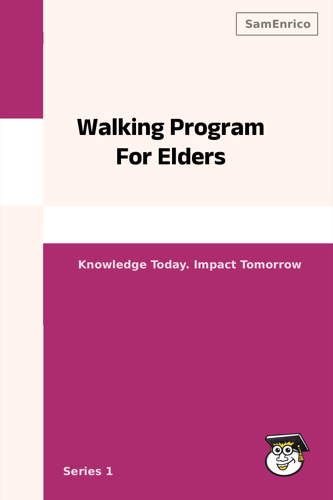
Walking Program For Elders eBook
Teaches progressive walking intervals and shoe sel
Teaches progressive walking intervals and shoe selection for cardiovascular health.
Formats
Free sample
Chapter 1: The Hidden Plateau--Margaret, age 72, had done everything right. For eighteen months, she walked two miles every morning before breakfast. She wore supportive sneakers. She never missed a day except when the driveway iced over. Her Fitbit cheered her on with little buzzes at 5,000 steps, then 8,000, then 10,000.
She felt virtuous. She felt diligent. She felt, she later admitted, like she was buying insurance against old age with every lap around her suburban block.Then came the staircase incident.Her daughter had asked her to housesit for a long weekend. The guest bedroom was on the second floor. Margaret carried her small suitcase up fourteen carpeted stairs and arrived at the top breathless – not mildly winded, but genuinely gasping, her hand pressed against her chest, her heart pounding like a trapped bird.
She had to sit down for three full minutes before she could unpack her toiletry bag."I walk every single day," she told her daughter later, embarrassed. "Why am I so out of shape?"Her daughter, a physical therapist, asked a simple question: "Mom, when you do your two miles, how hard are you breathing?"Margaret thought about it. "I'm not, really. I listen to audiobooks. It's relaxing."And there, in that single exchange, lies the problem that this entire book exists to solve.Margaret was trapped in what I call the Hidden Plateau – the silent, invisible ceiling that millions of older adults hit when they rely on steady-state walking alone.
They are moving their bodies. They are checking the boxes. They are accumulating steps. And yet, their cardiovascular fitness is not improving. In many cases, it is slowly, quietly declining.This chapter will explain why that happens, how the physiology of aging changes the rules of exercise, and why a simple shift in how you walk – not how much or how fast – can break you through that plateau for good.The Quiet Decline That Looks Like Success Let me start with a confession: I used to give bad advice.
For years, as a fitness educator working with older adults, I repeated the standard mantra: "Walk thirty minutes a day, five days a week. Keep it comfortable. Consistency is everything."I meant well. And that advice is not wrong – it is simply incomplete. It works reasonably well for people in their forties and fifties.
But after age sixty, something changes in the way the human body responds to steady, unchanging exercise. And no one told us.Here is the physiological reality: When you perform the same activity at the same intensity day after day, your body adapts fully within approximately two weeks. Your heart becomes slightly more efficient. Your muscles learn to use oxygen slightly better. And then – nothing.
You plateau.For a thirty-year-old, that plateau might be acceptable because their baseline fitness is already high. For a seventy-year-old, that plateau means you have stopped improving while the natural decline of aging continues underneath you. You are treading water, but the water level is slowly rising.The research is stark. After age sixty, VO2max – the gold-standard measure of aerobic capacity, essentially how well your heart and lungs deliver oxygen to your muscles – declines by roughly ten percent per decade in sedentary individuals. Regular steady walking slows this decline.
It does not reverse it. The best studies on interval walking show that to actually improve VO2max in older adults, you must introduce variability in intensity. You must periodically challenge the heart to work harder, then allow it to recover.Margaret's two-mile strolls were comfortable. That was the problem. Her heart never had to work hard enough to grow stronger.
She was maintaining, yes – but "maintaining" at age seventy-two, on a trajectory of natural decline, is another word for losing ground slowly.The "More Steps" Myth We have been sold a seductive lie, and it comes on a small plastic rectangle that vibrates on our wrists.The ten-thousand-steps goal originated not from science but from a Japanese marketing campaign in the 1960s for a pedometer called Manpo-kei, which literally translates to "ten thousand steps meter." It was a catchy number. It stuck. And now, decades later, we have built an entire culture of wellness around a marketing slogan.Let me be clear: Walking ten thousand steps at a slow, comfortable pace burns calories. It gets you outside. It improves mood.
These are good things. But it does not meaningfully improve cardiovascular fitness in older adults because it does not challenge the heart.Think of your heart as a muscle – because it is one. Like any muscle, it grows stronger when it is forced to work against resistance. For skeletal muscles, that resistance might be a weight or a resistance band. For the heart, the "resistance" is the demand for oxygenated blood from your working muscles.
When you walk slowly, your muscles need only a modest amount of oxygen. Your heart pumps along easily, never straining, never adapting.When you introduce short bursts of faster walking, your leg muscles suddenly require significantly more oxygen. Your heart must pump harder and faster to meet that demand. It stretches slightly with each more forceful beat. Over time, that stretching triggers adaptations: the heart muscle becomes stronger, the chambers become more elastic, and the blood vessels become more flexible.
Your resting heart rate drops. Your blood pressure improves. Your VO2max rises.This is not speculation. The Japanese Ministry of Health, Labor and Welfare funded a massive study of interval walking in older adults, involving more than one thousand participants over five years. The results were unambiguous: participants who performed interval walking – three minutes brisk, three minutes easy, repeated – improved their VO2max by ten to twenty percent over twelve weeks.
Participants who walked the same total distance at a steady pace showed no significant improvement. None.Steady walking maintained. Intervals improved. That difference – between maintaining and improving – is the difference between aging passively and aging actively.What Actually Happens Inside Your Body Let me walk you through the inside of your body during a steady walk versus an interval walk. This matters because understanding the "why" makes you far more likely to do the "how."Imagine you are walking at a comfortable, steady pace.
Your heart rate settles at about one hundred beats per minute. Your breathing is easy – you could sing along with an old Beatles song if you wanted to. Your leg muscles are contracting, but they are doing so aerobically, meaning they have plenty of oxygen to burn fuel. Your body is in a state of equilibrium. Nothing is being stressed.
Nothing is being forced to adapt.Now imagine you speed up for three minutes. Your heart rate climbs to one hundred twenty, then one hundred thirty, then one hundred forty beats per minute. Your breathing deepens – you can still speak in short sentences, but you cannot sing. Your leg muscles, now working harder, begin to produce metabolic byproducts like lactate. They send urgent signals to your brain: "Send more oxygen!"Your heart responds by pumping more forcefully.
The left ventricle – the chamber that pushes blood out to your body – stretches slightly more with each beat. This stretch triggers the release of growth factors that tell the…
This is the end of the free sample. Get the eBook to keep going. Buy now
About this book
Details
- Author
- Clanton Harmony
- Publisher
- SamEnrico
- Language
- English
- Genre
- Non-Fiction, Health & Wellness, Walking Fitness
- Released
- 2026-06-05
- Pages (approx.)
- 141
- Available as
- eBook, Audiobook

Read better in the ZLOADR app
Your eBooks on your phone or tablet. Sign in with your SamEnrico account and start reading.
More by Clanton Harmony
 Slide Design That SpeaksClanton Harmony$11.99
 Family Intervention for AddictsClanton Harmony$11.99
 Body Language Public SpeakingClanton Harmony$11.99
 The Last Stand of the Swiss Guard: Blood and Faith at the Vatican (1527)Clanton Harmony$11.99
 Land Use PlannerClanton Harmony$11.99
 How to Become a Holter Scanning TechnicianClanton Harmony$11.99
 Subscription Grandfathering Policy GuideClanton Harmony$12.99
 How to Produce Canopies and GazebosClanton Harmony$11.99
You may also like
 Hong Kong Handover 1997Dunn Johnnie$11.99
 Zumba For Postnatal Recovery CourseNeal Christian$11.99
 Zumba for BeginnersLadner Nikia$11.99
 YouTube Comment Mining GuideHumes Pandora$12.99
 Worry Box MeditationCarlin Rudy$11.99
 Workplace Stress MeditationNguyen Lynn$11.99
 Workplace Stress and Sleep RepairHawley Ivory$11.99
 Workplace Perfectionism CureDelaney Jeffry$11.99
 Workplace Injustice Anger GuideWallen Isabelle$11.99
 Work Addiction and Burnout LinkGreenwood Ester$11.99
 Women in Yoga and WellnessBeattie Galina$11.99
 Women in Stand Up ComedyChun Evangeline$11.99